Introduction
Offices are built for efficiency. But when teams spend every day in the same environment, responding to the same pressures, the same dynamics calcify. Fresh thinking gets crowded out by habit, and real trust gets harder to build.
Getting a team out of their daily environment is one of the most direct ways to break that pattern. A well-designed retreat rebuilds relationships, surfaces ideas that meetings never reach, and creates the kind of alignment that packed calendars rarely produce.
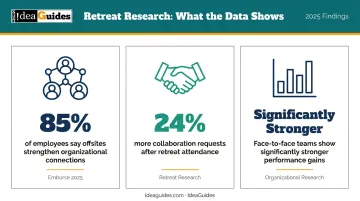
The proof is in the data. A longitudinal study of more than 700 law-firm partners found that retreat attendees received 24% more new collaboration requests in the following two months than non-attendees — and nearly 17% of those new relationships lasted at least two years.
This guide covers the top U.S. destinations for team building retreats, the best activity formats to consider, and how to plan one that produces real outcomes worth the time and travel.
Key Takeaways
- Team building retreats strengthen relationships and create cross-team connections that routine work rarely produces
- Top U.S. destinations include Napa Valley, Scottsdale, Aspen, Nashville, and Austin — each suited to different retreat goals
- Strong agendas balance structured work sessions, experiential activities, and unscheduled time for informal connection
- Skilled facilitation keeps every voice heard, turns conversations into decisions, and gives the retreat a clear purpose worth the investment
What Is a Team Building Retreat?
A team building retreat is a purposeful, off-site gathering designed to strengthen relationships, improve collaboration, and align team members around shared goals — in an environment that breaks from daily routine.
A retreat isn't just a meeting held somewhere nicer. The difference lies in the design: retreats combine structured work sessions, experiential activities, and unstructured social time, all working together to build the kind of trust that translates back to the workplace.
Why Organizations Invest in Them
The research is clear on why this works. Harvard Business Review's 2024 framework describes how offsites change an organization's "conversation network," creating connections that routine work simply doesn't produce. The data backs this up:
- A 2025 Emburse survey of 2,000 U.S. employees found 85% said offsites strengthened organizational connections
- Respondents attended an average of 2.6 annual events in 2024 — suggesting retreats have become a recurring investment, not a one-time experiment
The value isn't purely social, either. A 2020 meta-analysis of 24 controlled studies found that structured team-reflexivity interventions — where teams explicitly review their work, discuss feedback, and plan next steps — produced a moderate positive effect on performance, with significantly stronger results for face-to-face teams than virtual ones.
That finding has a practical implication: the off-site setting removes people from their routines and creates openness to reflection. But without structured facilitation to direct that energy, most of the value stays in the room rather than returning to the workplace.
Top U.S. Venues for Team Building Retreats
These destinations were selected based on accessibility from major metros, diversity of retreat-friendly venues, available team programming, and suitability across different retreat formats — from leadership offsites to multi-day innovation immersions.
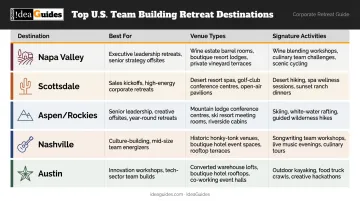
Napa Valley, California
Napa is a standout destination for executive leadership retreats and strategic planning offsites. The vineyard setting naturally slows the pace, encouraging the kind of reflective, unhurried conversation that high-stakes topics — culture alignment, long-range strategy, leadership transitions — actually require.
The concentration of luxury resort venues means lodging, meeting space, and curated team experiences are all integrated in one property, which simplifies logistics.
| Category | Details |
|---|---|
| Best For | Executive offsites, leadership strategy sessions, multi-day immersive retreats |
| Venue Types | Vineyard resorts, boutique hotels with conference facilities, private estate rentals |
| Signature Activities | Wine blending workshops, culinary team challenges, guided vineyard excursions, facilitated strategy sessions |
Scottsdale, Arizona
Scottsdale is one of the most consistently popular choices for sales kickoffs, leadership development programs, and cross-functional team retreats — and the infrastructure supports it. Full-service resort properties give teams access to indoor meeting spaces, outdoor challenge courses, spa wellness programming, and golf, often all within a single property.
The warm climate year-round is a practical advantage for groups that want outdoor programming without weather risk.
| Category | Details |
|---|---|
| Best For | Sales kickoffs, leadership programs, large group retreats, incentive trips |
| Venue Types | Full-service resort hotels, conference centers, luxury spa properties |
| Signature Activities | Desert hiking, ropes courses, golf tournaments, spa wellness days, poolside evening events |
Aspen / Rocky Mountains, Colorado
Where Napa and Scottsdale lean on resort infrastructure, the Rocky Mountain region puts outdoor adventure at the center of the retreat. The mountain environment creates genuine psychological distance from the office — which matters more than it sounds.
A 2022 randomized workplace study found that employees in a structured nature program reported 14.9% lower burnout scores and 29.3% lower salivary cortisol compared to a control group. Scheduling outdoor activity into your program deliberately creates the stress-reduction and attentional restoration that makes people more receptive to creative thinking and complex problem-solving.
| Category | Details |
|---|---|
| Best For | Outdoor-forward retreats, adventure-based team building, wellness-focused offsites |
| Venue Types | Mountain lodges, eco-retreats, boutique resort properties, ranch venues |
| Signature Activities | Guided hikes, white-water rafting, mountain biking, skiing/snowboarding, campfire storytelling sessions |
Nashville, Tennessee
Nashville has grown into one of the fastest-rising corporate retreat destinations in the country. The numbers back it up: Knowland's 2024 meetings-market report ranked Nashville first among large primary markets for meetings-and-events growth, at 38% growth year over year.
What makes Nashville work for retreats is the energy. The city's live music culture, honky-tonk buyouts, rooftop venues, and creative studio spaces make team events feel genuinely memorable rather than generic.
It's particularly well-suited for culture-building events, post-milestone recognition trips, and any group that wants the retreat to feel like a reward.
| Category | Details |
|---|---|
| Best For | Culture events, team celebrations, creative-industry retreats, post-milestone recognition trips |
| Venue Types | Boutique hotels, music venues, rooftop event spaces, creative studio lofts |
| Signature Activities | Songwriting workshops, line dancing classes, Nashville food tours, live music outings, escape rooms |
Austin, Texas
Austin sits at the intersection of startup culture and Hill Country nature — which makes it a strong choice for tech companies, innovation-driven organizations, and teams that want a blend of outdoor activity, creative culture, and solid meeting facilities.
The surrounding Hill Country offers lakeside retreat venues (Lake Travis is a standout) for teams that want nature immersion without sacrificing urban accessibility. Austin's ethos of creativity and participation translates well into retreat settings where you want people to show up fully engaged.
| Category | Details |
|---|---|
| Best For | Innovation workshops, tech company retreats, cross-functional team builds, leadership offsites |
| Venue Types | Lakefront retreat properties, boutique hotels, ranch venues, creative co-working spaces |
| Signature Activities | Kayaking and paddleboarding on Lake Travis, BBQ cook-offs, Austin food and culture tours, facilitated innovation sessions |
Best Team Building Ideas for Your Next Retreat
The best retreat agendas are intentional. They don't fill every hour — they sequence activities so that energy builds across the retreat arc, moving from connection to focus to output and back to connection.
Here are the core activity categories worth building around.
Outdoor Adventure Activities
Guided hikes, kayaking, ropes courses, zip-lining, scavenger hunts — outdoor adventure is one of the fastest formats for building trust precisely because it places people in novel situations where they rely on each other in ways office work rarely demands.
A few practical notes:
- Design options with the team's physical comfort range in mind
- Offer lower-intensity alternatives (nature walks, leisurely kayaking) alongside higher-challenge options
- Mix departments and seniority levels within activity groups — connections formed here often outlast the retreat itself
Creative and Culinary Workshops
Cooking classes, wine blending workshops, improv sessions, art classes, and songwriting workshops share a common dynamic: no one is "the expert." That levels the playing field in a way that opens up informal conversation and helps quieter team members engage more fully.
Culinary activities work especially well because everyone collaborates toward a shared outcome: the meal itself. That communal result gives the team something concrete to point to — a natural reinforcement of what they just built together.
Facilitated Innovation and Strategy Sessions
The highest-impact retreats don't just bond teams — they produce strategic alignment, new ideas, and decisions. That requires structured facilitation, not open-ended discussion.
IdeaGuides has guided more than 150 clients through strategic planning, innovation, and team alignment retreats nationwide. Their experienced facilitators use frameworks like World Café, Open Space Technology, Appreciative Inquiry, and structured brainstorming methods to keep sessions on track and productive.
Specialists like Ken Homer and Ray Madaghiele focus on large-group formats, while the broader team brings expertise in decision-making tools, ideation frameworks, and custom retreat design across engagements ranging from single-day offsites to four-day immersions.
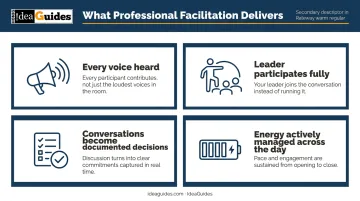
What distinguishes professionally facilitated sessions from internally run ones:
- Every voice gets heard, not just the loudest
- The leader participates fully instead of managing the room
- Conversations convert into documented decisions with owners and deadlines
- Energy is actively managed across long, multi-session days
Wellness and Mindfulness Activities
Group yoga, guided meditation, nature walks, spa programming, breathwork — wellness activities reduce the cortisol and mental noise that prevent candid, reflective conversation. That's particularly valuable scheduled before high-stakes strategy sessions.
A 2023 meta-analysis of 91 randomized workplace studies found significant improvements in stress, mental health, and well-being from mindfulness-based interventions. The evidence supports positioning these as recovery tools — brief, optional, and placed strategically in the agenda — rather than as standalone retreat goals.
Fun and Social Challenges
Escape rooms, trivia nights, talent shows, scavenger hunts, board game tournaments — low-stakes competitive activities are essential for cross-functional rapport, especially among people who don't work together daily.
One design choice makes a real difference: assign teams randomly or by cross-function rather than letting people self-select. Self-selected groups default to existing cliques. Intentionally mixed groups create new relationships — and those are often the ones people reference months later when they need to collaborate across departments.
How to Plan a Successful Team Building Retreat
Step 1: Define Purpose Before Anything Else
The most common retreat mistake is booking a venue before defining the goal. Purpose should drive every decision that follows — format, duration, activity mix, venue type.
Common retreat purposes include:
- Team alignment after organizational change or a merger
- Culture building and communication improvement
- Innovation generation and strategic planning
- Leadership development and succession conversations
- Recognition and morale following a major milestone
Step 2: Match Venue to Goals, Not Just Aesthetics
Each environment shapes the behavior and mindset of participants. A rough framework:
- Nature-forward venues (Aspen, Lake Travis): deep focus, relationship-building, stress reduction
- Urban venues (Nashville, Austin): energy, creativity, culture-celebration
- Resort venues (Scottsdale, Napa): recognition, executive-level programming, multi-day immersion
A vineyard in Napa serves a different purpose than a creative studio in Austin — and choosing for aesthetics alone often means the environment works against the agenda.
Step 3: Balance Structured and Unstructured Time
SHRM's retreat planning guidance is clear: don't over-program. Teams that have time to process, reflect, and converse informally between sessions bond more deeply than those in back-to-back sessions.
A well-paced retreat protects time for informal connection:
- Reserve meals, breaks, and evenings for spontaneous conversation
- Build buffer time after demanding sessions
- Structure only what you need to produce decisions — and let the rest breathe
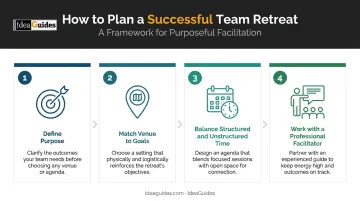
Step 4: Work with a Professional Facilitator
Even the best venue and agenda fall short without skilled facilitation. A professional facilitator manages group energy, prevents dominant voices from drowning out others, keeps sessions on track, and converts conversations into decisions that actually stick.
IdeaGuides' pre-retreat process starts with stakeholder interviews and surveys to build a fully customized agenda matched to each session's goals. For organizations planning their first retreat or a high-stakes strategic offsite, working with experienced facilitators is the difference between a retreat that produces lasting change and one that produces good intentions.
Frequently Asked Questions
What is a team retreat?
A team retreat is a purposeful off-site gathering where employees step away from their regular work environment to build relationships, align on goals, and engage in activities that strengthen collaboration. These range from focused one-day workshops to multi-day immersive programs depending on the team's objectives.
What to do at a team retreat?
The best retreats balance structured work sessions (strategy, planning, innovation workshops), experiential activities (outdoor adventures, cooking classes, escape rooms), wellness programming, and unstructured social time. Over-programming one type at the expense of others is the most common agenda mistake.
How much does a team retreat cost?
Costs vary widely based on group size, duration, venue type, and activities included. Instead, budget by line item: venue, meals, facilitation, travel, lodging, activities, and a contingency buffer. Per-person costs differ sharply between a local day retreat and a multi-day destination offsite.
How long should a team building retreat be?
One-day retreats work well for focused workshops or culture events. Two-to-three day formats are better for strategic alignment, deep relationship-building, and multi-session programming. The right duration depends on the retreat's purpose and how far participants need to travel to attend.
How do you plan a company retreat?
Start by defining a clear purpose, then set a budget and choose a venue that matches your goals. Design a balanced agenda, arrange logistics (travel, accommodations, meals), and bring in a professional facilitator to run structured sessions and ensure the retreat produces concrete outcomes.
What makes a team retreat successful?
Four elements drive retreat success:
- A defined purpose that guides every agenda decision
- Intentional venue selection matched to your goals
- A balanced agenda with protected informal time
- Skilled facilitation to keep sessions on track
Following up with documented action items ensures the team's momentum carries back into the workplace.