Introduction
Picture this: a prospect asks three people at your company the same question — "What does your product actually do?" — and gets three different answers. The sales rep talks about features. Marketing leads with a brand story. Leadership describes the vision. None of them are wrong, exactly, but none of them are the same.
That disconnect erodes trust faster than almost any competitive threat. And it's not a people problem — it's a messaging problem.
A messaging workshop is a structured, facilitated session that brings the right stakeholders together to align on your core value proposition and communicate it consistently across every channel and audience.
According to a 2024 Gartner survey of 632 B2B buyers, 69% encountered inconsistencies between a supplier's website and what sellers told them — meaning message misalignment isn't just an internal headache. Buyers notice it too.
This guide covers when a messaging workshop is the right move, what preparation it requires, how to run one effectively, and what separates workshops that produce lasting change from ones that generate enthusiasm on the day and confusion the week after.
Key Takeaways
- A messaging workshop requires the right stakeholders, solid pre-workshop research, and a neutral facilitator to be effective.
- The primary output is a documented messaging framework — ready for use by marketing, sales, and leadership right away.
- Workshops fail most often due to skipped preparation, unfocused facilitation, or no follow-through after the session.
- An external facilitator brings neutrality and process structure that internal teams struggle to replicate.
- A well-run workshop feeds directly into ongoing content, campaigns, and team training — not a one-and-done event.
When Should You Run a Messaging Workshop?
A messaging workshop isn't a recurring calendar item. It's triggered by specific business conditions. Three scenarios consistently signal it's time:
- Launching something new — a product, service line, or business unit where messaging must be built from scratch
- Entering new territory — a new market, customer segment, or rebrand where existing messaging no longer fits
- Seeing warning signs — high sales cycle friction, poor conversion rates, or team members describing the product differently to the same customer
Internal Warning Signs to Watch For
The third scenario above is often the most telling. These are the most common indicators that a workshop is overdue:
- Sales and marketing use different language to describe the same offering
- Customer feedback doesn't match how the company talks about its value
- New hires struggle to explain what the company does and why it matters
- Website copy says one thing; sales decks say another
That said, a messaging workshop isn't the right solution for every communication problem. If your core product, audience, or market position is still undefined, the session will surface confusion rather than resolve it. Nail down those foundational decisions first, then schedule the workshop.
What You Need Before Your Messaging Workshop
The quality of a messaging workshop is determined almost entirely by the preparation done before participants enter the room. Sessions that skip this phase typically end in circular conversation, with post-it notes that mean nothing by the next morning.
Pre-Workshop Research
Voice of customer interviews are the single most valuable input you can bring into a messaging workshop. Aim for 5–8 conversations with your best-fit customers before the session. What you're capturing:
- How customers describe their problem in their own words
- The language they use to describe your value
- What they say to colleagues when recommending you
Customers articulate benefits in ways internal teams rarely do. Internal teams describe what the product does. Customers describe what changed for them — and that distinction is what makes messaging land externally.
An employee survey is the second critical input. Distribute it across sales, marketing, customer service, and leadership. Look for:
- How team members currently describe the company
- What they believe the core value proposition is
- Where their answers diverge from each other and from customers
The gaps between what the company thinks it communicates and what customers actually hear are where the most important workshop conversations happen.
Stakeholder Invite List
With your research in hand, turn to the room itself. The ideal group is 6–10 participants representing:
- Marketing and brand
- Sales and customer-facing roles
- Product or service leadership
- At least one executive sponsor
Too few participants limits perspective. Too many creates noise. The facilitator's job is to structure participation so every voice contributes meaningfully — not just the loudest ones.
Define Goals and Deliverables Before the Session
Objectives and deliverables are not the same thing — and conflating them leads to vague outcomes. Objectives describe the alignment you're trying to reach. Deliverables are the tangible outputs the team walks away with. Establish both in writing before the session.
Example objective: Align on a single value proposition that sales and marketing can both use
Example deliverable: A message map with core value proposition, three supporting pillars, and audience-specific talking points
How to Run a Messaging Workshop: Step-by-Step
No two messaging workshops follow the exact same agenda. Effective ones, however, always follow the same progression: ground the group in customer reality → establish what you stand for → define your unique value → build supporting messages → commit to next steps.
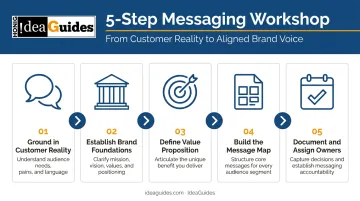
Step 1: Ground the Group in the Customer's Reality
Open with voice-of-customer material. Share direct quotes from customer interviews. Read testimonials aloud. Show how the market currently talks about the category. This step serves one purpose: preventing the group from defaulting to internal jargon from the first minute.
Consider making this interactive — a customer persona exercise, a quote-matching activity, or a quiz on customer language — rather than a passive slide deck. Engagement from the start sets the tone for the full session.
Step 2: Establish Brand Foundations
Before drafting any messages, the group must agree on what the company fundamentally stands for. Use structured questions to surface both alignment and gaps:
- What problem do we uniquely solve?
- Who do we serve, specifically?
- What do we want to be known for in five years?
Disagreements here are not problems — they're the work. The facilitator's role is to guide the group toward productive consensus, not suppress conflict. What gets surfaced and resolved in this phase prevents contradictions from appearing in the final messaging.
Step 3: Define the Value Proposition
Guide the group through developing a clear, audience-specific value proposition: a statement that captures the benefit delivered, for whom, and why only this company can deliver it.
The common mistake here is letting the conversation drift toward product features. An effective value proposition leads with customer outcomes, not capabilities. Workshop multiple drafts and test each one against a simple criterion:
Would our ideal customer understand this without explanation?
If the answer is no, the draft isn't ready. Converge on one articulation that every person in the room can commit to — then move forward.
Step 4: Build the Message Map
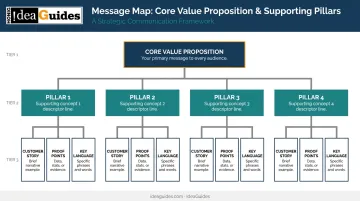
With the value proposition locked in, the group now has an anchor. Build out 3–4 supporting message pillars — each a distinct benefit that reinforces that core statement. For each pillar, identify:
- A concrete customer story or result
- Specific proof points (data, testimonials, case examples)
- Language that makes the claim credible and memorable
This is the message map — the reference document that informs all marketing, sales, and communications activity going forward. IdeaGuides structures this phase around five sequential outputs — corporate profile, customer profile, product/service profile, media profile, and unified key message — delivered as a written report that documents everything the group produced.
Step 5: Document, Assign Owners, and Set Deadlines
End the workshop by documenting all decisions in real time and assigning clear ownership for next steps:
- Who drafts the messaging architecture document?
- Who reviews and approves it?
- When does the group reconvene to validate and refine?
Without named owners and deadlines, the session ends with energy and no follow-through. Distribute the messaging document within one week — before the momentum fades.
Key Variables That Determine Messaging Workshop Success
Two companies can follow the same agenda and get very different results. These variables separate workshops that produce durable, actionable messaging from ones that generate enthusiasm in the room and confusion afterward.
Facilitator Neutrality
The facilitator's job is to guide the process — not contribute opinions on what the message should be. Research published in Design Science found that high facilitator impartiality had a more positive effect on team trust than lower-impartiality facilitation — a meaningful finding for any session where cross-functional alignment is the goal.
Internal facilitators often struggle with this because they have views, relationships, and roles that shape how they manage the room. The most effective facilitators prevent dominant voices from crowding out quieter ones and hold the group accountable to producing real decisions, not just discussions.
Participant Mix
Messaging workshops fail when the wrong people are in the room — either too homogenous a group (only marketing) or too large and unfocused. The ideal mix surfaces genuine contradictions in how the company is perceived internally versus externally, and working through those gaps is where the most useful output comes from.
A productive mix typically includes:
- A senior leader who can speak to company direction
- A customer-facing rep (sales, success, or support) who hears objections daily
- A marketing lead who owns the language
- One cross-functional voice (product, ops, or finance) to challenge assumptions
Pre-Workshop Research Depth
Groups that enter a messaging workshop without customer interview data, competitive context, or a clear audience definition spend the session debating assumptions rather than building on insights. Committing 1–2 weeks of pre-workshop research — even just five customer interviews and a competitor messaging audit — measurably improves how long the resulting messaging holds up.
Post-Workshop Follow-Through
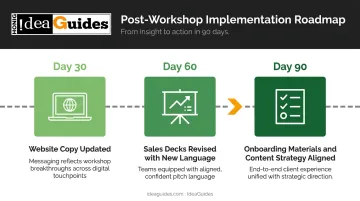
A structured messaging document — not a folder of photos of sticky notes — is the deliverable that matters. Good implementation looks like:
- Messaging informing website copy within 30 days
- Sales decks updated to reflect new language within 60 days
- Onboarding materials and content strategy aligned within 90 days
Should You Facilitate It Yourself or Bring In a Professional?
Some teams can run an effective messaging workshop internally — particularly for small teams doing a light messaging refresh, when a skilled internal communicator can act as a neutral facilitator, or when time and budget constraints are significant.
However, internal facilitators face a core structural challenge: they are simultaneously a participant (with views on what the message should be) and a facilitator (whose job is to remain neutral). That dual role frequently compromises the quality of both functions.
An external facilitator sidesteps that conflict entirely — and brings capabilities that are hard to replicate internally.
What an External Facilitator Brings
- Has no stake in the outcome, so participants trust the process
- Can challenge senior voices without political risk
- Spots groupthink, dominant voices, and avoided questions that insiders often miss
- Brings a structured approach tested across many organizations and contexts
IdeaGuides has facilitated messaging and alignment workshops for over 150 organizations, with a team of experienced facilitators and 25+ years of experience guiding leadership teams to clear, actionable decisions.
"As always, your mastery of the room was beyond impressive. Everyone was just so blown away that you were able to maintain not just interest, but enthusiasm for six plus hours." — Eve Alintuck, Project Director, Brandfusion
A Practical Decision Framework
| Run it internally when... | Bring in an external facilitator when... |
|---|---|
| Small team, light messaging refresh | High stakes: product launch or rebrand |
| A neutral internal facilitator is available | Cross-functional or leadership alignment is needed |
| Budget constraints are significant | Past internal workshops stalled or produced no change |
| Scope is narrowly defined | The company is entering a significant transition |
Frequently Asked Questions
How long should a messaging workshop typically take?
A full messaging workshop typically spans 4–8 hours, run as a single session or split across two half-day blocks. Simpler scopes finish in half a day; multi-product or multi-audience workshops usually need the full day.
Who should be in the room for a messaging workshop?
The ideal group is 6–10 participants, including representatives from marketing, sales, product or service leadership, and an executive sponsor. Cross-functional representation is essential — messaging that only marketing touches rarely gets adopted by sales, and vice versa.
What is the main deliverable from a messaging workshop?
The primary output is a documented messaging framework (sometimes called a message map or message house) covering the core value proposition, 3–4 supporting pillars, audience-specific talking points, and proof points usable across marketing, sales, and communications.
How is a messaging workshop different from a brand strategy session?
A brand strategy session focuses on identity, visual language, personality, and market positioning. A messaging workshop focuses specifically on the language and talking points used to communicate that identity to specific audiences. The two are related and often inform each other, but are distinct in scope and output.
How often should a company revisit its messaging?
Every 12–24 months under normal conditions. Revisit sooner when a trigger occurs: a product launch, rebrand, entry into a new market, or consistent signals that current messaging isn't landing with buyers.
Can a messaging workshop be run effectively in a virtual format?
Yes — virtual workshops can be highly effective with the right collaboration tools and tight facilitation. In-person sessions tend to reach agreement faster, but remote sessions compensate with strong pre-work and disciplined agenda management.