
Introduction
Workplace miscommunication costs US businesses an estimated $1.2 trillion annually, according to Grammarly Business's 2024 State of Business Communication report. For customer-facing teams, that cost isn't abstract — it shows up as lost deals, negative reviews, agent burnout, and customers who walk away.
Bad customer experiences put $3.7 trillion in global revenue at risk each year, and the communication quality of your frontline staff is the single biggest variable in that equation. Yet most organizations still treat communication as an innate ability rather than a trainable skill — and their training investments reflect that assumption.
Platform selection is where that assumption gets tested. Most tools offer completion tracking; fewer actually change how people communicate under pressure. This guide covers five platforms worth evaluating — what each does well, who it's built for, and how to decide which approach fits your team.
Key Takeaways
- Poor communication directly drives customer churn, escalations, and staff attrition — all of which show up in measurable business outcomes
- The most effective platforms prioritize realistic practice over passive content delivery
- Choose between live facilitated training and AI-driven platforms based on team size, budget, and required skill depth
- Analytics that track behavior change matter more than completion rates
- IdeaGuides delivers customized communication workshops, with facilitated training completed for 150+ client organizations across corporate, nonprofit, and government sectors
Why Communication Skills Training Matters for Customer-Facing Teams
Customer-facing roles carry a different communication burden than most. Agents and representatives switch contexts dozens of times per shift, manage emotional labor under pressure, de-escalate conflicts, and represent the brand in every single interaction. These aren't passive skills. They require structured, repeated practice.
The business stakes are clear: 29% of consumers stopped buying from a brand after a poor customer experience, according to PwC's 2025 Customer Experience Survey. Communication failures don't just frustrate customers — they trigger defection.
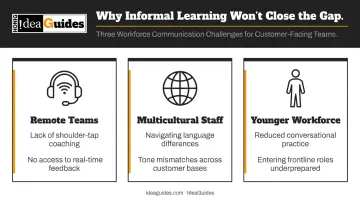
Several workforce realities have made this harder to ignore:
- Remote support teams can't rely on shoulder-tap coaching or in-the-moment feedback
- Multicultural staff navigate language and tone differences across customer bases
- Younger employees entering frontline roles often lack the conversational practice that previous generations built in person
The skills gap is real, and informal learning won't close it.
That's where structured training programs — and the platforms that deliver them — become the deciding factor between a team that handles pressure well and one that loses customers to it.
Best Communication Skills Training Platforms for Customer-Facing Teams
These platforms were evaluated on training effectiveness, relevance to customer-facing roles, delivery format, and ability to produce measurable behavior change — not just content completion rates.
IdeaGuides
IdeaGuides is a San Francisco Bay Area–based facilitation and training firm with over 25 years of experience. Their team of experienced facilitators has guided more than 150 client organizations through communication, team alignment, and collaboration training. Every engagement is live, expert-led, and built around the specific dynamics of the client's team.
Their Customer Service Excellence workshop is available in half-day, full-day, and keynote formats, covering active listening, tone and body language, de-escalation of difficult customers, and co-creating a Customer Service Policy that participants actually commit to.
The 80% interactive format includes role plays, scenario exercises, and a custom workbook built from the group's own ideas during the session.
The City of Oakland's Bureau of Building reported that staff "immediately utilized what they learned to deal with upset or confused citizens" after completing the training — a direct measure of behavioral transfer that matters more than any completion certificate.
Best For: Organizations seeking deep, lasting communication behavior change through expert-facilitated, live workshops — ideal for cross-functional or customer-facing teams needing real skill application and alignment
Delivery Format: Live facilitated workshops, team training sessions, retreats, and offsites; in-person or virtual via Zoom, customized per engagement; 2 to 8 hours, up to 500 participants
Key Differentiator: Master Trainers with authored expertise in team building and communication; 250+ completed projects; highly interactive sessions where every participant's voice is heard
Exec
Exec is an AI-powered training platform built specifically for teams that need to practice live customer conversations at scale. It combines AI voice roleplay, call scoring, structured learning paths, and live 1:1 coaching — giving sales, support, and customer success teams a realistic environment to rehearse under pressure.
The platform's AI simulates genuine customer frustration and escalation, not just polite exchanges. That unpredictability is intentional: conversations that go sideways in practice translate to calls agents can actually handle.
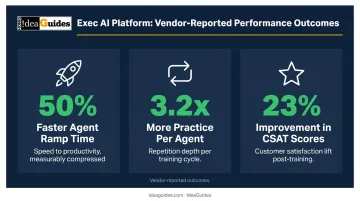
The platform reports vendor-claimed outcomes of 50% faster agent ramp time, 3.2x more practice per agent, and 23% improvement in CSAT scores, alongside manager dashboards and skill-based performance reporting.
Best For: L&D leaders at enterprise sales, support, and customer success teams needing scalable, measurable conversation practice with behavioral analytics
Delivery Format: AI voice-based roleplay, call scoring on real conversations, structured programs, and live 1:1 coaching
Key Differentiator: AI simulates realistic customer frustration and escalation; manager dashboards track performance trends and skill development over time
Code of Talent
Code of Talent is a mobile-first microlearning platform built for frontline and customer-facing teams in retail, hospitality, branch networks, and multi-location service businesses. It's designed around one practical constraint: frontline employees don't sit at desks, and training windows are short.
The platform delivers 5-to-10-minute lessons that employees complete on their phones between shifts or during breaks. Gamification elements — badges, points, peer evaluations, and leaderboard tracking — sustain engagement in high-turnover environments where traditional training rarely sticks. The platform reports a 90%+ average module completion rate across 500+ teams deployed.
Best For: Retail, hospitality, and branch network teams needing accessible, mobile-first communication and customer experience training
Delivery Format: Short mobile modules, gamified lessons, scenario-based practice, and real-time analytics; integrates with existing LMS via API
Key Differentiator: Purpose-built for frontline workers with no desk access; high completion rates in high-turnover environments
Articulate 360
Articulate 360 is an e-learning authoring platform used by over 125,000 organizations and 133 million learners worldwide. Rather than offering pre-built courses, it gives L&D teams a toolkit to build their own. Its two primary tools, Rise 360 and Storyline 360, allow course creators to develop responsive, device-friendly e-learning and complex branching scenarios that simulate real customer conversations.
For communication training, Storyline's branching capability is particularly relevant: learners make choices in simulated customer interactions and see the consequences play out, which is far more effective than passive video. The AI Assistant claims to accelerate course creation up to 9x, and the Content Library 360 provides 13 million+ images and customizable templates.
Best For: L&D teams who want to build and scale custom, branded communication training across large organizations
Delivery Format: Self-paced interactive e-learning, branching scenario simulations, responsive courses, and LMS-publishable content
Key Differentiator: Deep authoring flexibility with Rise and Storyline; strong template library and collaboration tools for distributed L&D teams
TalentLMS
TalentLMS is a cloud-based learning management system trusted by 70,000+ teams, positioned primarily for SMBs and distributed organizations that need to deploy customer service and communication training quickly. It launches 2x faster than a typical LMS setup and supports SCORM, xAPI, cmi5, video, quizzes, and blended learning paths.
For global or multilingual support teams, TalentLMS supports training delivery in 15 languages, with AI translation extending that to 40+. It also integrates natively with Zoom, Slack, and Salesforce — making it practical for teams already built on those tools. The Learning Playground feature adds a self-led practice layer for scenario-based skill building.
Best For: SMBs and global distributed teams needing fast, low-friction LMS deployment for customer service training and compliance
Delivery Format: Video modules, quizzes, learning paths, SCORM/xAPI content, and blended sessions; Salesforce, Zoom, and Slack integrations
Key Differentiator: Rapid rollout, broad integration ecosystem, and multi-language support for global customer-facing teams
Key Features to Look for in a Communication Skills Training Platform
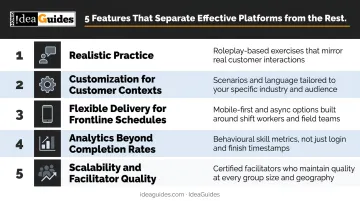
Not all platforms deliver the same type of value. Before choosing one, evaluate on these five dimensions:
1. Realistic practice over passive content Scenario-based roleplay builds skills that video content simply can't replicate — reps learn to handle pushback, read tone shifts, and recover from missteps only by practicing those moments. For customer-facing roles where a single interaction can win or lose a relationship, pressure-based practice is non-negotiable.
2. Customization for customer-facing contexts Generic "communication skills" content rarely addresses de-escalation, complaint handling, or upselling conversations specifically. Platforms should allow scenario customization tied to the team's actual job situations — or better yet, build that customization into the facilitation itself.
3. Flexible delivery that fits frontline schedules Many customer-facing employees work shifts and lack desk access. Mobile-first or microlearning formats address this reality. Teams that can dedicate focused time to learning often benefit more from a live workshop format, so the right delivery model ultimately depends on how your workforce is structured.
4. Analytics beyond completion rates Brandon Hall Group found that over 25% of learning never transfers to workplace performance. Completion rates don't measure transfer. Look for platforms that track response quality, scenario scores, or manager-observed behavior change — metrics that connect training to actual performance.
5. Scalability and facilitator quality Whether that means enterprise LMS integrations or access to credentialed facilitators, the platform must scale without diluting what makes the training effective. A provider that stretches thin across hundreds of learners — and starts cutting corners on facilitation — isn't a long-term solution.
How to Choose the Right Communication Training Approach
Live Facilitation vs. Digital Platforms
These serve genuinely different needs:
- Live facilitated training (like IdeaGuides workshops) is most effective when teams need deep behavioral change, nuanced real-time feedback, and practice with actual group dynamics. The facilitator reads the room and adapts — no algorithm does that.
- Digital platforms excel at ongoing reinforcement, large distributed teams, or just-in-time learning. They scale where live facilitation can't.
A 2025 PMC-indexed study found that live online training with interaction and roleplay can produce comparable results to in-person instruction — but non-interactive digital formats consistently underperform both.
Consider Team Size, Budget, and Training Cadence
| Team Profile | Recommended Approach |
|---|---|
| Small team or executive group | High-touch live facilitation with full customization |
| Large, dispersed frontline team | Scalable microlearning or LMS with mobile access |
| Hybrid or blended need | Live workshop for foundational change + digital for reinforcement |
Many organizations use both. The live session builds the behavioral foundation; digital tools keep the skills sharp between sessions — which matters more than most teams expect.
Questions to Ask Before Selecting a Platform
Before committing, work through these:
- Can this be customized to our specific customer scenarios? Generic content helps at the margins, but scenario-specific training is what actually changes behavior.
- How does the platform measure behavior change, not just completion? If the answer is "we track who finished the module," keep looking.
- What level of facilitator or support quality is guaranteed? For live programs, ask about facilitator credentials and pre-session discovery processes.
- Does the format fit how our team actually works? A platform that requires desktop access won't reach your shift-based frontline staff.
Conclusion
The best communication skills training platform is the one that matches how your team actually learns, fits the complexity of conversations they face daily, and drives the specific behavior change your organization needs.
Digital platforms scale. Live facilitation goes deeper. Most strong programs combine both.
IdeaGuides has guided 150+ client teams through expert-facilitated, highly interactive communication training — including government agencies navigating difficult public interactions and cross-functional corporate teams rebuilding their service culture. If your team needs that kind of depth, contact IdeaGuides to discuss how their Customer Service Excellence workshops can be shaped around your goals.
Frequently Asked Questions
What is the best platform to learn communication skills?
The right platform depends on team size, delivery preference, and learning goals. Expert-facilitated programs like IdeaGuides work well for deep skill development and lasting behavioral change, while microlearning apps like Code of Talent suit ongoing reinforcement at scale.
How do you train customer-facing employees in communication skills?
The most effective programs combine scenario-based role-play, live facilitated workshops, and regular coaching — not just content delivery. Microlearning modules can reinforce skills between sessions, but practice with real feedback is what drives lasting behavioral transfer.
What communication skills are most important for customer-facing teams?
Active listening, empathy, assertive communication, conflict de-escalation, and clear verbal and nonverbal expression are foundational. Priority varies by role — de-escalation matters most in support, persuasive communication matters most in sales, and warmth is central in hospitality.
How do you measure the ROI of communication skills training?
Track CSAT scores, first-contact resolution rates, escalation rates, and manager-observed behavior change. Employee retention trends also reflect training quality over time. Without baselines established before training begins, measuring impact becomes guesswork.
What's the difference between live facilitated training and e-learning for communication skills?
Live facilitation offers real-time feedback, group dynamics practice, and deep customization. E-learning offers scalability, flexibility, and self-paced reinforcement. Many organizations benefit from combining both — live sessions for foundational change, digital tools for ongoing practice.
How often should customer-facing teams receive communication skills training?
Onboarding training should be supplemented with regular refreshers — research supports distributed practice over one-off annual programs. A 2025 meta-analysis found a moderate, statistically meaningful advantage for spaced repetition (d = 0.54), with monthly or quarterly short-burst sessions consistently outperforming single annual events for both retention and behavior change.