The truth is, poorly planned retreats waste time and erode trust. A well-structured one can reset a department's alignment, rebuild relationships, and generate momentum that carries forward for months. The difference almost always comes down to intentionality.
This guide covers what a department retreat actually is, why they work, how to plan one well, specific activity ideas worth trying, and how to make the impact stick after everyone goes home.
Key Takeaways
- Define 2-3 specific outcomes before booking anything — purpose drives every other decision
- Go offsite, even modestly; physically leaving the office signals that this time is different
- A neutral facilitator frees leadership to participate fully instead of running the room
- Balance structured work sessions with genuine downtime — overscheduling kills energy
- Post-retreat follow-through determines whether the day produces lasting change
What Is a Department Retreat?
A department retreat is a structured, intentional gathering for a single team — distinct from a company-wide all-hands or an executive offsite. The smaller, focused format allows for deeper conversation and more targeted outcomes around that department's specific goals, challenges, and relationships.
It's not a vacation, and it's not a day of back-to-back presentations. What sets a good retreat apart is that every hour is purposeful — clear goals, a structured agenda, and real follow-through on what gets discussed.
These gatherings go by several names, including:
- Team offsite
- Away day
- Department offsite
- Staff retreat
The label matters less than what shapes them. Done right, a retreat creates protected space for the kind of strategic and relational conversations that daily operations rarely allow.
Why Department Retreats Drive Real Results
The Tunnel Vision Problem
Daily execution is necessary, but it narrows focus. Teams get locked into reactive mode (processing requests, hitting deadlines, firefighting) and lose sight of the bigger picture. A retreat breaks that cycle.
Gallup's 2025 State of the Global Workplace report found that only 20% of employees worldwide are engaged at work, with low engagement costing an estimated $10 trillion in lost productivity globally. That's not just an HR metric — it's a signal that most teams are operating well below their collaborative potential.
Trust and Psychological Safety
When colleagues interact outside their normal roles and hierarchies, they build the kind of genuine rapport that makes collaboration easier back at work. Google's Project Aristotle research, which studied 180 teams, identified psychological safety as the single most important factor in team effectiveness.
Teams with higher psychological safety brought in more revenue, retained people longer, and were rated effective twice as often by executives.
A well-facilitated retreat creates conditions for that safety to develop, especially valuable for departments with remote or hybrid members who rarely share physical space.
Retention and Belonging
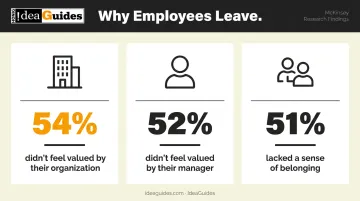
McKinsey research found that employees who quit shared three common reasons:
- 54% didn't feel valued by their organization
- 52% didn't feel valued by their manager
- 51% lacked a sense of belonging
Retreats directly address all three. When done genuinely, they signal that leadership invests in the team as people, not just as output.
Creative Problem-Solving
Changing the physical environment has a measurable effect on thinking. Research published in the Journal of Consumer Research found that moderate ambient noise (around 70 dB) improved creative task performance compared to quieter settings, because moderate novelty promotes more abstract, flexible thinking. Moving a team out of their usual space — even to a different building — shifts the mental context enough to open up new thinking.
How to Plan a Department Retreat: Best Practices
Start With a Clear Purpose
Before booking a venue or picking activities, define 2-3 specific outcomes. What does the department need to align on? What relationship gaps need closing? What strategic questions need answers?
The purpose shapes every other decision. Without it, you end up with a day that feels pleasant but doesn't actually move anything forward.
Go Offsite — Even on a Budget
Physically leaving the workplace is critical for mental gear-shifting. A community room, a partner's conference space, a park — each works better than the conference room down the hall. The act of leaving signals that this time is different and worth protecting.
Budget-conscious options to consider:
- Local community center meeting rooms
- A team member's neighborhood library or co-working space
- A partner organization's offsite facilities
- An outdoor setting for part of the day
Get a Skilled Facilitator
This is worth addressing directly: when a manager facilitates their own retreat, they can't fully participate. They're also perceived — fairly or not — as having an agenda. That perception alone suppresses candid input from the team.
A neutral, experienced facilitator ensures every voice is heard, keeps discussions on track, and captures decisions in formats that translate into action. IdeaGuides, based in the San Francisco Bay Area and serving clients nationwide, specializes in this kind of department-level work. Operating since 1999, their experienced facilitators have guided departments through strategic planning, team alignment, and innovation sessions across government, education, manufacturing, and technology.
One client, a Development Associate at a private K-8 school, described it this way: "Bruce was a great guide to our work, while allowing our needs to be heard and drive the agenda for the day." After their one-day retreat, she noted that monthly meetings became more productive and communication became more open and constructive — lasting changes, not just a good day.
Balance Structure With Space
Alternating focused work sessions with team-building activities and genuine downtime isn't just nice to have — it's necessary. Overscheduling is one of the most common retreat mistakes, and it leaves participants exhausted rather than energized.
Build in what some facilitators call "white space" — unstructured time for informal conversation. That's often where the most honest exchanges happen.
Involve the Team in Planning
Co-designing the retreat agenda with team input increases buy-in and ensures the content is actually relevant. A brief pre-retreat survey — asking about priorities, concerns, and preferred activity types — signals that the retreat is designed for the team, not just handed down to them.
IdeaGuides conducts structured interviews and surveys with clients before every retreat, using that input to build the agenda collaboratively. By the time the day starts, the agenda already reflects what the team actually needs to work through — not a generic template.
Department Retreat Ideas That Actually Work
The best retreat activities do double duty: they're engaging in the moment and reinforce the retreat's strategic purpose. Here are ideas organized by what each type is best suited for.
For Team Alignment and Strategic Thinking
- Facilitated strategic planning sessions using a structured framework: reflect on the past, define mission and values, assess the present, envision the future, set goals and tactics
- Appreciative inquiry exercises — asking the team what's already working and how to replicate it, rather than starting from a deficit perspective
- Future visioning workshops where the department maps where it wants to be in one to three years, then works backward to identify the steps to get there
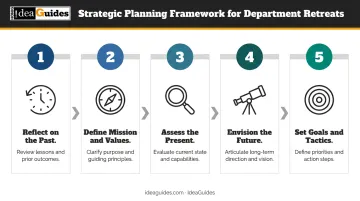
These work best with a skilled facilitator who can translate open-ended discussion into concrete commitments.
For Building Relationships and Trust
- Cooking challenges — teams plan and prepare a shared meal together, which requires communication, negotiation, and a sense of humor
- Structured peer-coaching circles where colleagues practice giving and receiving feedback in a low-stakes format
- "Name origin" or personal story exercises that help colleagues see each other as full human beings rather than just job titles
These activities break down role hierarchies without requiring anyone to be vulnerable in uncomfortable ways.
For Creativity and Innovation
- Mini hackathons — give small teams a real departmental challenge and a time constraint; the constraint itself drives creative thinking
- Improv comedy workshops — these sharpen listening, adaptability, and the capacity to build on others' ideas — skills that transfer directly to collaborative work
- Open Space Technology sessions, where participants self-organize around the questions they find most pressing
Stepping outside routine patterns — even for a few hours — tends to loosen fixed thinking. That's what makes these formats more than fun: they shift how people approach problems back at the office.
For Energy and Fun
- Escape rooms — excellent for revealing natural problem-solving styles in a low-stakes, memorable format
- Scavenger hunts or treasure hunts — IdeaGuides team member Dave Blum, creator of the Dr. Clue Build-A-Treasure-Hunt program, designs these specifically to build team cohesion and communication in an energizing way
- Outdoor activities like hiking or group challenges, which combine physical movement with informal relationship-building
Fun shared experiences create lasting memories and the kind of inside jokes that bind teams together. Those informal connections aren't incidental — they're part of what makes collaboration easier when the work gets hard.
For Purpose and Reflection
- Volunteer day tied to a cause the department cares about — a shared act of contribution reconnects people to meaning beyond daily tasks
- Leadership fireside conversation — an informal Q&A format where senior leaders speak candidly about direction, challenges, and their own perspective
- Closing reflection exercise where each person shares their biggest takeaway, a commitment they're making, or one thing they appreciate about a colleague
These work especially well as retreat openers or closers to anchor the day's purpose.
Building Your Department Retreat Agenda
A half-day to full-day format works well for most department retreats. A benchmark structure for a single day (9 a.m. to 4 p.m.):
| Time | Activity Type |
|---|---|
| 9:00–9:30 | Connection warm-up activity |
| 9:30–11:30 | Core strategic work session (energy is highest) |
| 11:30–12:00 | Small group discussion or activity |
| 12:00–1:00 | Lunch (informal, unstructured) |
| 1:00–2:30 | Collaborative team activity or second work session |
| 2:30–3:30 | Idea convergence and decision-making |
| 3:30–4:00 | Reflection and action planning |
Two-day retreats allow for deeper work, but resist the urge to fill every hour. Built-in downtime is part of the design, not a gap in it.
Two logistical details make a measurable difference in how well the day runs:
- Device use: Set a group agreement at the start. Designated check-in breaks — rather than open phone use throughout — protect discussion quality without feeling punitive.
- Pre-retreat prep: Send the agenda, any pre-reading, and stated goals at least one week out. Participants who know what's coming contribute more from the opening activity onward.
Making the Impact Last: Post-Retreat Follow-Through
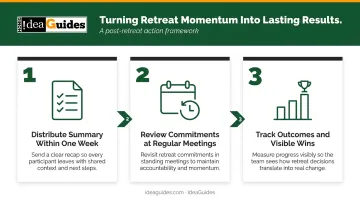
A retreat without follow-through is just a day off-site. Three steps that turn momentum into results:
Distribute a summary within one week — key decisions, commitments, action items, and owners. The facilitator's documented outputs are essential here. IdeaGuides provides clients with a report capturing the results and output of the meeting, which becomes the foundation for follow-through.
Review commitments at regular team meetings — the retreat should feel like the beginning of an ongoing conversation, not a one-time event. Schedule a 30-day check-in specifically to assess progress on action items.
Track outcomes — ask: what changed because of our retreat? What can we point to? Even a short list of visible wins — a decision that moved forward, a process that changed — keeps the team invested and makes the next retreat easier to justify.
Frequently Asked Questions
What is a department retreat?
A department retreat is a structured offsite or dedicated gathering for a single team, designed to achieve specific goals such as strategic alignment, relationship-building, and problem-solving. Unlike a company-wide event or casual team outing, it is defined by its intentionality: every element serves a purpose.
What is the purpose of a department retreat?
The core purposes are rebuilding team alignment, creating space for strategic thinking away from daily operations, strengthening relationships among colleagues, and generating actionable decisions that improve how the department works together.
What is another word for a staff retreat?
Staff retreats are also called team offsites, away days, team retreats, department offsites, or staff off-sites. "Offsite" and "away day" tend to be the most common in corporate settings; "staff retreat" is more typical in nonprofits and government agencies.
How long should a department retreat be?
A half-day to full-day format works for most departments. Two-day formats make sense when there's significant strategic ground to cover. A focused half-day with clear goals will consistently outperform a full day packed with too many agenda items.
Should we hire a professional facilitator for our department retreat?
A professional facilitator is especially valuable when the retreat involves complex discussions, sensitive dynamics, or important decisions. It frees leadership to participate fully, and a skilled facilitator ensures decisions are documented clearly and assigned to owners before everyone leaves the room.
How do we make sure our retreat is productive and not just a day off?
Three keys: define clear goals before the retreat, build an agenda that balances structured work sessions with team activities, and commit to post-retreat follow-through with assigned action items and clear owners.