Why Financial Firms Need Professionally Facilitated Retreats
Financial firms operate in an environment that makes candid team dialogue difficult. The pressures stack up fast:
- Market volatility demands rapid strategic pivots with little room for deliberation
- Regulatory scrutiny keeps every conversation guarded and on-script
- Fintech disruption forces departments to rethink long-standing processes
- Siloed structures — where compliance, trading, operations, and wealth management rarely intersect — let critical misalignments go unaddressed for months
A team retreat seems like the obvious fix. But without skilled facilitation, these off-sites default to PowerPoint recaps, senior voices dominating Q&A, and participants leaving with no clearer direction than when they arrived. The firm has spent the budget, blocked the calendars, and booked the venue — for a very expensive status update.
Professionally facilitated retreats are different. They're designed to produce decisions, not just discussions.
Key Takeaways
- Professional facilitation transforms a financial firm's retreat from a social gathering into a strategic alignment session with actionable outcomes.
- Financial services teams face distinct challenges (hierarchy, risk aversion, siloed thinking) that require facilitators who understand the culture.
- Effective retreat agendas balance structured strategic sessions with relationship-building activities.
- External facilitators provide the neutrality that internal leaders simply cannot.
- Post-retreat accountability structures separate lasting change from a pleasant day out of the office.
The Business Case for Facilitated Retreats in Financial Services
The Hidden Cost of Misalignment
Financial firms operate under cultural pressures that make honest peer-to-peer dialogue rare: performance metrics create defensiveness, compliance culture discourages speculation, and hierarchical authority shapes who speaks and who stays quiet. Day-to-day operations rarely create space to surface and resolve the tensions between departments.
The organizational cost is real. Research on shared services in financial organizations found that more than a third of companies have realized their cross-organizational objectives only marginally or not at all — with managers reporting stagnating performance directly tied to entrenched divisions between teams. In banking specifically, disjointed information across departments has slowed decision-making and hampered responses to market changes.
When compliance, revenue-generating divisions, and operations are pulling in different directions, clients feel it. Internal efficiency erodes. Decisions that need to be made get pushed to the next meeting cycle — and then the next.
Connecting Retreats to Strategic Planning Cycles
Financial firms already run structured planning cycles: annual planning, mid-year reviews, succession planning. A facilitated retreat plugs directly into those cycles by transforming top-down directives into team-owned action plans. The difference between a directive people comply with and a strategy people champion comes down to whether they had a hand in shaping it.
That buy-in has measurable consequences. Strategic planning research in banking contexts confirms that structured planning activities — formulation, implementation, evaluation, and control — have a statistically significant positive influence on financial performance and internal business processes. A well-facilitated retreat is where alignment actually gets built — not announced.
For financial firms, this means retreats work best when timed to coincide with existing planning milestones:
- Pre-annual planning: Surface cross-departmental priorities before budget discussions begin
- Mid-year reviews: Recalibrate team commitments against shifting market conditions
- Post-merger or restructuring: Rebuild shared direction when teams and mandates have shifted
High Performers Who Don't Collaborate
Financial firms often house strong individual performers who have limited practice collaborating across functions. A trader, a compliance officer, and a wealth management lead may each be excellent at their jobs — and rarely speak to each other about shared priorities. Facilitated retreats give those conversations a structure and a purpose, so that when a compliance concern intersects with a revenue decision, the right people have already built the working relationship to handle it.
IdeaGuides has worked directly with financial services clients including California Bank & Trust, American Express, and MasterCard — organizations where understanding the culture, not just running a process, determines whether a retreat produces real alignment or just fills a day.
What Makes Financial Firm Retreats Uniquely Challenging
Hierarchy That Silences the Room
In financial firms, junior team members habitually defer to senior leaders — even when explicitly asked for open input. Without skilled facilitation, a retreat reinforces the existing power structure rather than opening new dialogue. A skilled facilitator actively equalizes participation: using structured turn-taking, small-group breakouts, and anonymous input tools that give every level of the organization a genuine voice without threatening authority or making anyone feel put on the spot.
IdeaGuides' approach explicitly positions facilitators as neutral meeting leaders who "equalize the interactive playing field for maximum participation." Because the facilitator holds no stake in the firm's internal politics, they can draw out a mid-level manager's concern just as readily as they'd engage the CFO and frame it constructively for the room.
Risk Aversion and the Candor Problem
Financial professionals are trained to avoid uncertainty and protect information. That instinct doesn't disappear when they sit down for a retreat. People stay vague. Concerns go unvoiced. Assumptions go unchallenged.
Skilled facilitators address this directly before tackling sensitive content. Techniques like brainwriting (written idea generation before group discussion), anonymous digital input, and Nominal Group Technique create structured channels for honest participation.
IdeaGuides' use of introverted processes — where ideas are generated privately before being shared — reduces the social risk of speaking up. The data from the room becomes richer, and leadership gets a far more accurate picture of where the organization actually stands.
Analytically-Minded Audiences Skeptical of "Soft" Exercises
Many financial professionals will disengage from activities that feel abstract or disconnected from business outcomes. The facilitator's credibility depends on anchoring every exercise to measurable goals.
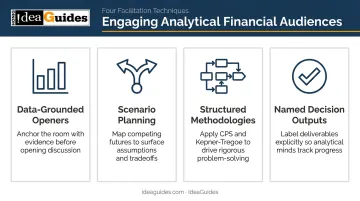
Effective techniques for this audience include:
- Open sessions with internal performance metrics, client feedback trends, or operational benchmarks to ground discussion in objective reality
- Use scenario planning: present two or three plausible future conditions and ask teams to map priorities and resource allocation under each, mirroring how financial professionals already think about risk
- Apply structured methodologies like Creative Problem Solving (CPS) and Kepner-Tregoe, which feel rigorous and process-driven rather than improvised
- Close every session with a named decision point or specific output, not open-ended reflection
Competing Departmental Agendas
Compliance teams, revenue divisions, and operations rarely arrive at a retreat with identical priorities. Left unmanaged, the loudest department sets the agenda while real tensions stay buried.
Pre-retreat interviews with stakeholders from each group allow the facilitator to map those conflicts before walking into the room. That preparation makes it possible to design sessions that bring competing priorities into productive dialogue rather than suppressing them.
Building an Effective Retreat Agenda for Financial Teams
Start Before the Retreat
Effective facilitation begins weeks before the off-site. IdeaGuides' standard pre-retreat process involves stakeholder interviews and surveys with key participants — gathering input on departmental tensions, strategic priorities, and what people actually hope to resolve. This prevents the most common retreat mistake: a generic agenda that misses the firm's real challenges entirely.
From that pre-work, IdeaGuides refines a draft agenda collaboratively with the client until it fits the firm's organizational goals. By the time the retreat begins, the facilitator already knows where the friction points are.
Map Sessions to Business Outcomes, Not Activity Types
Every agenda item should answer: What decision or alignment does this session produce?
Examples for financial firm retreats:
- "Reach consensus on client service priorities for Q3–Q4"
- "Identify the top three cross-departmental workflow bottlenecks"
- "Clarify ownership of the compliance integration project"
For results-oriented financial professionals, this framing is non-negotiable. Every minute away from the desk has a cost — sessions need to produce decisions, not just discussion.
Build In Dedicated "Decide and Assign" Moments
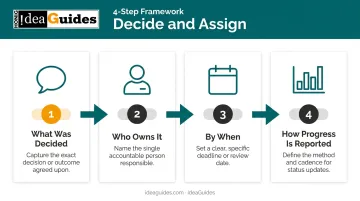
Retreats in financial firms frequently stall because conversations end without clear decisions. Before moving to the next agenda item, a skilled facilitator pauses the group to confirm:
- What was decided — stated explicitly, not implied
- Who owns it — a single named individual, not a department
- By when — a specific date, not "soon"
- How progress will be reported — and to whom
IdeaGuides builds action planning as a defined final phase of every facilitated session. Participants leave with documented commitments, not just good intentions.
Plan for What Happens After
A retreat without a post-session accountability structure loses momentum within weeks. Before the retreat ends, the facilitator should help the group establish:
- A documented decision log distributed immediately after the retreat
- A 30-day check-in session already scheduled on participants' calendars
- A designated internal champion responsible for tracking follow-through
IdeaGuides produces a written report of session outputs that gives teams a concrete reference point for holding each other accountable in the weeks that follow.
Internal vs. External Facilitator: Why It Matters in Financial Firms
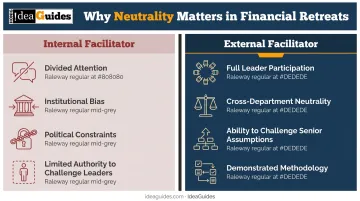
Senior internal leaders cannot simultaneously participate in strategic discussions and guide the group process. They carry institutional biases, are subject to political pressures, and — no matter how skilled — cannot challenge a CEO's assumption the way a neutral outsider can.
The value an external facilitator provides to a financial firm retreat:
- Full participation for leaders — the CFO can engage in the substance of strategic conversation without managing the room
- Neutrality across departments — no internal allegiances, no history with the political dynamics
- Ability to challenge senior assumptions — done respectfully but without the career consequences an internal person would face
- Demonstrated methodology — a named, reproducible process rather than improvised group management
Not all external facilitators are equally suited to financial firms. When vetting candidates, prioritize:
- Experience with professional services or financial sector teams
- professional facilitation standards, which signals adherence to professional ethics and standards
- A clearly described methodology — not just "we guide conversations"
- References from organizations of comparable size and complexity
IdeaGuides' experienced facilitators have worked with financial services organizations — including California Bank & Trust and American Express — across more than 25 years and 150+ client engagements. Internal leaders participate fully in the substance of the retreat because IdeaGuides manages the process.
Measuring Retreat Success Beyond the Day Itself
Participant satisfaction scores tell you whether people enjoyed the retreat. They don't tell you whether it changed anything. Post-retreat success indicators worth tracking for financial firms:
- Decisions made and held — were the commitments from the retreat still in place 60 days later?
- Action item completion rates at 30, 60, and 90 days post-retreat
- Cross-departmental initiatives launched as a direct result of retreat conversations
- Qualitative shifts in communication — are compliance and operations talking more, and differently?
For a quantitative benchmark, FINRA's engagement work using structured input tools produced concrete numbers: survey participation rose to 93%, 78% of survey items improved, and cross-departmental cooperation increased by 8%.
It's not a retreat study — but it confirms that structured, facilitated engagement in financial organizations moves measurable needles. The same logic applies when a facilitator builds in accountability mechanisms from day one.
The facilitator's job doesn't end when the off-site does. A scheduled 30-day check-in, distributed documentation, and a named internal champion are what separate a retreat that changed the organization from one that everyone remembers fondly but can't name a single lasting result.
Frequently Asked Questions
How long should a financial firm team retreat last?
Most focused strategic retreats run one to two days; deeper alignment work across multiple departments typically benefits from two to three days. Financial firms should resist the urge to pack too many topics into a single day — rushed agendas undermine the depth of conversation that makes facilitation valuable.
Should a financial firm use an internal or external facilitator for a retreat?
External facilitators are almost always more effective for leadership-level retreats in financial firms. They bring neutrality, can challenge senior assumptions without political consequence, and allow internal leaders to participate fully as strategic contributors rather than spending energy managing the process.
What topics should a financial firm's retreat agenda cover?
Typical agenda items include strategic priorities, cross-departmental alignment, client service challenges, talent and succession planning, and deferred decisions — each mapped to specific business outcomes.
How do you encourage participation from reserved or hierarchy-aware financial professionals?
Skilled facilitators use anonymous input tools, small-group breakouts, structured turn-taking, and ground rules established at the retreat's opening to create conditions where quieter participants contribute without fear of judgment or professional consequence.
How can a facilitator maintain confidentiality during sensitive financial discussions?
The facilitator should establish explicit confidentiality norms at the opening, clarify what will and won't be documented, and handle sensitive strategic information in line with the firm's disclosure and compliance standards.
How do you measure the ROI of a facilitated team retreat for a financial firm?
ROI indicators include decisions made and sustained, action items completed within agreed timelines, reductions in recurring cross-departmental conflicts, and qualitative feedback from participants and their managers in the weeks following the retreat — not just satisfaction scores from day-of surveys.