Introduction
Here's a fact that should give any CEO pause: according to research from the Center for Creative Leadership, only 18% of senior executives rated their leadership team "very effective" — yet 97% agreed that improving executive team effectiveness would positively impact organizational results.
That gap is the problem. Organizations invest significant resources recruiting exceptional individual executives, then assume proximity will produce performance. It rarely does.
Individual brilliance and collective excellence are not the same thing. Executive teams function as social systems: how members interact, challenge each other, and execute together determines outcomes far more than any single leader's credentials.
This article breaks down the specific traits and behaviors that separate executive teams that consistently make great decisions from those that underperform despite impressive resumes, and what leaders can do to build those traits on purpose.
Key Takeaways
- Elite executive teams need both talent capital (individual competence) and social capital (interaction quality) — each one without the other falls short
- High-performing teams treat intellectual conflict as a tool for better decisions, not a threat to manage
- Authority should shift to whoever is most qualified for each challenge, not whoever holds the highest title
- Once a decision is made, every member executes it fully — regardless of prior disagreement
- These traits require deliberate, structured investment — they don't develop on their own
What Sets Elite Executive Teams Apart: Talent Capital vs. Social Capital
Two Pillars, One Framework
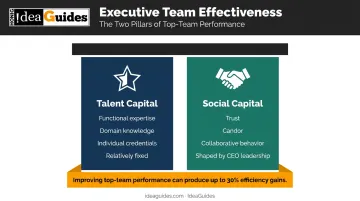
Executive team effectiveness rests on two completely independent dimensions:
- Talent capital — the individual competence each executive brings to their functional role
- Social capital — the quality of trust, candor, and collaborative behavior within the team
Both are necessary. Neither is sufficient on its own. This is the counterintuitive reality that many organizations miss when they focus hiring efforts exclusively on individual pedigree.
A team of highly capable executives with poor interpersonal dynamics will produce little more than each person could accomplish working alone, or even less when they work at cross-purposes. Meanwhile, a team with moderate individual talent but strong social capital will consistently outperform a collection of brilliant but poorly aligned executives.
The Asymmetry That Changes Everything
Talent capital is relatively fixed per individual. You can't significantly increase a CFO's financial acumen in six months. Social capital, on the other hand, is fluid — shaped directly by the CEO's behavior, standards, and willingness to enforce them.
McKinsey research shows that improving top-team performance can produce efficiency gains of up to 30%. The lever isn't always hiring differently — it's often leading the existing team differently.
Team Size and Performance
Research points toward a practical ceiling on executive team size. Katzenbach and Smith's seminal HBR work found that effective teams are typically fewer than 10 members — large enough for diverse expertise, small enough for genuine accountability and high-quality interaction.
Beyond roughly 10 members, groups tend to fragment into sub-teams. Real dialogue gets replaced by performance theater. Individual accountability diffuses — and with it, the candor that makes executive teams worth having.
Five Core Traits of Elite Executive Teams
Trait 1: Fluid, Expertise-Based Leadership
Elite executive teams don't rigidly defer to hierarchy on every matter. Leadership responsibility shifts naturally to whoever is most qualified for a given challenge — and the rest of the team actively supports that shift rather than competing with it.
Call it "power flux." When a supply chain crisis hits, the Chief Operating Officer leads. When a regulatory matter surfaces, the General Counsel takes the wheel. The CEO doesn't need to weigh in on every decision, and nobody jockeys for position.
This requires something specific: team members must develop genuine awareness of each other's strengths. Not surface-level familiarity, but real understanding of who knows what and where each person's judgment is most reliable. When that knowledge exists, there's no ego friction — the right person steps forward and the team rallies behind them.
Trait 2: Intellectual Candor and Healthy Conflict
Elite executive teams treat conflict as a necessary condition for reaching the best decisions — not as something to be managed or smoothed over. The critical distinction: intellectual conflict (ideas, strategies, and approaches competing) versus personal conflict (ego-driven friction). High-performing teams actively welcome the former and prevent the latter.
When executives are genuinely invested in outcomes, they push back on weak ideas — including their own. That's not dysfunction. It's engagement.
Google's Project Aristotle, which studied 180 teams to identify what made them effective, found that psychological safety — the shared belief that the team is safe for interpersonal risk-taking, as defined by researcher Amy Edmondson — was the single most important dynamic. Psychological safety doesn't mean conflict-free. It means people feel safe enough to challenge assumptions, admit uncertainty, and say what they actually think.
Without it, executives perform agreement in the room and undermine decisions in the hallway.
Trait 3: Participatory Decisions, Unified Execution
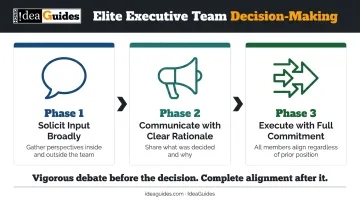
Elite teams practice a three-part discipline:
- Solicit input broadly before finalizing major decisions — including from voices outside the immediate executive team
- Communicate decisions with clear rationale so the broader organization understands not just what was decided but why
- Execute with full commitment once a decision is made — regardless of where individuals stood during the debate
The third component is the hardest and the most important. When individual executives hedge on decisions they disagreed with — slow-walking implementation, signaling skepticism to their teams, or publicly qualifying their support — the damage spreads fast. Organizational confusion sets in, trust in leadership erodes, and the signal to the broader team is clear: this isn't really a unified group.
The discipline elite teams practice is holding a firm line: vigorous debate before the decision, complete alignment after it.
Trait 4: Mutual Advocacy Among Peers
High-performing executive teams do something that rarely gets discussed: they actively advocate for each other. When a CFO's financial modeling prevented a costly acquisition, the CEO mentions it in the next board meeting. When the CHRO's retention strategy drives measurable results, the COO brings it up with the leadership team.
This isn't flattery. It's a deliberate practice of building colleagues' professional standing — particularly for contributions that might otherwise go unnoticed outside someone's functional area.
Over time, the practice reshapes team culture in three concrete ways:
- Individual executives gain confidence and broader organizational credibility
- Cross-functional trust deepens as people see peers recognized for real contributions
- Collective ownership over results displaces individual scorekeeping
Teams that do this consistently tend to make better decisions — because people are more willing to share information when they know credit travels.
Trait 5: A High Positive-to-Negative Feedback Ratio
Effective executive teams maintain a clear imbalance toward reinforcing feedback over critical feedback. The exact ratio is less important than the principle.
When critical feedback vastly outweighs acknowledgment of genuine contributions, executives become defensive, disengaged, and less receptive to correction exactly when it matters most.
This is not about avoiding difficult conversations. It's about ensuring that when you need an executive to hear hard feedback, they're psychologically available to receive it — rather than bracing for the next criticism.
High-performing teams make acknowledgment of real contributions a regular, specific practice. Not generic praise, but concrete recognition: "The market analysis you presented last week changed how we're thinking about the acquisition timeline." That specificity is what makes it credible and what keeps the team open to candor.
What Quietly Destroys Executive Team Performance
Four Behaviors That Corrode Social Capital
Researchers studying interpersonal conflict have identified four communication patterns that are particularly destructive:
- Persistent criticism — attacking ideas or people rather than engaging substantively with the issue
- Defensiveness — responding to challenges with self-protection rather than curiosity
- Stonewalling — withdrawing from dialogue, refusing to engage, going silent
- Contempt — communicating disrespect or superiority
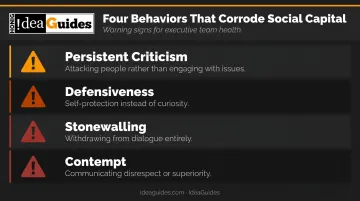
When these behaviors appear in an executive team, intellectual conflict stops being productive. Every debate risks becoming personal. Eventually, people stop engaging honestly altogether.
The Outsized Impact of One Outlier
One executive who consistently displays any of these behaviors — chronically dismissive, passively obstructive, subtly contemptuous — can degrade the functioning of the entire team, even if their individual technical performance looks fine. The social contract of the team breaks down around them.
That makes it the CEO's responsibility to address — directly and without delay.
The Three Root Causes of Low Social Capital
Most cases of low executive team social capital come down to one of these:
- The CEO hasn't defined what acceptable behavior looks like
- The CEO hasn't enforced those standards once set
- Or both — which is more common than either alone
The starting point is always definition: what behaviors are expected, what is unacceptable, and what will happen when the line is crossed. Ambiguity here is not neutral — it's permission for the lowest-quality dynamics to set the standard.
How to Cultivate These Traits in Your Leadership Team
Start With Structure, Not Hope
Executive team social capital does not develop on its own. Proximity and shared goals are not enough. Deliberate investment is required: specifically, regular time dedicated to how the team works together, not just what the team is working on.
This doesn't require massive time commitments. A structured five minutes at the start of each leadership meeting — a brief reflection on how the last decision went, or one acknowledgment per person — builds habits incrementally. In-person sessions dedicated specifically to team dynamics (separate from operational reviews) produce more substantial shifts.
Surface the Gap Between Perception and Reality
One of the most consistent findings in executive team work is that how team members believe the team functions and how it actually functions are different things — often significantly different.
Structured diagnostics close that gap:
- Anonymous surveys that capture honest perceptions of team dynamics
- Confidential individual interviews that surface issues people won't raise in group settings
- Facilitated team assessments that create shared visibility into patterns
IdeaGuides uses exactly this approach in executive team engagements — conducting pre-session stakeholder interviews and surveys before any retreat or team session begins. The information gathered shapes the agenda and ensures that the real issues, not just the visible ones, get addressed.

Use Expert Facilitation for High-Stakes Team Work
When a leadership team is working on its own dynamics, asking one member to simultaneously participate and facilitate rarely works. The CEO can't manage the group process and be a full participant in it. Hierarchy shapes who speaks and how.
IdeaGuides' executive facilitation sessions address this directly. As neutral facilitators, they equalize the participation dynamic: quieter voices are heard, dominant ones don't crowd out the room, and sensitive issues get addressed rather than avoided. Sessions range from focused half-day workshops to multi-day retreats, each built around the specific team's challenges rather than a generic agenda.
The tools — structured conflict resolution, consensus-building facilitation, team norm-setting — are the same ones that helped a Dow AgroSciences management team during a complex two-company integration.
"The session helped the group come together around a shared vision and move from two separate companies toward 'us.'" — Paul Frey, General Manager, Dow AgroSciences
Teams that invest deliberately in how they work together don't just function better. They make better decisions, move faster, and hold together when conditions get hard.
Frequently Asked Questions
How do you build high-performing executive teams?
Building high-performing executive teams requires deliberate investment in individual capability and team interaction quality. That means clear behavioral standards, regular time devoted to team-effectiveness work (not just operational reviews), and a CEO willing to hold executives accountable to both.
What are the key components of high-performing executive teams?
The core components include:
- A balance of talent capital and social capital
- Psychological safety that enables candid debate
- Intellectual candor and unified decision execution
- Shared accountability for enterprise outcomes
- Adaptability when conditions change
What are the 7 C's of executive presence?
IMD's framework identifies seven attributes: Character, Charisma, Confidence, Credibility, Connection, Composure, and Clarity. While these describe individual presence, they shape team effectiveness too — credibility, connection, and composure most directly influence how executives engage in collective debate and decisions.
What is the difference between talent capital and social capital in executive teams?
Talent capital is the individual competence each executive brings to their functional role. Social capital is the quality of trust, candor, and collaborative dynamics within the team. Social capital can amplify talent capital significantly, or neutralize it entirely when team dynamics are dysfunctional.
How large should an executive team be for optimal performance?
Research and practitioner experience suggest keeping executive teams smaller than 10 members. This threshold maintains high-quality interaction and genuine accountability while providing enough collective expertise to address complex organizational challenges.
How does conflict contribute to high-performing executive teams?
Healthy intellectual conflict — disagreement over ideas, strategies, and approaches — signals an engaged team and produces sharper decisions. The key is separating it from personal conflict and maintaining a culture where ideas compete while people collaborate. Psychological safety is what makes that distinction sustainable.