Introduction
Leadership teams invest serious time and money in strategic planning retreats. Two days offsite, executives pulled from their desks, a venue booked months in advance — and then everyone walks away with a vague list of priorities, no clear decisions, and the same unresolved tensions that existed before the retreat began.
This happens more often than it should. And in most cases, the facilitator is the variable that made the difference.
Research cited in Harvard Business Review estimated that 67% of well-formulated strategies fail due to poor execution. Poor retreat facilitation is a direct contributor — sessions without skilled guidance frequently produce false consensus, undocumented decisions, and plans no one feels accountable to implement.
The facilitator you choose determines whether your retreat produces strategic clarity — or becomes another expensive off-site that fades within a week. This guide walks you through exactly what to look for, what to ask, and how to avoid the most common hiring mistakes.
Key Takeaways
- A retreat facilitator manages the process so your leadership team can focus entirely on strategic thinking.
- Look for a documented methodology, pre-retreat discovery, and post-retreat follow-up — not just a one-day agenda.
- Evaluate facilitators on five criteria: credentials, methodology, sector fit, facilitation style, and verifiable references.
- Red flags: vague scopes of work, no conflict-handling approach, and no deliverables after the session ends.
- Matching facilitator specialization to your organization type — corporate, non-profit, large group, cross-functional — dramatically improves outcomes.
What Is a Strategic Planning Retreat Facilitator?
Merriam-Webster defines "facilitate" as "to make easier" and "to help bring about." That definition captures the role well: a strategic planning retreat facilitator is a professionally trained, neutral guide who designs and manages the retreat process so leadership can focus on thinking, not running the room.
What a Facilitator Is — and Isn't
Confusing a facilitator with a consultant or trainer is one of the most common hiring mistakes — and it shapes whether your retreat produces decisions or just discussion:
| Role | What They Do |
|---|---|
| Facilitator | Guides group process; stays neutral on content and outcomes |
| Consultant | Provides expertise and advises on what decisions to make |
| Trainer/Educator | Transfers knowledge; instructs the group |
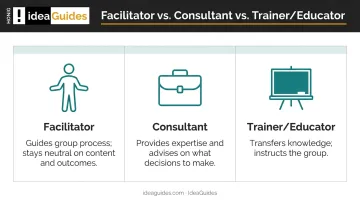
A facilitator does not supply the answers. Their job is to design a process that draws out the group's own thinking, surfaces honest perspectives, and moves the team toward collective decisions they're genuinely committed to.
Internal vs. External Facilitators
Once you understand the role, the next question is who should fill it. Most organizations choose from three options:
- Internal facilitators (HR leaders, senior managers) — convenient, but their positional authority shapes who speaks up and what stays unsaid.
- Generalist external facilitators — skilled at managing group dynamics, but without deep strategic planning methodology.
- Specialist external facilitators — trained in strategic planning frameworks, with a track record of relevant client engagements.
For high-stakes retreats, specialist external facilitators consistently produce clearer decisions and stronger follow-through. Their neutrality removes positional bias, and their methodology ensures the session ends with a plan the whole team owns.
Why the Right Facilitator Makes or Breaks Your Strategic Retreat
A poorly facilitated retreat doesn't just waste a day. It produces something worse than no meeting at all: a false sense of alignment that evaporates when leaders return to their desks.
What Goes Wrong Without Skilled Facilitation
McKinsey's research on executive decision-making found that 61% of executives said at least half their decision-making time was ineffective, while only 37% said their organizations made decisions that were both timely and high quality. Meeting design is a primary driver of that gap.
Without skilled facilitation, strategic retreats tend to fail in predictable ways:
- Dominant voices crowd out quieter perspectives, skewing decisions before discussion even begins
- Interpersonal tension and political dynamics keep the real issues off the table
- Off-topic tangents consume time that should go to critical decisions
- Heads nod in the room, but buy-in evaporates when people get back to their desks
- The day ends with ideas but no clear ownership, so nothing moves forward
What a Skilled Facilitator Actually Does
Each of those failure modes is a design problem — and a skilled facilitator solves them before the session even starts. In practice, that means:
- Creating psychological safety so uncomfortable conversations happen productively
- Drawing out quieter voices through structured methods like brainwriting, small-group breakouts, and anonymous input
- Neutralizing dominant personalities through process design rather than confrontation
- Keeping sessions on track by separating content discussion from process management
- Closing with documented next steps, named owners, and decisions the whole team actually stands behind
That last point matters more than most teams realize. Shared ownership of a plan — not just a document handed down from leadership — is what drives execution when everyone returns to their day jobs.
Key Factors to Consider When Choosing a Strategic Planning Retreat Facilitator
Not all facilitators are the right fit for every organization. The following five factors help leadership teams move past surface-level vendor comparisons to evaluate on criteria that actually predict retreat success.
Facilitation Credentials and Relevant Experience
Formal credentials signal professional accountability. Membership in the professional facilitation community means a facilitator adheres to a recognized code of ethics covering client service, group autonomy, confidentiality, and professional development. The Certified Professional Facilitator (CPF) designation goes further, requiring a live facilitation demonstration, client engagement role-play, and experience review.
IdeaGuides' facilitators hold professional facilitation standards as a team-wide standard — not just a credential for one or two senior members.
Beyond credentials, ask about depth of strategic planning experience:
- How many strategic planning retreats have they led?
- What types and sizes of organizations do they have experience with?
- Can they show a client portfolio that resembles your organization?
Process, Methodology, and Pre/Post-Retreat Support
A one-day agenda is not a process. Evaluate whether the facilitator offers a structured approach covering three distinct phases:
- Pre-retreat discovery — interviews, surveys, and context-setting to design a session that fits your actual needs
- The retreat itself — a customized facilitation approach matched to your group dynamics and strategic goals
- Post-retreat documentation — a written output capturing decisions, priorities, and next steps
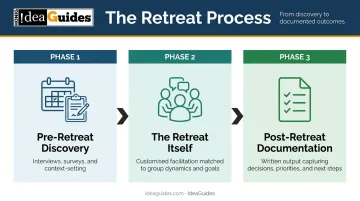
Ask directly: will they produce a written summary? Do they offer post-retreat check-ins? A facilitator who disappears after the session ends leaves the team without accountability support when implementation starts.
IdeaGuides begins every engagement with stakeholder interviews and surveys — a formal discovery process that ensures the retreat design reflects your team's real priorities, not a generic agenda.
Organizational and Sector Fit
A facilitator experienced in corporate executive offsites may not understand the governance dynamics of a non-profit board. A specialist in Open Space Technology for 200-person conferences serves a very different need than someone focused on 10-person senior leadership alignment.
Match the facilitator's demonstrated experience to your specific context:
- Sector: corporate, non-profit, government, healthcare, education
- Group size: small leadership team vs. large cross-functional group
- Retreat format: one-day alignment session vs. multi-day strategic planning process
IdeaGuides' team includes facilitators with specific sector expertise — Michael Wong specializes in non-profit organizations, while Ken Homer focuses on large-group methodologies including Open Space Technology and World Café.
Facilitation Style and Engagement Approach
Ask how the facilitator designs for participation across different personality types. A skilled facilitator uses a mix of methods: brainstorming, brainwriting, small-group breakouts, structured reflection, and visual tools. The goal is ensuring both introverted and extroverted participants contribute equally.
Then ask the harder question: how do they handle conflict or dominant personalities when they surface in the room?
A trained facilitator should describe a specific, tested approach — not a vague commitment to "keeping things positive." Look for concrete techniques: anonymizing input tools, structured turn-taking, or breakout formats that give quieter participants room before the loudest voice sets the direction.
Track Record, References, and Scope Clarity
Require verifiable references — contact information for two or three past strategic planning clients who can speak to:
- The facilitator's process and preparation
- How they handled unexpected group dynamics
- Whether the retreat produced outcomes that were actually implemented
Once references check out, scrutinize the scope of work document before signing. A trustworthy facilitator provides:
- Clear deliverables with timelines
- Defined roles for both the facilitator and your team
- Space and logistics requirements
- A transparent fee structure — vagueness here is a reliable warning sign
How IdeaGuides Can Help You Get More from Your Strategic Planning Retreat
IdeaGuides is a San Francisco Bay Area-based facilitation firm with more than 25 years of experience guiding leadership teams toward real strategic clarity. Founded in 1999, the team includes experienced facilitators, published authors, and specialists in non-profit and large-group methodologies.
To date, IdeaGuides has worked with more than 150 clients across over 250 strategic planning, alignment, and innovation sessions nationwide.
What Sets IdeaGuides Apart
The IdeaGuides team brings a specific combination of depth and breadth that's difficult to find in a single facilitation firm:
- Matches methodology to your group's needs — Open Space Technology, World Café, Appreciative Inquiry, SWOT facilitation, Nominal Group Technique, and proprietary ideation frameworks
- Sector-specific experience: Corporate clients including BASF, Dow AgroSciences, Sony, and American Express; non-profits including AFTRA; government agencies including the City of Oakland and the U.S. Army's CECOM
- Structures every session to equalize participation, so quieter voices carry as much weight as the loudest ones in the room
- Conducts interviews and surveys before every engagement to build agendas around your team's real goals, not a generic template
- Published expertise: Team members have authored books on strategic planning, innovation, team building, and meetings, bringing documented methodology alongside hands-on experience

These aren't standard credentials — they reflect how IdeaGuides approaches every engagement: tailored preparation, structured participation, and a clear path to decisions your team can act on.
The Ketchikan Community Concert Band's board described their 2024 IdeaGuides strategic planning session this way: "The board came away from the session with good direction and attainable goals." Dow AgroSciences noted that their management group "came together around a shared vision" with "increased optimism and teamwork."
Ready to Talk About Your Retreat?
If your leadership team has an upcoming retreat and you want it to produce real strategic clarity, contact IdeaGuides to discuss your specific needs.
- Phone: 1.415.479.2028
- Email: bruce@IdeaGuides.com
IdeaGuides responds within two business days and builds every proposal around your organization's goals, group dynamics, and desired outcomes.
Conclusion
The right facilitator isn't defined by prominence or price. Look for someone whose credentials, process, style, and sector experience match what your leadership team actually needs — someone who can guide the room toward real strategic clarity and a plan your team is genuinely committed to executing.
That choice sets the conditions for everything that follows. A skilled facilitator helps design a retreat where decisions get made — and where the discipline of structured, inclusive thinking carries over into how your leadership team works for months afterward.
Frequently Asked Questions
What are the 5 steps of strategic planning?
The Balanced Scorecard Institute outlines five core stages: define mission and vision, conduct a situational analysis, set strategic goals and objectives, develop and implement action plans, then monitor and adapt. A skilled facilitator moves the group through each step, ensuring every stage ends with documented, agreed-upon outputs.
What are the 7 elements of a strategic plan?
BDC identifies seven components: executive summary, company description, mission/vision/values, strategic analysis (internal and external), SWOT analysis, business goals with supporting projects, and a 12-month action plan with owners and KPIs. A facilitator's role is to drive clarity and alignment on each element within the session's time constraints.
What are the 5 C's of strategic thinking?
The 5 Cs of strategic thinking are Context, Color, Connective Tissue, Cost, and Consequence. In a retreat setting, a skilled facilitator structures conversations around each dimension, moving the group from ambiguity to shared, documented agreement on what matters and why.
What are the 4 P's of strategic leadership?
The Bloomberg Harvard City Leadership Initiative's strategic leadership framework identifies Perception, Process, People, and Projection as its four dimensions. Facilitators use organizing frameworks like this to build retreat agendas that address every critical dimension of strategy within the available time.
What should you look for when hiring a strategic planning retreat facilitator?
Prioritize: verified credentials (such as professional facilitation standards), a structured pre/post-retreat process, sector-relevant experience, a clear written scope of work, and checkable references from comparable organizations. Vague answers to any of these questions are a reliable warning sign.
How much does a strategic planning retreat facilitator typically cost?
Costs vary based on facilitator experience, retreat length, group size, deliverables, and travel — no reliable industry-wide benchmark exists. Focus on scope and value rather than flat-fee comparisons. Hiring an underqualified facilitator to cut costs typically proves more expensive than getting the right person from the start.