The problem is that most organizations default to whoever is most convenient: an internal leader, a local contact, a friend of the board. Convenience isn't a selection criterion. Fit is.
This article covers what a board retreat facilitator actually does, the factors that separate a good match from a poor one, questions to ask before you hire anyone, and how IdeaGuides can help you find the right fit for your board's specific goals.
Key Takeaways
- A board retreat facilitator manages process — not content — freeing leaders to participate fully instead of running the room
- External facilitators bring objectivity no internal leader can replicate, particularly when sensitive topics or strong personalities are at play
- Relevant experience in your sector or retreat type matters more than raw years in business
- The questions a facilitator asks you during vetting reveal more than their résumé
- Strong retreats end with clear decisions and owner-assigned next steps, not notes that never leave the room
What Does a Board Retreat Facilitator Do?
Facilitation is commonly defined as helping a group think together, explore options, and make decisions. The facilitator designs and steers the process — managing discussion flow, time, and group dynamics — so participants can focus entirely on the substance of the conversation.
A facilitator doesn't supply the answers. They create the conditions under which the group discovers them together.
Core Roles During the Retreat
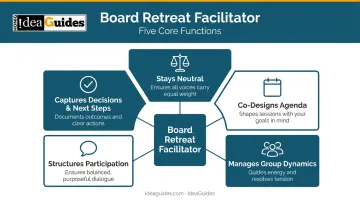
A skilled board retreat facilitator wears several hats simultaneously:
- Stays neutral — no political investment in outcomes, which frees them to probe, redirect, and challenge without baggage
- Co-designs the agenda with leadership before the retreat, then keeps discussions on track without letting tangents consume the day
- Steps in when strong personalities dominate or derail, redirecting tension constructively
- Uses structured techniques — anonymous input tools, brainwriting, the Nominal Group Technique — to surface ideas from quieter participants
- Closes the session with captured decisions and clear next steps, not just energized conversation
IdeaGuides, for example, conducts stakeholder interviews and surveys before every retreat to design an agenda tied to the board's specific goals. A high-level draft is shared with leadership, then refined collaboratively until it fits the organization's needs. That pre-retreat work is often what separates a productive retreat from a meandering one.
Why External Beats Internal for Board Retreats
When a board chair or executive director facilitates, they face a fundamental problem: they cannot simultaneously guide the process and contribute their own perspective. The organization loses either a good facilitator or a full participant — often both.
External facilitators bring two things an internal leader can't. No prior alliances, no history, no political investment in the room — that objectivity is especially valuable when the agenda touches governance gaps, leadership transitions, or interpersonal conflict. And a professional who has facilitated dozens of retreats carries a pattern library of what goes wrong and how to recover, something an internal leader running their third retreat simply cannot replicate.
The University of Minnesota Extension's analysis acknowledges real tradeoffs — internal facilitators know the culture, external ones bring greater perceived neutrality — but the dual-role constraint is the decisive factor for most board settings.
Key Factors to Consider When Choosing a Board Retreat Facilitator
No single factor decides this. The goal is to find someone whose experience, methodology, and interpersonal style align with what your board specifically needs from this retreat.
Relevant Experience and Track Record
Depth of experience in your sector matters more than total years in business. A facilitator with 10 retreats in your specific context understands nonprofit governance or government board alignment at a level a generalist with 100 retreats in other industries simply won't. They know the vocabulary, the decision-making culture, and the friction points that derail these sessions.
Ask for concrete examples: How many retreats have they facilitated for organizations of similar size and complexity? What were the stated goals, and what actually happened afterward?
Facilitation Credentials and Methodology
A widely used professional facilitation competency framework covers six domains: building client relationships, designing group processes, sustaining participation, guiding toward outcomes, maintaining professional knowledge, and modeling positive professional attitude. Use these as your evaluation checklist.
Note the credential distinction: general facilitation membership is open to anyone interested in facilitation. The Certified Professional Facilitator (CPF) designation requires a separate assessed pathway — including a live facilitation demonstration and structured interviews. Both signal commitment to professional standards, but they're not equivalent.
Methodology matters just as much. Ask what specific frameworks a candidate uses and why they'd fit your retreat:
| Method | Best For |
|---|---|
| Open Space Technology | Complex issues with diverse stakeholders, self-organizing agendas |
| World Café | Large group dialogue, surfacing collective intelligence |
| Appreciative Inquiry | Strength-based planning, rebuilding team cohesion |
| Structured dialogue | Deliberative processes, weighing options and tradeoffs |
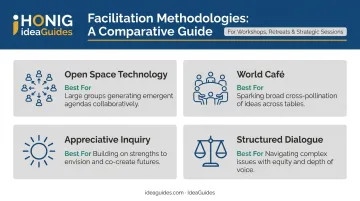
If a candidate can't explain why a method fits your goals and group size, that's your answer.
Fit with Your Organization's Context and Goals
Each retreat type demands a different design. A facilitator who's strong at strategic planning may not have the skills for conflict resolution — and vice versa. Know which you're hiring for:
- Strategic planning: Structured visioning, prioritization, roadmap development
- Governance development: Board roles, accountability frameworks, policy clarity
- Team alignment: Surfacing divergence, building shared direction
- Conflict resolution: Neutral mediation, structured dialogue, rebuilding trust
Pay attention to whether a candidate asks good questions during the vetting process. A skilled facilitator will want to understand your board's culture, current tensions, and desired outcomes before agreeing to the engagement. Readiness to commit after a 15-minute call with no questions about your organization is a red flag.
Ability to Handle Difficult Group Dynamics
This is the most underweighted factor in most searches. Research documented in SSIR describes rubber-stamp boards, misplaced loyalty that silences hard questions, and groupthink driven by homogeneous composition. HBR's analysis notes that unchecked dominant directors can shape a board's entire tone , with others withholding views or rushing agenda items to avoid confrontation.
Ask directly: Describe a session where a participant tried to redirect the agenda mid-retreat. What did you do? Strong answers are specific and process-oriented. Weak ones are vague or overconfident ("I just read the room").
Cost and Value
Fees for board retreat facilitation vary based on retreat length, preparation required, participant count, and travel. Frame it as a return on investment rather than a line-item cost. A facilitator who produces a strategic plan the board actually executes pays for themselves. So does one who resolves a governance conflict that's been consuming leadership time for months.
Don't limit your search geographically. Many experienced facilitators work nationally and adjust fees based on organization size and scope. The cheapest or nearest option rarely serves the board's actual needs.
Questions to Ask Before You Hire a Board Retreat Facilitator
The discovery call is where real fit is revealed. What a facilitator asks you is often as telling as what they answer.
Ask these five questions of any candidate:
- Walk me through how you'd handle a participant who tries to redirect the agenda mid-session.
- How do you design an agenda when the board chair and executive director have competing priorities?
- What does a successful retreat look like to you, and how do you measure it?
- What specific methods would you use for this retreat, and why?
- Describe a retreat that went significantly off script — what happened, and what did you do?
The answers will tell you a great deal. Here's what to listen for:
- Specific and process-oriented: "I use anonymous written input rounds before open discussion to surface concerns that wouldn't otherwise emerge in front of senior voices"
- Vague or overconfident: "I'm very experienced with difficult groups; I just read the room and adjust"
Check references with intention. Don't ask whether they enjoyed working with the facilitator. Ask: "Describe a moment when the retreat went off script — what did the facilitator do?" and "What would you do differently about how you prepared the facilitator for your organization's context?" Those questions reveal how a facilitator actually performs, not just how likable they are.
How IdeaGuides Can Help
IdeaGuides is a professional facilitation firm with over 25 years of experience guiding boards, leadership teams, and organizations through retreats, strategic planning sessions, and alignment workshops. With more than 150 clients and 250 projects completed since 1999, their work spans corporate, nonprofit, and government clients across California and nationwide.
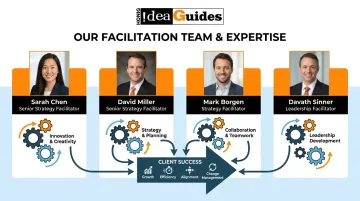
Each facilitator on the IdeaGuides team brings a distinct area of specialization — so clients are matched based on retreat goals, not availability:
- Michael Wong — Facilitator specializing in nonprofit organizations, including board-level strategic planning sessions
- Ken Homer — Large group specialist trained in Open Space Technology and World Café, ideal for retreats engaging broad stakeholder groups
- Ray Madaghiele — Master Facilitator and author of a strategic planning book, best matched to retreats centered on organizational strategy
- Alice Cochran — Expert Facilitator and author of multiple books on meetings, with deep expertise in structured group process design
- Adam Shames — Master Facilitator and author of Teambreakers, focused on innovation, team development, and collaborative group processes
- Bruce E. Honig — Chief Executive Facilitator and author of over five books on innovation, team building, and meetings, suited to multi-objective retreats combining strategy, alignment, and creative problem-solving
That match shapes everything that follows. Working with IdeaGuides includes:
- Experienced facilitators across the entire team
- Authors of multiple published books on meetings, innovation, and strategic planning
- Highly participatory session design using both introverted and extroverted processes to ensure every voice is heard
- Collaborative pre-retreat process — interviews, stakeholder surveys, and co-designed agendas — before the retreat begins
- Proprietary tools including the Leading Effective Meetings workbook, Finding the Solution cards, and Creative Collaboration recipe book
- Sessions designed to end with clear decisions and actionable next steps
Reach IdeaGuides at bruce@IdeaGuides.com or 1.415.479.2028 to discuss your board retreat goals and get a tailored proposal within two business days.
Frequently Asked Questions
What does a retreat facilitator do?
A retreat facilitator designs and guides the group process so participants can focus on the substance of conversations rather than managing the room. They remain neutral on outcomes while keeping the agenda on track, drawing out quieter voices, and ensuring the session ends with captured decisions and clear next steps.
What are the key roles of a facilitator?
A widely used professional facilitation framework defines facilitator competencies across six domains, covering everything from process design to professional conduct. For board retreats specifically, the most critical roles are maintaining neutrality and mediating conflict — both of which require an experienced external facilitator who has no stake in the outcome.
Should a board retreat facilitator be external or internal?
External facilitators are almost always preferable for board retreats. They bring objectivity, have no political stake in outcomes, and — critically — allow internal leaders including the executive director and board chair to participate fully rather than split their focus between guiding the room and contributing their own perspective.
How much does it cost to hire a board retreat facilitator?
Fees depend on the facilitator's experience, retreat length, preparation time, participant count, and travel. Day rates for professional facilitators typically start in the low thousands and scale up with complexity. Request a custom proposal so you can weigh the cost against the specific outcomes your board needs from the session.
How do I know if a facilitator is the right fit for my board retreat?
Evaluate fit based on relevant sector or retreat-type experience, the quality of questions they ask during your discovery conversation, references from similar organizations, and whether their proposed methodology aligns with your retreat's specific goals. Personality matters, but proven process skill matters more.