Introduction
The facilitation training market is genuinely difficult to navigate. Options range from $15 Udemy videos to $5,000 three-month certifications — and most program descriptions sound more or less the same. For individual learners, picking the wrong program costs an afternoon. For HR and L&D leaders buying on behalf of their organization, the wrong choice wastes budget and produces no measurable behavior change.
The core problem: most programs look similar on paper but differ dramatically in what they actually build. A self-paced video course and a cohort-based certification might both promise "facilitation skills," but one produces awareness and the other produces capability. That distinction matters more than price.
Atlassian's 2024 survey of 5,000 knowledge workers found that 72% of meetings are ineffective and 78% of employees say meeting volume actively prevents them from completing their work. Skilled internal facilitators fix this — but only if their training built real capability, not just familiarity with concepts.
This article covers six programs worth serious consideration — with verified pricing, formats, and the specific buyer scenarios each one fits best.
Key Takeaways
- Cohort-based programs with live practice consistently outperform self-paced video for building durable facilitation skills
- Programs range from under $20 for introductory video content to $5,000+ for comprehensive certifications
- Match program depth to your goal: awareness-building and capability-building require very different investments
- Post-program community access matters: facilitators who return to unsupported environments lose skills quickly
- Custom organizational training often delivers more value than enrolling individuals in standardized programs
Why Facilitation Training Matters for HR and L&D Leaders
Facilitation isn't just a skill for professional workshop designers. It's what determines whether a strategic planning session produces real decisions or just fills a day. Whether a cross-functional alignment meeting ends with clarity or confusion. Whether training programs delivered by internal facilitators actually engage participants — or don't.
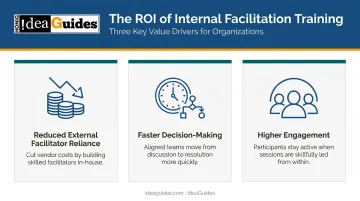
The ROI levers are concrete:
- Reduced reliance on external facilitators for recurring internal workshops
- Faster decision-making when internal sessions are run with structure and skill
- Higher engagement in training programs delivered by skilled internal facilitators rather than subject-matter experts reading slides
The Human Factor in Learning Design
Human-facilitated learning and self-paced digital modules produce different outcomes — and the gap matters for L&D buyers designing programs at scale. Live, facilitated environments build stronger psychological safety than digital-only formats. That directly affects whether participants engage, take risks, and carry new behaviors back to the job.
The practical implication: a video library can build awareness, but changing how your managers run meetings requires live practice with real feedback. Those are different investments with different outcomes.
Best Facilitation Training Courses for HR and L&D Leaders
The programs below were selected for practical orientation, credential recognition, and fit for professionals who need to facilitate real organizational work — not just classroom exercises.
Voltage Control Facilitation Certification
Voltage Control offers a three-month, cohort-based certification aligned with professional facilitation community core competencies. It's also the first facilitation program to receive provider-level endorsement from the Higher Learning Commission (HLC) — a third-party credential review that assessed the organization's quality, reliability, and operational soundness.
The curriculum moves through three phases: Foundations, Electives, and Capstone. Participants select two self-paced elective modules from a library that includes Workshop Design, Liberating Structures, and Facilitating with AI — making it one of the few programs directly relevant to L&D teams navigating AI adoption internally.
| Detail | Info |
|---|---|
| Format | Live cohort-based online sessions plus asynchronous electives; ~6–8 hours per week |
| Duration | 3 months; Friday live sessions for Foundations and Capstone phases |
| Price | $5,000 |
| Best for | Executives, chiefs of staff, HR leaders, and consultants who want a comprehensive, credentialed program with portfolio outcomes |
Leadership Strategies — The Effective Facilitator
Leadership Strategies' flagship course follows their Practical, Dynamic, Interactive (PDI) training model. The defining characteristic: 80% of curriculum time is practice, not lecture. Participants work through consensus-building, conflict management, and keeping groups on track — skills that transfer directly to internal workshops the following week.
The four-day virtual edition is intensive by design. It's built for professionals who need to develop real facilitation capability quickly, without a multi-month commitment.
| Detail | Info |
|---|---|
| Format | Live, instructor-led online training; full-day sessions |
| Duration | 4 consecutive days |
| Price | $3,200 |
| Best for | HR and L&D professionals who want intensive, immediately applicable facilitation skills in a condensed timeframe |
Facilitator School Masterclass
Facilitator School's Masterclass is a six-week cohort program — capped at 12 participants — combining 21+ self-paced video lessons with six two-hour live facilitation labs each week. The small cohort size allows for real peer feedback rather than the surface-level participation common in larger online programs.
Before graduating, each participant leads a 45-minute demo workshop in the Facilitator Playground, providing real practice experience with peer critique. Two time-zone cohort options (Europe/Asia-Pacific and Americas/Europe) make it workable for global teams.
| Detail | Info |
|---|---|
| Format | On-demand video lessons plus 2-hour live weekly workshops |
| Duration | 6 weeks; approximately 2–4 hours per week |
| Price | €1,495–€6,500 (approximately $1,650–$7,200 USD) depending on tier, from individual enrollment to private team delivery |
| Best for | Busy team leaders and HR professionals new to facilitation who prefer a blended, lower-time-commitment format |

LUMA Institute Facilitator Certification Program
LUMA specializes in human-centered design. Their Facilitator Certification Program trains participants to plan and run group sessions using the LUMA System — 36 validated HCD methods spanning Looking, Understanding, and Making frameworks.
The structure is distinct from most programs: two live learning sessions (four instructional hours each), followed by two live practice sessions with expert critique, then three monthly coaching calls. That post-program coaching structure, scheduled at months one, two, and three after the final session, is where LUMA sets itself apart from programs that end when the last session closes.
Note: Completion of the LUMA Practitioner Certification is a prerequisite.
| Detail | Info |
|---|---|
| Format | Live online sessions (learning + practice) followed by monthly coaching calls |
| Duration | 4 sessions (16 live hours) plus 3 months of coaching |
| Price | $2,900 |
| Best for | L&D leaders in innovation-driven organizations who want facilitation skills grounded in human-centered design methods |
ICA Technology of Participation (ToP) — Group Facilitation Methods
The Institute of Cultural Affairs has been delivering facilitation training for over 40 years through its Technology of Participation (ToP) methodology. The foundational Group Facilitation Methods (GFM) course is a two-day program available in-person across multiple countries and online through ICA chapters.
ToP methods are built for the contexts HR leaders navigate most: organizational change, strategic planning, and cross-functional alignment. The short time commitment and variable pricing make it practical for organizations that need to train multiple people without a large per-seat budget.
| Detail | Info |
|---|---|
| Format | In-person (primary) or online; workshop-style with hands-on practice |
| Duration | 2-day foundational course; advanced courses available |
| Price | Varies by region and chapter; contact your regional ICA chapter for current pricing |
| Best for | HR leaders seeking a globally recognized, cost-effective, and immediately applicable facilitation methodology |
IdeaGuides Custom Facilitation Training
IdeaGuides is a San Francisco Bay Area facilitation and training group with over 25 years of experience. The team includes experienced master facilitators, published authors, and specialists in large-group facilitation, nonprofit environments, strategic planning, and experiential team building.
The core differentiator is organizational fit. Rather than enrolling staff in a standardized external program, IdeaGuides builds training around the team's actual work. Before any session begins, trainers conduct stakeholder interviews to understand the organization's specific meeting challenges, culture, and goals. The resulting program, whether it covers Leading Effective Meetings, Facilitating Ideation Sessions, or Creative Thinking, draws scenarios and practice sessions from the client's real context.
Participants practice facilitating the exact kinds of sessions they'll run the following week — not generic case studies.
IdeaGuides has delivered this approach across corporate clients including BASF, Dow, and Sony; government and military organizations like CECOM and the City of Oakland; nonprofits; and educational institutions — with each engagement designed around that organization's specific dynamics.
| Detail | Info |
|---|---|
| Format | Custom on-site, off-site, or virtual (Zoom) training tailored to organizational needs |
| Duration | Flexible; designed to fit the organization's timeline and goals |
| Price | Contact IdeaGuides for custom pricing |
| Best for | HR and L&D leaders who need context-specific training for intact teams, rather than enrolling individuals in a standardized external program |
How We Chose These Facilitation Training Courses
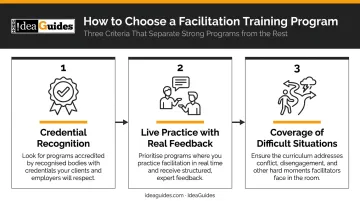
Selection was based on three criteria that matter specifically to organizational buyers — not individual learners.
1. Credential recognition. Programs either align with professional facilitation competencies, carry third-party endorsement (such as HLC's provider review for Voltage Control), or have established track records in the field. A completion certificate from a program with no external validation is a weaker organizational investment.
2. Live practice with real feedback. Facilitation is a practice skill. Every program on this list includes some form of live instruction and real-time feedback — not just video content. The one exception is self-paced introductory options, which are useful for awareness but not for capability development.
3. Coverage of difficult situations. Managing dominant voices, re-engaging low-participation groups, navigating conflict, and keeping sessions on track — these are where untrained facilitators consistently struggle. Programs that spend substantial curriculum time on these scenarios deliver more practical value than those that cover them briefly or not at all.
The Most Common Mistake HR Buyers Make
Selecting a program based on price-per-seat alone, without accounting for learner time, opportunity cost, and whether the program actually changes behavior on the job.
A $3,200 intensive that equips five managers to run 20 more productive workshops per year delivers far more organizational value than five $15 video courses that produce no behavior change. The math on facilitation training ROI needs to include what happens after the last session, not just what the invoice says.
Programs without post-program support tend to see skill degradation as facilitators return to workplaces that don't reinforce what they learned. When evaluating any program, look for:
- A peer community or alumni network for ongoing practice
- Reference materials or toolkits participants can use on the job
- Optional coaching or follow-up sessions after the core training ends
These aren't extras. For a serious L&D investment, they're what determine whether skills stick.
Conclusion
The right facilitation training depends on what you're trying to accomplish. Foundational vocabulary and awareness? Affordable self-paced options can cover that. Durable capability that actually changes how your teams run meetings, workshops, and strategic sessions requires live practice, instructor feedback, and structured ongoing reinforcement.
When evaluating any program, look past the curriculum outline to the instructor experience, the cohort design, and what support exists after the final session. A skilled facilitator who returns to a workplace without reinforcement structures will revert to old habits, regardless of how good the training was.
Organizations that want training built around their specific team dynamics and real work — not a generic program their staff sits through — can contact IdeaGuides to discuss a custom engagement built on over 25 years of professional facilitation experience.
Frequently Asked Questions
What is the best facilitation certification for HR professionals?
professionally endorsed programs like Voltage Control's certification offer the strongest external credibility and portable recognition. Leadership Strategies' Effective Facilitator is the better choice for professionals who need immediately applicable skills rather than a formal credential.
How long does a facilitation training course typically take?
Introductory video courses run 1–2 hours. Intensive bootcamp-style programs take 4 days. Comprehensive cohort certifications run 6 weeks to 3 months. Longer programs with live practice consistently produce more durable skill development than shorter ones.
Is online facilitation training as effective as in-person training?
Well-designed online cohort programs — those that preserve live practice and instructor feedback — are comparable to in-person training and carry the added benefit of developing virtual facilitation skills. Purely self-paced online courses are a weaker option for building real facilitation capability.
How much does facilitation training cost?
Self-paced introductory courses on platforms like Udemy typically run under $100 (prices vary due to frequent promotions). Mid-tier cohort programs range from $1,500–$3,200. Comprehensive certifications range from $3,000–$6,000+. Custom organizational training is priced separately based on team size and scope.
Do I need a certification to be a professional facilitator?
No. Certification adds external credibility and is useful for career advancement or client-facing work, but it isn't required to facilitate effectively. For HR and L&D leaders building internal team capability, training that produces actual behavior change matters more than the credential attached to it.
What is the difference between facilitation training and facilitation certification?
Training is the learning process of building facilitation skills. Certification is a formal credential awarded upon demonstrating competency — either through a program's requirements or an external body like the professional facilitation — but earning the credential and developing real capability aren't always the same thing.