Introduction
Most organizations waste more meeting time than they realize. McKinsey research found that 61% of executives consider at least half their decision-making time ineffective, and a separate Harvard Business Review analysis reported that 70% of meetings keep employees from productive work. The gap between a session that generates real breakthroughs and one that circles back to the same tired ideas usually comes down to one thing: facilitation.
Creative workshop facilitation is a purposeful process — one where a skilled facilitator guides a group through structured activities designed to unlock divergent thinking, surface ideas that wouldn't come up on their own, and convert those ideas into decisions people actually commit to.
What follows covers the core skills every creative facilitator needs, proven techniques for generating and prioritizing ideas, how to structure a session for real results, and when to bring in a professional rather than run things internally.
Key Takeaways
- Effective facilitation uses deliberate techniques to unlock group creativity, not just manage an agenda.
- Core skills include active listening, psychological safety creation, reading group dynamics, and managing divergent vs. convergent thinking.
- Effective workshops follow a five-stage arc: open, diverge, converge, commit, and close.
- Dominant voices, creative blocks, and flagging energy each have specific facilitation responses.
- Hiring a professional facilitator often separates incremental ideas from genuine breakthroughs.
What Is Creative Workshop Facilitation?
Standard meeting facilitation manages discussion flow and keeps a group on agenda. Creative workshop facilitation goes further: it adds intentional structure to unlock imagination, encourage risk-taking with ideas, and give participants multiple pathways to contribute beyond just talking.
As the professional facilitation community defines it, facilitation helps a group think together, explore options, and reach decisions while the facilitator designs and guides the process. The creative layer means that process is explicitly designed to generate ideas, not just manage conversation.
Where Creative Facilitation Adds the Most Value
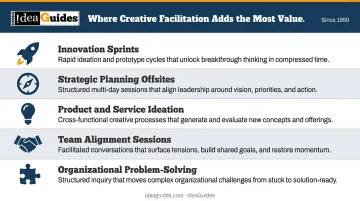
Organizations tend to see the highest return from professional creative facilitation in these contexts:
- Innovation sprints — Where speed of idea generation matters as much as quality
- Strategic planning offsites — Where leaders need to think beyond their operational day-to-day
- Product and service ideation — Where the goal is volume of options before selection
- Team alignment sessions — Especially after mergers, restructuring, or prolonged misalignment
- Organizational problem-solving — When internal attempts have stalled or recycled the same answers
The common thread: these are high-stakes moments where the quality of thinking directly shapes the quality of decisions. When the process is poorly designed, the cost shows up in weak decisions, stalled initiatives, and teams that leave the room no clearer than when they walked in.
Core Skills Every Creative Workshop Facilitator Needs
Active Listening and Probing Questions
Skilled creative facilitators don't just track what people say. They listen for the assumption or unmet need sitting underneath an idea. When a participant says "we need better internal communication," a surface-level facilitator nods and moves on. A skilled one asks: "What would change if that problem were solved? What's not happening now that should be?"
These layered questions are what surface insights that reshape the group's direction — not just add more content to the whiteboard.
Psychological Safety
Creative risk-taking only happens when people feel safe sharing imperfect ideas. Edmondson's foundational research on team psychological safety — linking safety to interpersonal risk-taking and speaking up — has been widely applied to facilitation contexts. In practice, this means:
- Establishing "no wrong answer" ground rules at the start
- Using anonymous idea-submission methods (sticky notes, written rounds) before open discussion
- Modeling openness yourself — facilitators who react neutrally to all ideas signal that it is safe to share
Reading and Adapting to Group Dynamics
Great creative facilitators adjust in real time. They notice when energy is flagging, when one voice is filling the room, or when a subgroup has mentally checked out. Noticing matters — but responding is the job.
That might mean switching from verbal discussion to silent brainwriting, splitting into breakout pairs, or calling a short break before a demanding activity. Facilitators who stick rigidly to their agenda regardless of what the room is telling them miss what's actually happening in front of them.
Managing Divergent and Convergent Thinking
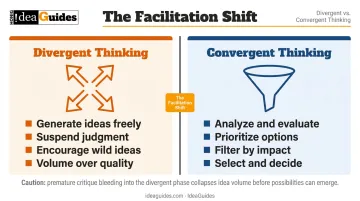
Creative workshops require the facilitator to deliberately shift between two modes:
- Divergent — generating as many ideas as possible without evaluation
- Convergent — analyzing, prioritizing, and deciding among options
The most common facilitation error is letting critique bleed into the divergent phase too early. When someone says "we tried that last year" during idea generation, the facilitator's job is to redirect — not evaluate — and protect the creative space until the group is ready to shift modes.
Neutrality with Genuine Energy
A creative facilitator stays neutral on content — they don't advocate for their own ideas — but brings real enthusiasm to the process. A flat, disengaged facilitator kills creative momentum even when the techniques are sound. Holding that balance — genuine energy without a personal stake in the outcome — is a practiced skill. Most facilitators develop it only after leading dozens of sessions and learning to separate their own preferences from the group's work.
Proven Creative Workshop Facilitation Techniques
Brainwriting and Silent Brainstorming
Open verbal brainstorming has a well-documented problem: the loudest voices shape the output before quieter participants have contributed. Brainwriting solves this by having everyone write ideas simultaneously (on sticky notes, paper, or a digital tool) before any discussion shapes individual thinking.
This is especially valuable in senior leadership teams, where hierarchy suppresses candid input. Studies on production blocking show that the one-speaker-at-a-time constraint is the primary driver of productivity loss in traditional brainstorm sessions — a finding that aligns with what experienced facilitators see in the room.
IdeaGuides uses brainwriting as a standard ideation tool, structuring participation formats that draw out both introverted and extroverted contributors before group discussion begins.
Visual Thinking and Collaborative Mapping
Making thinking visible changes how a group processes it. Mind maps, affinity diagrams, and sticky-note clustering let participants see patterns, connections, and gaps that stay invisible in purely verbal conversation. Graphic facilitation research consistently links visual representations to stronger shared meaning and group memory — and any experienced facilitator will tell you the same.
When 700 ideas end up on a wall (as happened in one BASF session IdeaGuides facilitated), clustering them into themes is the only way to make sense of the output. Visual tools make that possible.
"Yes, And" Improv-Based Building
Borrowed from improv theater, the "Yes, And" principle requires participants to affirm and build on an idea before redirecting or modifying it. Instead of "that won't work because...", the response becomes "yes, and we could extend that by..."
This creates a culture of additive creativity during the divergent phase, keeping early-stage ideas in play long enough to develop rather than letting reflexive critique close them down prematurely.
IdeaGuides' Play for Innovation program and retreat formats use improv exercises, including "Yes, And" games, to lower inhibitions and build collaborative momentum before deeper ideation work begins.
Perspective-Shift Exercises
Asking participants to approach a problem from an entirely different viewpoint breaks the cognitive patterns that generate the same ideas every session. Practical prompts include:
- "How would a first-time customer see this?"
- "What would we do if budget were no constraint?"
- "What would our most skeptical competitor say we're missing?"
Techniques like the "In-the-Shoe-Of" exercise and Walt Disney's three-role strategy (Dreamer, Realist, Critic) structure these shifts so they surface real blind spots rather than producing surface-level observations.
Dot Voting and Structured Prioritization
After a large divergent phase, groups need a fast, fair way to move from a large pool of ideas to a short list without letting debate dominate. Dot voting gives each participant a limited number of colored dots to allocate to their preferred ideas on the board. Preferences become visible immediately, and the group can see where energy naturally concentrates.
Dot voting is not a final decision ; it indicates preference and surfaces consensus areas. Skilled facilitators use it as one step in a structured convergence process, not as a substitute for judgment.
How to Structure a Creative Workshop Session for Maximum Impact
Opening and Psychological Contract
The opening is not housekeeping. It's where the facilitator sets the tone, establishes ground rules, and uses a brief warm-up activity to shift participants' mindsets from "work meeting mode" to "creative collaboration mode."
Effective ground rules for creative sessions typically include: defer judgment, encourage wild ideas, build on others' contributions, and stay focused on the question at hand. Co-creating these rules with the group — rather than presenting them as mandates — builds ownership of the session's norms from minute one.
Divergent Phase — Generating Without Limits
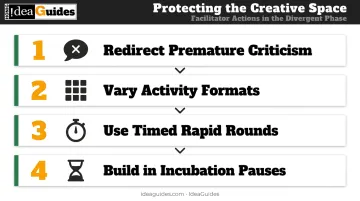
The facilitator's job during divergent thinking is to protect the creative space. That means:
- Redirecting premature criticism ("Let's capture that and come back to evaluation later")
- Keeping energy high through varied activity formats
- Using timed rounds and rapid-fire prompting to maintain volume and momentum
- Building in a short incubation pause — research shows brief intervals actually increase idea variety in the final push
Convergent Phase — Prioritizing What Matters
The transition from divergent to convergent is where many workshops lose their footing. Abrupt shifts ("OK, now which ones do we actually like?") create cognitive whiplash. Skilled facilitators bridge the modes with transitional language and structured tools that make narrowing feel collaborative rather than arbitrary.
Common convergent tools include:
- Dot voting — participants allocate a fixed number of votes across all ideas
- Impact-effort matrices — ideas plotted by feasibility vs. potential value
- Heat maps — visual clustering that surfaces consensus without debate
Action Planning — Turning Ideas into Commitments
Without this phase, even brilliant workshop outputs die in a slide deck. The goal is specific commitments: who does what, by when. Research on implementation intentions confirms that pairing goals with specific triggers — "I will do X when Y happens" — measurably improves follow-through compared to vague intentions. At IdeaGuides, explicit action planning is built into every session, and all commitments are captured in writing before participants leave the room.
Debrief and Close
A brief closing reflection — what worked, what surprised us, what we're taking away — serves two purposes: it reinforces learning and gives the facilitator concrete feedback for the next session. All session outputs should be documented and distributed promptly — before momentum fades.
Common Challenges in Creative Workshop Facilitation (and How to Overcome Them)
Dominant Voices and Quiet Participants
Unequal participation is the most predictable workshop problem. A few assertive voices shape the output while others disengage. Specific moves that address this:
- Switch to brainwriting before any open discussion, so ideas form independently before anyone can anchor the group
- Use small breakout pairs or trios before full-group sharing to lower the social risk
- Deploy anonymous submission methods: sticky notes, written rounds, or digital tools
- Invite quieter participants directly but warmly: "We haven't heard from this side of the room yet"
IdeaGuides trains facilitators in their Leading Effective Meetings program specifically on managing dominating personalities, silent participants, and other difficult dynamics — treating it as a core competency, not an edge case.
Creative Blocks and "We've Tried This Before" Resistance
When a group hits a wall or cynicism creeps in, experienced facilitators don't push harder on the same approach. Instead:
- Reframe the problem statement. A problem well-defined is often a problem half-solved
- Introduce a constraint like "What would we do if we could only spend $500?" to force new pathways
- Run a perspective-shift exercise to approach the challenge from an unexpected viewpoint
- Build in an incubation break — brief pauses consistently yield more ideas across more categories
The "Blocks/Unblock Game" in IdeaGuides' Creative Thinking training surfaces and dismantles exactly these mental barriers, helping groups move past the recycled-idea loop.
Energy Management and Pacing
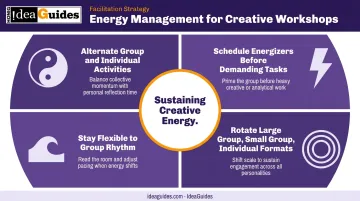
Creative workshops require sustained cognitive energy, and poorly paced sessions generate low-quality ideas in the back half. Effective pacing strategies:
- Alternate high-energy group activities with quieter individual reflection
- Schedule energizers before cognitively demanding tasks, not after
- Build in format variety: rotating between large group, small group, and individual modes
- Keep the schedule flexible enough to respond to the group's actual rhythm, not just the planned agenda
When to Bring in a Professional Creative Workshop Facilitator
An internal leader facilitating their own team faces an inherent structural problem: they are simultaneously a participant with opinions, authority, and relationships. That dual role — no matter how skilled the leader — creates dynamics that suppress candid input and bias outcomes toward the facilitator's preferred direction.
Signs an External Facilitator Is the Right Call
- The session involves high-stakes decisions (strategic pivots, organizational change, major product directions)
- Internal facilitators are too close to the content to remain genuinely neutral
- Previous internal sessions have failed to produce actionable outcomes or have recycled the same impasse
- The group needs a fresh perspective to break through recurring creative blocks
- The leader's full participation as a contributor would add more value than their facilitation
What Professional Facilitators Bring
- Genuine neutrality — no agenda, no positional authority, no organizational relationships that skew participation
- Deep technique repertoire — hundreds of facilitation tools matched to the group and problem
- The leader's full presence — when a professional runs the session, the most senior voices in the room can focus entirely on contributing, not managing
- Ability to manage difficult dynamics without political risk — redirecting a dominant voice or surfacing a dissenting perspective is far easier for a neutral external party
IdeaGuides has spent over 25 years providing exactly this for organizations ranging from Fortune 500 companies to nonprofits and government agencies. Their team of certified master facilitators and experienced facilitators has completed 250+ projects for 150+ clients across industries.
Every engagement is designed around the client's specific goals, group dynamics, and context — starting with stakeholder interviews before a single agenda item is set.
Their tagline, "More great ideas per minute, guaranteed," reflects methodology as much as confidence: a structured four-phase ideation process and a toolkit drawn from Synectics, Creative Problem Solving, and Design Thinking, backed by a track record that includes a BASF session where the group generated over 700 initial ideas and converged to 22 final concepts.
Frequently Asked Questions
What is creative facilitation?
Creative facilitation is a guided group process that uses intentional techniques to inspire divergent thinking, ensure all voices contribute, and produce actionable ideas. It differs from standard meeting facilitation by its emphasis on creativity, multiple modes of expression (visual, verbal, written), and deliberate separation of idea generation from evaluation.
What are the 4 C's of facilitation?
One practical framework describes four elements skilled facilitators attend to simultaneously: Content (what's being discussed), Context (the environment and session purpose), Conversation (the quality of dialogue and interaction), and Collaboration (how effectively the group works toward shared outcomes). Note that no single canonical "4 C's" exists in professional facilitation standards — different practitioners frame this differently.
How much do creative workshop facilitators charge?
Pricing varies widely based on session length, group size, preparation required, and facilitator experience. Professional facilitation firms typically price by the day or half-day, with travel, customization depth, and post-session documentation affecting the final cost. The more useful measure is what better decisions and faster idea cycles are worth to your organization.
What is the difference between a facilitator and a trainer?
A trainer delivers content and teaches participants new knowledge or skills. A facilitator guides a group's own thinking process to generate ideas, solve problems, or reach decisions — not inject their own expertise into the substance. Creative workshop facilitators often draw on both skill sets when designing sessions.
How do you encourage participation in a creative workshop?
The most effective tactics: establish psychological safety through clear ground rules at the start, use brainwriting instead of verbal-only brainstorming, break into small groups before full-group sharing, and use anonymous contribution methods like sticky notes. These all reduce the social risk of sharing an idea publicly — which is the primary participation barrier in most groups.
When should an organization hire a professional creative workshop facilitator?
When the session involves high-stakes decisions, when internal leaders are too close to the topic to stay neutral, when previous sessions have produced the same impasse, or when the group needs an outside perspective and fresh facilitation techniques to unlock genuine creative output.