Introduction
Most organizations can describe what they do. Far fewer can clearly articulate who they're for, why they're different, or what makes their brand worth choosing. That gap between knowing your product and owning your position costs companies customers, alignment, and momentum.
A brand positioning workshop is one of the most direct ways to close it. But results vary enormously. Two teams can follow the same agenda and arrive at completely different outcomes depending on how the session is structured, who's in the room, and whether the right preparation happened beforehand.
This article covers what you need to know to run one well:
- What a brand positioning workshop actually involves
- What to prepare before the session
- A step-by-step process for running it
- The variables that determine whether it works
- The most common ways these sessions go wrong
Key Takeaways
- A brand positioning workshop is a structured, facilitated session to align stakeholders on target audience, core differentiators, and market position
- Effective workshops require real customer data and competitive research before anyone enters the room
- The session follows a deliberate sequence: customer insights, competitive mapping, then positioning statement drafting
- Outputs include a positioning statement, brand personality, brand promise, and a testing plan
- Facilitation quality and input honesty matter as much as the agenda itself
What Is a Brand Positioning Workshop (and When Do You Need One)?
A brand positioning workshop is a facilitated, goal-driven session that brings key stakeholders together to agree on how a brand communicates its unique value. It covers the target audience, competitive frame of reference, brand essence, promise, personality, and proof points.
Unlike a general brainstorm or design sprint, it produces a shared, documented positioning framework that guides how the brand shows up — internally and externally.
When You Need One
Several situations signal that a workshop is overdue:
- Launching or relaunching a brand
- Entering a new market or competitive category
- Responding to competitive pressure that's eroding differentiation
- Noticing that messaging has drifted across teams and channels
- Experiencing internal disagreement about the brand's direction
- Preparing for a significant growth phase or fundraising round
When a Workshop Is NOT the Right Move
Positioning work has prerequisites. A workshop is premature if:
- Foundational customer and competitive research doesn't yet exist
- Leadership buy-in is absent — workshop outputs rarely survive without executive ownership
- The team expects a half-day session to replace months of strategic work
Brand positioning is high-stakes work. Skipping these prerequisites often means spending a full day in a room reaching consensus on a framework that the market — and your own customers — won't recognize.
What to Prepare Before Your Brand Positioning Workshop
Preparation shapes the quality of every decision made during the session. A workshop built on internal assumptions produces positioning built on guesses.
Two critical pre-work inputs make the difference:
- A pre-session questionnaire sent to all attendees before the session — surfaces individual thinking on the brand's direction before people get into a room together, reducing the risk of groupthink or deference to whoever speaks first
- Existing customer research or data — interview findings, survey results, win/loss analysis, or any direct customer language that captures how buyers actually talk about the problem and the alternatives they consider
Stakeholder Invite List and Room Composition
Most practitioners recommend 6–15 attendees drawn from:
- Senior leadership
- Marketing and communications
- Sales (who hear customer objections firsthand)
- Any team member who regularly shapes brand communications or interacts with customers
Too large a group makes consensus difficult. Too small a group risks blind spots, especially if no one in the room regularly talks to customers.
Once you've settled on who's in the room, decide who's running it.
Choosing a Facilitator
A good facilitator does more than keep time. Their core responsibilities include:
- Managing group dynamics and preventing dominant voices from taking over
- Drawing out uncomfortable truths that participants might not raise on their own
- Guiding the group from divergent input toward concrete, shared decisions
When an internal leader — often the CEO or CMO — runs the session, their views inevitably shape the outcome. Other participants self-censor. The positioning reflects one person's perspective, not the group's best collective thinking.
An external facilitator sidesteps this problem. IdeaGuides, for example, uses structured techniques like brainwriting and nominal group technique to make sure quieter voices carry as much weight as the loudest ones in the room — a deliberate design choice, not an afterthought.
How to Run a Brand Positioning Workshop Step by Step
A brand positioning workshop follows a deliberate sequence. Each step builds on the one before. Skipping ahead (say, drafting the positioning statement before mapping the competitive landscape) undermines the quality of everything that follows.
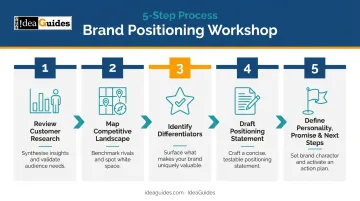
Step 1: Review Customer Research and Define Target Audience
Open with the customer data. Present survey results, interview findings, or voice-of-customer language at the start so every decision that follows is grounded in market reality rather than internal assumption.
Guide participants to:
- Identify which customer segments the brand serves best
- Define what those customers most care about: functional needs, emotional drivers, and aspirational goals
- Distinguish between customers the brand currently serves and customers it most wants to serve (these often differ)
This distinction matters. Many positioning workshops default to describing who the brand has historically served rather than making a deliberate choice about who it should serve.
Step 2: Map the Competitive Landscape
List every real alternative a prospective customer might consider, including doing nothing or solving the problem in-house. For each competitor, capture:
- What they are genuinely known for in the market
- Who they are best suited for, based on observable market behavior
Use a visual tool such as a positioning map or the Blue Ocean Strategy Canvas to show where competitors cluster, where open space exists, and where the brand currently sits versus where it could own a more differentiated position.
The goal is an honest read of the landscape, not a critique of competitors.
Step 3: Identify Differentiators and Proof Points
Guide participants to articulate what the brand does that competitors cannot easily replicate : not just features, but the specific value those features deliver for the target customer. Cross-reference against the competitive map. If a claimed differentiator is already owned by a competitor, it's a parity point, not a differentiator.
For each real differentiator, identify the corresponding reasons to believe — concrete, verifiable proof points that make the claim credible to a skeptical buyer:
- Case study results and client outcomes
- Credentials, certifications, or track record
- Third-party validation a customer could independently verify
Step 4: Draft the Positioning Statement
The positioning statement is an internal alignment tool, not a tagline. A useful structure, adapted from Geoffrey Moore's positioning template:
For [specific audience] who [need or goal], [brand] is the [category] that delivers [key differentiator], supported by [specific reasons to believe].
Have the group write two or three variations before settling on one. Test each against the actual customer language gathered in pre-work. The right version should sound like something a real customer would recognize as true, not something only the marketing team would say about itself.
Step 5: Define Brand Personality, Promise, and Next Steps
Once the positioning statement is agreed upon:
- Brand personality — How the brand speaks, what tone it takes across touchpoints
- Brand promise — The consistent experience customers can expect
- Brand archetype (optional) — A useful shorthand for keeping communications consistent
Close by defining how the positioning will be tested before full rollout:
- Share it with a customer subset for gut-check feedback
- Use it in live sales conversations and measure the response
- Review it with frontline teams who will carry the message daily
Assign clear ownership for the post-workshop deliverables document. Without an owner, the outputs stay in a folder.
That documentation discipline is where many workshops fall short. IdeaGuides structures its messaging workshops around a similar five-phase sequence: corporate profile, customer profile, product/service profile, media profile, and unified message creation. A formal written report is delivered at the end so the decisions made in the room don't evaporate once participants leave.
Key Variables That Determine Workshop Outcomes
Two organizations can follow the same workshop agenda and arrive at dramatically different results. The quality of inputs, the honesty of participants, and the skill of facilitation shape everything.
Pre-Work and Research Quality
Workshops built on real customer data — actual language, actual objections, actual comparisons buyers make — produce positioning that resonates. Workshops built on internal assumptions produce positioning that sounds good internally but falls flat externally. Practitioners consistently treat customer interviews and data synthesis as essential prerequisites.
How Specifically You've Defined the Target Audience
Broad positioning that tries to serve everyone resonates with no one. The more specifically the group can define who the brand is for — including what makes ideal customers different from merely acceptable ones — the more differentiated and defensible the positioning becomes.
Willingness to Acknowledge Competitive Reality
A workshop that avoids hard truths about where competitors have already earned credibility will produce positioning the brand cannot legitimately own. Research on group decision-making confirms that surfacing dissent and divergent evidence improves decision quality. A process that actively invites uncomfortable truths produces better strategic outcomes than one that defaults to consensus comfort.
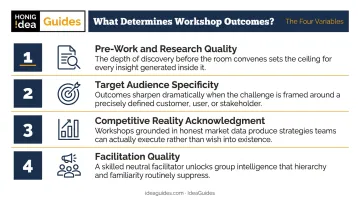
Facilitation Quality and Group Process
Even well-prepared teams with strong inputs can produce weak positioning when a few voices dominate or when the group confuses alignment with true consensus. A skilled facilitator manages those dynamics — using structured techniques to ensure all perspectives surface, then guiding the group from divergent thinking to convergent decisions.
Common Mistakes That Derail Brand Positioning Workshops
Skipping Customer and Competitive Research
Starting with internal opinions rather than market data is the most common and costly mistake. When participants argue from gut feeling rather than evidence, the session becomes a battle of preferences rather than a strategic exercise.
The fix: make pre-work non-negotiable. No research, no workshop — or at minimum, delay the session until foundational inputs exist.
Treating the Positioning Statement as the Final Output
A polished positioning statement sitting in a slide deck changes nothing. Organizations that stop at the statement — without activating it — will find it has little impact on how the brand actually shows up in the market.
The real work starts after the session ends. That means:
- Testing the statement with target customers
- Sharing it internally so teams can align around it
- Building a messaging hierarchy from it
- Reviewing it against real sales conversations to check fit
Running the Session Without a Neutral Facilitator
When a senior internal leader runs the workshop, other participants defer. The positioning reflects one person's perspective, and everyone else has implicitly agreed. The room reaches agreement, but not through genuine alignment.
External facilitation removes that dynamic. Research on neutral facilitation shows that impartial facilitators improve trust and perceived potency in group sessions. A facilitator with no stake in the outcome gets more candor from participants — and that candor is what makes the final positioning decision stick.
Frequently Asked Questions
What are the 3 C's of brand positioning?
The 3 C's are Customers, Competitors, and Company — the three lenses through which a brand must evaluate its position. Effective positioning is relevant to the audience, differentiated from rivals, and authentic to what the organization can actually deliver.
What are the 5 C's of brand positioning?
The 5 C's extend the framework to include Company, Customers, Competitors, Collaborators, and Context (or Climate). The additions bring in market environment and partnerships, giving a broader view of how a brand can realistically position itself.
What are the 4 P's of brand positioning?
The 4 P's — Product, Price, Place, Promotion — are the traditional marketing mix framework. They inform how positioning is expressed across touchpoints, but positioning strategy must come first before the 4 P's can be applied effectively.
What is the 3-7-27 rule in branding?
The 3-7-27 rule suggests customers need roughly 3 exposures to recognize a brand, 7 to remember it, and 27 to develop a preference. That means positioning must be consistent and repeated over time — one message, delivered once, won't build lasting recognition.
How long does a brand positioning workshop typically take?
Most workshops run as a half-day to full-day session. From pre-work through post-workshop deliverables, the full process typically spans four to six weeks.
How many people should attend a brand positioning workshop?
Most practitioners recommend 6 to 15 attendees, representing leadership, marketing, and sales without making consensus building unmanageable. Quality of representation matters more than group size.