Introduction
Here's a pattern most teams recognize: the retreat ends on a high, everyone drives home energized, and by Wednesday the next week, nothing has changed.
That's a design problem. Most offsites are built around fun, not outcomes — activities get booked before anyone defines what the team actually needs to achieve.
According to McKinsey, disengagement combined with attrition costs a median-size S&P 500 company between $228M and $355M annually. That's the cost of teams that aren't aligned, communicating well, or pulling in the same direction.
This guide covers what actually makes a team building retreat work — structure, the right activity mix by category, professional facilitation, and how to sustain gains after everyone heads home. Whether you're planning your first offsite or rebuilding one that's lost its impact, the difference comes down to intentional design from the start.
Key Takeaways
- Retreats succeed through clear intention, structure, and facilitation — not activities alone.
- Start with one clear goal (communication, trust, alignment, innovation) before choosing a single activity.
- Strong agendas balance strategic work sessions with genuine human connection activities.
- Structured debriefs improve team effectiveness by approximately 20–25%.
- Professional facilitation frees leaders to participate fully, rather than run the room.
Why Your Team Needs a Building Retreat
Regular meetings keep operations moving, but they rarely shift how people relate to each other. The same voices dominate. The same dynamics repeat. Hierarchy stays intact.
Retreats work differently. Removing people from their usual environment breaks habitual communication patterns and creates room for honest conversation that doesn't happen across a conference table — with a full inbox visible on everyone's screen.
When Retreats Matter Most
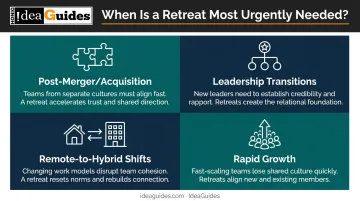
Some organizations need retreats regularly. Others need them urgently at specific moments:
- Post-merger or acquisition — "us vs. them" dynamics don't resolve on their own. IdeaGuides worked with Dow AgroSciences during a company integration; the general manager said it "helped reduce the 'us and them' to 'we,' increased optimism and teamwork, and built confidence regarding the direction of the company."
- Leadership transitions — new leaders need to establish trust quickly; their teams need clarity on direction and norms.
- Remote-to-hybrid shifts — distributed teams lose the informal connection that offices provide naturally. Research involving 110 participants across 13 countries found intentional social rituals were key to maintaining team bonds.
- Rapid growth — scaling fast often means adding people faster than culture can absorb them.
Gallup's meta-analysis links top-quartile engagement to 23% higher profitability and 18% higher sales productivity compared to the bottom quartile. That kind of performance doesn't happen by accident — it's built deliberately.
What Makes a Team Building Retreat Actually Work
Gathering people in a nice location is not team building. Neither is an escape room with no debrief, or a dinner that never gets past small talk.
Effective retreats require three things working together:
- Intention — a defined primary goal before any activity gets chosen
- Structure — an agenda where each block maps to an outcome
- Facilitation — someone guiding participation and extracting real learning from the experience
The Intention Problem
Most retreat planning starts in the wrong place. Someone books a venue, then looks for activities to fill the schedule. The question that should come first is: What does this team need to achieve?
The answer should be specific. Not "team building" — that's too vague. Something like:
- Rebuild trust after a restructure
- Break down communication silos between product and sales
- Generate aligned strategy for the next 18 months
- Integrate two teams from a recent acquisition
Every session and activity should then connect back to that goal. If you can't explain why an activity made the agenda, it probably shouldn't be there.
The Structure Problem
A well-structured retreat isn't just a tighter schedule. It's intentional sequencing — mixing high-energy activities with reflection time, and strategic sessions with relationship-building moments.
That sequencing is backed by evidence. A controlled meta-analysis of 72 interventions and 8,439 participants found effect sizes of d=0.683 on teamwork and d=0.919 on performance — with experiential, practice-based formats outperforming lecture-only content. That's the difference between talking about communication and actually practicing it under real conditions.
The same research identified four mechanisms that drive measurable team-building outcomes:
- Goal setting — shared clarity on what the team is working toward
- Role clarification — understanding who owns what and why
- Interpersonal relationship work — building the trust that makes collaboration possible
- Problem solving — practicing decisions together under realistic conditions
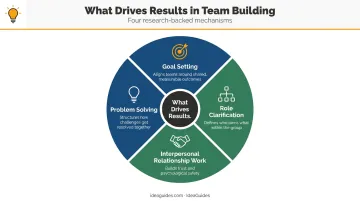
Activities that address at least one of these mechanisms earn their place on the agenda. Those that don't are just filler.
How to Structure a Team Building Retreat
Before the Retreat: The Diagnostic Step
Survey and interview team members before the retreat. This isn't just a courtesy — it surfaces friction points, hidden priorities, and communication gaps that a single planning conversation with leadership would miss.
IdeaGuides conducts interviews with multiple stakeholders before every retreat engagement, including confidential individual interviews when team dynamics are a concern. The result is an agenda that fits the team's actual needs, not a planner's assumptions. As one client put it: "Bruce was a great guide to our work, while allowing our needs to be heard and drive the agenda for the day."
Surveys also give participants a sense of ownership before they arrive. They've contributed to the agenda. They're not walking into someone else's plan.
A Sample One-Day Retreat Arc
This structure works for focused, single-day retreats:
- Opening connection activity (30–45 min) — low-stakes, breaks the formality, levels the room
- Facilitated goal-setting or strategic session (90 min) — the substantive work
- Team-building activity tied to session themes (60–90 min) — experiential, debriefed
- Lunch with cross-department mixing — intentional seating, not self-selected
- Afternoon workshop or breakout (60 min) — smaller groups, different voices
- Reflection and closing circle (30 min) — commitments, next steps, follow-up plan
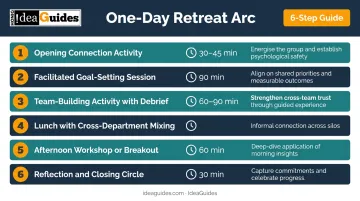
Multi-day retreats expand this arc. Days two and three allow deeper relationship-building, more ambitious programming, and space for ideas to develop overnight before the group reconvenes.
Designing Breakout Groups
Don't let people self-select. Teams always cluster with familiar colleagues, which defeats the purpose. Mix departments, tenures, and seniority levels deliberately. World Café — one of the methodologies IdeaGuides uses regularly — rotates participants across tables and conversations naturally, cutting across hierarchical and departmental lines.
Ohio State University reported "significant cross-disciplinary discussion, alignment, and outcomes" from a facilitated IdeaGuides session — a direct result of intentional group design, not accidental chemistry.
The Closing Ritual
Every retreat needs a structured ending. Not a wrap-up speech — a debrief with specific commitments. That means naming what shifted, agreeing on what changes, and assigning ownership of each next step before anyone leaves the room.
Research across 46 samples found that properly conducted debriefs improved team effectiveness by approximately 20–25%. The closing ritual is where that gain gets captured — or lost.
Best Team Building Retreat Activity Ideas by Category
One principle before diving into specific activities: the best activity is the one that matches your team's current need. Use the goal you've defined to filter which category fits — then pick within that category.
Facilitated Workshops and Innovation Sessions
These are the highest-ROI activities on a retreat agenda. Structured group sessions guided by a skilled facilitator tackle real business challenges: strategic alignment, communication styles, problem-solving on live issues — while simultaneously building the relational fabric of the team.
Formats worth knowing:
- World Café — small-group rotating conversations that surface collective intelligence across a large room
- Open Space Technology — participant-driven dialogue where the most pressing priorities emerge organically
- Design thinking sprints — structured creative problem-solving against a real challenge
IdeaGuides' facilitator Ken Homer specializes in Open Space Technology and World Café for large groups. Dave Blum, IdeaGuides' Treasure Hunt Maven, brings a different energy through experiential activities built around navigation, communication, and active problem-solving outside the conference room.
The key is debrief. Without it, even the best workshop loses its lasting impact.
Outdoor and Adventure Activities
Common formats include:
- Hiking or nature walks
- Ropes courses and challenge elements
- Kayaking or paddleboarding
- Charity bike builds
- Field day competitions
These all work for similar reasons: they remove hierarchy, create natural opportunities for informal conversation, and put people in situations where collaboration is visible.
Outdoor activities work best when someone connects the experience back to workplace behavior afterward. "What did it take to navigate that challenge together, and where do we do the same thing at work?" That question transforms an enjoyable afternoon into a reference point the team can return to.
Creative and Experiential Activities
These lower social defenses and reveal different sides of team members:
- Escape rooms — natural pressure test for problem-solving and leadership styles under time constraints
- Cooking or mixology classes — collaborative, informal, no hierarchy in the kitchen
- Treasure hunts — navigation, communication, active team coordination in a city or venue
- Art or mural projects — especially powerful with a give-back element, such as donating the work to a local organization
These scale across team sizes and industries. A 12-person startup and a 200-person corporate department can both run a cooking competition effectively.
Volunteer and Community-Based Activities
Volunteer activities are uniquely powerful for team building. Research analyzing 53,000 employee responses across hundreds of businesses found that collective company-sponsored volunteering specifically supports coworker bonding — more so than individual volunteer service. The mechanism matters: shared purpose, equal footing, and an emotional anchor that participants remember long after the retreat ends.

Options to consider:
- Food bank or meal prep shifts
- Habitat for Humanity builds
- Animal shelter support
- Community beautification projects
Volunteering aligns retreat activities with company values, which strengthens culture rather than just programming.
Social and Culinary Experiences
Cooking competitions, chili cook-offs, progressive dinners, or a team-curated playlist dinner (each person submits a song meaningful to them; the group guesses who submitted what) — these create connection between heavier strategic sessions.
The informal moments on a retreat often do as much relational work as the structured ones. They're the conversations people remember and reference for months. Schedule them intentionally, especially for evening programming.
The Role of Professional Facilitation in Retreat Success
What a Facilitator Actually Does
A facilitator holds the process — agenda, time, participation balance, group dynamics — so that all participants, including the leader, can be fully present in the content.
That's the key distinction. When a team leader runs a retreat, they're simultaneously managing logistics, watching the clock, monitoring group energy, and trying to contribute ideas. That split focus diminishes both their leadership and their thinking. With a professional facilitator, the leader sits alongside their team and engages as a peer.
IdeaGuides describes this directly: "A professional facilitator frees the entire team, including the leader, to be a contributing participant."
What to Look For in a Facilitator
Not every facilitator is suited to every retreat. Evaluate candidates on:
- Pre-retreat process — do they conduct stakeholder interviews and surveys before designing the agenda? Or do they show up with a template?
- Methodological range — a single facilitation technique rarely fits all situations. Look for someone who can adapt in real time
- Neutrality — critical for retreats addressing conflict, post-merger integration, or cultural change, where a stake in the outcome changes the conversation
- professional facilitation credentials — the professional facilitation community defines six professional competency domains, from collaborative client relationships to guidance toward actionable outcomes. These are meaningful selection criteria
IdeaGuides' team of seasoned facilitators, with over 25 years of experience across 150+ clients, brings this level of customization to every engagement. The pre-retreat consultation process (interviews, surveys, and collaborative agenda refinement) is built into every engagement.
When DIY Facilitation Works
Not every retreat needs an outside facilitator. Internal facilitation works well for:
- Smaller, lower-stakes retreats with clear, uncontroversial agendas
- Team retrospectives with an experienced internal lead
- Department planning sessions where alignment is already strong
For retreats addressing conflict, major strategic pivots, cultural integration, or leadership transitions, bring in someone external. Neutrality matters more than convenience in those situations — and the psychological safety that comes with a neutral facilitator produces more honest conversation.
How to Sustain Team Gains After the Retreat
The 48 hours after a retreat are critical.
Within 48 hours:
- Circulate a shared document of commitments, decisions, and next steps made during the retreat
- Assign an owner and a deadline to each item
- Schedule a 30-day check-in meeting before anyone forgets
IdeaGuides provides a meeting output report after facilitated sessions — a documented record of what was decided, generated, and agreed to. That document becomes your go-to anchor for follow-up conversations.
Over the following quarter:
- Use icebreakers or check-in formats from the retreat as recurring meeting openers
- Revisit team agreements made at the retreat during quarterly reviews
- Celebrate wins that trace back to retreat-sparked ideas or relationships — this signals that the retreat was a beginning, not a standalone event
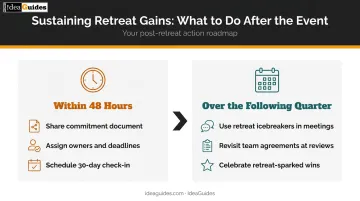
Those quarterly habits are what make the difference between a retreat that fades and one that compounds. Gallup research identifies meaningful recurring manager conversations as a central driver of sustained engagement — and one well-designed retreat can't substitute for that consistency. What it can do is give your team shared language, agreements, and experiences to draw on every time you check in.
Frequently Asked Questions
How do you structure a team retreat?
Effective retreats follow a clear arc: pre-retreat goal-setting and stakeholder surveys, an opening connection activity, facilitated strategic or team-building sessions, intentional downtime, and a structured closing debrief with committed next steps. Each time block should map to a specific outcome — not just "free time" or "workshop."
What activities do you do at a work retreat?
The main categories are facilitated workshops, outdoor or adventure activities, creative experiences (escape rooms, treasure hunts, cooking classes), volunteer activities, and social or culinary events. The right choice depends on your team's specific goal — not which activity is most popular or easiest to book.
What is a team-building retreat?
A team-building retreat is a structured, intentional offsite event designed to strengthen communication, trust, and collaboration across a team. It differs from a standard company offsite in that team development is the primary goal — not a side benefit of getting people in the same room.
How long should a team building retreat be?
One-day retreats work for focused workshops or smaller teams with a specific agenda. Two- to three-day retreats allow for deeper relationship-building and more ambitious programming. The right length depends on your goals, budget, and how distributed your participants are — start there, not with a number.
How do you measure the success of a team retreat?
Track whether retreat commitments are acted on in the weeks following the event. Monitor changes in team communication and engagement over the following quarter. Collect participant feedback within one week — if nothing observable changed, revisit the agenda structure and facilitation approach before the next retreat.