Introduction
Most teams return from a corporate retreat energized — and within two weeks, old habits resurface. The silos rebuild. Communication stays shallow. The "big ideas" from the offsite gather dust in someone's notes.
What separates a forgettable outing from one that actually changes how a team works is the intentionality behind the design — not the venue or the budget.
Gallup's research shows only 20% of employees worldwide are engaged at work, costing the global economy an estimated $10 trillion in lost productivity. Well-designed team interventions, retreats included, address specific drivers of that disengagement — but only when they're built around clear goals, a thoughtful sequence, and real follow-through.
This article covers high-impact corporate retreat ideas organized by purpose, plus a practical framework for sequencing and planning them so the investment actually sticks.
Key Takeaways
- Effective retreats combine icebreakers, collaborative challenges, creative experiences, and skilled facilitation to produce real outcomes
- Activity sequence matters: start with connection, move into trust and collaboration, close with strategy
- Anchor every retreat to a specific goal: improving communication, breaking silos, or aligning on direction
- Debriefing after activities is the most-skipped step — and one of the most valuable
- Professional facilitation turns good activities into lasting, actionable team change
What Makes a Corporate Retreat Actually Work
Team Bonding vs. Team Building
These terms get used interchangeably. They're not the same thing, and that distinction is where many retreat plans go wrong.
Team bonding is informal and relationship-focused: shared meals, social activities, casual conversation. It builds familiarity and goodwill. Team building is structured and goal-oriented: it targets specific skills, surfaces real team dynamics, and produces behavioral change. Effective retreats typically weave both together, with bonding creating the conditions for building to land.
Why Generic Activities Fall Short
Off-the-shelf retreat packages tend to prioritize entertainment over outcomes. They skip two things that matter most:
- Psychological safety — Without it, people perform rather than engage. Amy Edmondson's foundational research across 51 work teams found that psychological safety directly enables learning behavior, which in turn drives team performance.
- The debrief — A meta-analysis of 46 samples covering 2,136 participants found that properly structured debriefs improved team effectiveness by roughly 20–25%. Most retreats skip this step entirely.
Intentional Retreat Design
The mindset shift that separates retreats producing lasting change from those producing a one-day morale bump: start with a goal, then select activities that serve it.
Is this team dealing with communication breakdowns across departments? Post-merger culture clash? A strategy that needs buy-in from people who weren't in the room when it was written? Each scenario calls for a different design.
IdeaGuides, for example, conducts stakeholder interviews and surveys before every retreat — not to fill out a form, but to build an agenda that fits the team's actual situation rather than a generic template.
Best Corporate Retreat Ideas for Effective Team Building
The activities below are organized by primary purpose — connection, collaboration, creativity, and strategic alignment. Most effective retreats combine two or three categories rather than staying in one lane.
Icebreaker and Connection Activities
Icebreakers serve a specific function: they reduce social friction, help participants show up as people rather than job titles, and establish the psychological safety needed for deeper work later. They belong at the start of any retreat.
Three formats that work reliably:
- Human Bingo — Customizable, travel-friendly, gets people talking across departments without the awkwardness of forced introductions. The competitive structure gives people permission to approach strangers.
- Two Truths and a Lie — No materials required, works for any group size. More importantly, it builds empathy and listening in a format that feels low-stakes.
- Personal Artifact Sharing — Each person brings one item representing something outside of work. The conversations that follow are often the most memorable of the entire retreat because they reveal the whole person, not just the colleague.
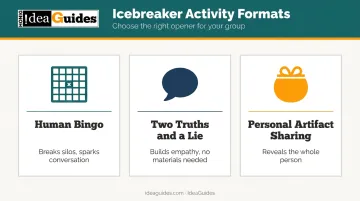
None of these require elaborate setup — and that's the point. What matters is the openness they create before the harder work begins.
Creative Problem-Solving Challenges
These activities require real teamwork while feeling engaging rather than high-pressure. They're where cross-departmental mixing and natural leadership emergence happen organically.
Indoor formats:
- Escape Room — Reveals how people communicate under pressure and who steps into leadership naturally. Works especially well for cross-functional groups who don't normally collaborate.
- Marshmallow/Tower Building Challenge — Rapid prototyping mindset. Teams quickly learn that planning without testing doesn't work — a lesson that transfers directly to how they approach projects at work.
- Silent Line-Up — Coordination without verbal communication. Surfaces assumptions about hierarchy and disrupts typical power dynamics in ways that spark real conversation afterward.
Outdoor formats:
- Scavenger Hunt — Collaborative, competitive, adaptable to any city or destination. IdeaGuides' Dave Blum, author of Dr. Clue Build-A-Treasure-Hunt, specializes in designing customized treasure hunt experiences that build team cohesion through clue-solving and structured exploration — including company-specific or location-specific content.
- Cardboard Boat Building — Resource constraints, creative thinking, and a memorable shared outcome (especially if something sinks). High energy, high recall.
Outdoor and Adventure Activities
Research published in the Journal of Environmental Psychology confirms that natural environments reduce cognitive fatigue and improve emotional regulation — which is why people have more authentic conversations on a trail than in a conference room. A 2024 corporate case study found psychological capital improvements in 8 of 9 participants following a five-day outdoor program.
Activity options by fitness level and group size:
- Guided hike or nature walk with facilitated debrief — Accessible, reflective, works for almost any group. The walking itself opens up conversation differently than sitting across a table.
- Kayaking or group cycling — Builds shared physical experience and genuine camaraderie. Choose based on your group's comfort and fitness range.
- Field Day / Team Olympics — Relay races, trivia rounds, creative team challenges. Highly customizable, inclusive across fitness levels, and reliably fun.
The key: offer varying intensity levels so the full team can participate meaningfully. An outdoor activity that excludes a third of your people defeats its own purpose.
Facilitated Strategic and Learning Sessions
Not every valuable retreat moment involves movement or competition. Structured conversations — when properly facilitated — often produce the most durable outcomes. Here's what that looks like in practice:
- World Café — Structured conversational process for large groups. Participants rotate between discussion tables, cross-pollinating ideas across the group. IdeaGuides' Ken Homer and Ray Madaghiele both specialize in this methodology, particularly for large, cross-functional groups navigating complex challenges.
- Business Case Study Workshops — Teams solve real or realistic company challenges together. Strategic thinking applied in a collaborative, lower-stakes setting — useful for stress-testing decisions before they matter.
- Skill-building through improv or cooking — Shared learning experiences that lower defenses. Improv in particular builds listening, spontaneity, and psychological safety. IdeaGuides' Play for Innovation sessions use exactly this format — combining improv games with creativity challenges for groups of 5–50 participants.
The common thread in effective strategic sessions: a facilitator manages process while leaders engage in content. When the team leader has to run the session, they can't fully participate in it.
How to Sequence Your Retreat Activities for Maximum Impact
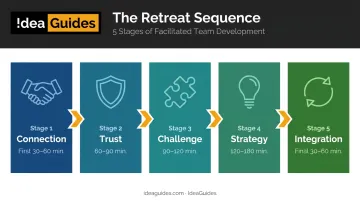
The order of activities is as important as the activities themselves. Most effective retreats follow a recognizable arc:
Connection → Trust → Challenge → Strategy → Integration
Jumping into high-stakes problem-solving before people feel comfortable together typically backfires. Here's how to structure it:
Opening (first 30–60 minutes): Start with a low-stakes, non-competitive connection activity. The goal is psychological safety — the foundation everything else depends on. Human Bingo or personal artifact sharing works well here.
Middle of the retreat: Layer in collaborative challenge activities — indoor problem-solving, outdoor experiences, or skill-building sessions. These require real teamwork but should feel engaging rather than pressure-heavy. This is where cross-departmental mixing happens naturally.
Strategic sessions: Schedule these after trust has been built — typically the second half of a multi-day retreat or the afternoon of a full-day session. Teams engage far more authentically in strategic conversation once they've connected on a human level first.
Debrief after every major activity. Even 10 minutes of structured reflection — What happened? What did you notice? How does this apply back at work? — dramatically increases retention and real-world application. It's the most commonly skipped step, and consistently the highest-impact one.
Planning Your Corporate Retreat: Key Considerations
The Non-Negotiables Before You Book Anything
- Define the primary goal — What specific change should participants walk away with? Without this, every activity decision becomes arbitrary.
- Know your group — Size, physical ability range, tenure mix, remote or hybrid participants who may need accommodation.
- Set a realistic per-person budget that accounts for venue, facilitation, transportation, food, and activities — not just the "fun" line items.
Logistics That Get Overlooked
- Dietary restrictions and accessibility needs — Collect these during registration, not the week before. Mobility considerations, elevator access, and ramp availability matter.
- Sufficient downtime — Over-scheduling is one of the most common retreat mistakes. Burned-out participants don't absorb anything.
- Advance notice — Give team members enough lead time to arrange childcare, commuting changes, or other personal logistics.
The One Rule Most Retreat Planners Ignore
Resist the urge to fill every hour. The informal moments — shared meals, a walk between sessions, unstructured end-of-day time, or a casual conversation over coffee — are where real relationship-building happens. Build these in intentionally, not as filler, but as part of the plan.
The retreat mistake that costs you the most isn't bad activities — it's no breathing room between them.
Conclusion
What makes a corporate retreat worthwhile shows up weeks later — in how the team communicates, whether cross-department collaboration improves, and how people handle conflict when the pressure is real.
Getting there requires choosing activities with intention, sequencing them thoughtfully, and connecting them back to real workplace goals. A structured debrief matters. So does having a skilled facilitator managing the process — because when someone owns the structure, everyone else can fully engage in the work.
Whether your team needs to rebuild trust after rapid change, align around a new strategy, or simply reconnect after months of siloed work, the design of that retreat matters more than the destination.
IdeaGuides has spent over 25 years helping organizations across California and nationwide design and facilitate retreats that produce real outcomes — from strategic alignment to culture integration to team cohesion. If you're ready to build something more than a standard offsite, reach out to start a conversation about what your team needs.
Frequently Asked Questions
What is the difference between team building and team bonding at a corporate retreat?
Team bonding is informal and social — shared meals, casual activities, relationship-building. Team building is structured and goal-oriented, designed to develop specific skills or address real team challenges. Effective retreats integrate both, using bonding to create the psychological safety that makes building possible.
How long should a corporate retreat last for effective team building?
It depends on what you're trying to accomplish. A half-day works for focused goal-setting; a full day allows for meaningful connection plus strategic work. Deeper trust-building, culture change, or multi-workstream strategy generally requires at least an overnight stay or two-day format.
How do I choose the right team building activities for my group?
Start with a clear goal, then consider your group's size, physical ability range, and current team dynamics. New teams need connection-first activities. Tenured teams with silos benefit more from collaborative challenge formats that break familiar patterns and mix people differently.
Do we need a professional facilitator for a corporate retreat?
Not for every activity, but facilitation becomes essential for strategic sessions, large groups, and teams working through real communication or alignment challenges. A skilled facilitator manages process so participants can engage in content, which is especially important when the team leader is also a key voice in the discussion.
How can we measure whether our corporate retreat actually worked?
Use both qualitative and quantitative signals: participant feedback, observed behavior changes, and measurable indicators like engagement survey scores, meeting effectiveness, or project completion rates. Establish baselines before the retreat so you have something to compare against.
What are common mistakes companies make when planning corporate retreats?
The biggest ones: over-scheduling the agenda, skipping the debrief after activities, choosing activities for entertainment rather than outcome, and failing to define what success looks like before the retreat begins. Skipping that definition makes evaluation nearly impossible, regardless of how well the retreat goes.