Introduction
AI is handling more of the technical work. Data analysis, report generation, even portions of code — machines are covering ground that once required specialized human expertise. What that leaves behind is a clear differentiator: how well your people communicate, collaborate, and solve problems together.
As automation absorbs more of the technical workload, organizations are redirecting investment accordingly. Soft skills workshops — once treated as optional culture initiatives — have moved into strategic territory. Teams that can navigate conflict and adapt under pressure are outperforming those that can't, regardless of technical capability.
This article covers the top soft skills workshops for corporate teams in 2026, what makes them work, and how to choose the right one for your team's actual gaps.
Key Takeaways
- Seven of the top 10 fastest-growing global skills are human/interpersonal — not technical (WEF, 2025)
- Workshops outperform e-learning for team-level behavior change by targeting interaction patterns, not just individual knowledge
- The five highest-impact workshop types in 2026: communication, EQ, creative problem-solving, conflict resolution, and adaptive leadership
- Facilitation quality matters as much as curriculum — the facilitator's skill determines whether behavior change sticks
- Start with a skills gap assessment, not a catalog, to choose the right intervention
Why Soft Skills Workshops Are a Strategic Priority in 2026
The Macro Shift Is Real
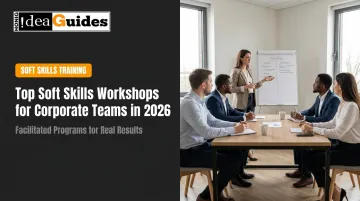
The World Economic Forum's Future of Jobs Report 2025 surveyed over 1,000 employers representing 14 million workers. The result: seven of the top 10 fastest-growing global skills are human/soft skills — creative thinking (#4), resilience and agility (#5), leadership and social influence (#7), among others. Technical skills lead the list, but interpersonal capabilities dominate the rest of it.
Deloitte's 2026 Global Human Capital Trends report adds a sharper business edge: organizations that pursue AI adoption with a purely technical focus are 1.6x more likely to underperform on return expectations compared to those that develop human capabilities in parallel.
Where Team Dysfunction Actually Lives
Individual online courses build knowledge. Workshops change behavior — and those aren't the same thing.
Most team performance problems aren't caused by individuals lacking information. They're caused by interaction patterns — the kind that show up as:
- Feedback that never gets delivered honestly
- Meetings that stall without reaching a decision
- Conflict that gets avoided until it becomes expensive
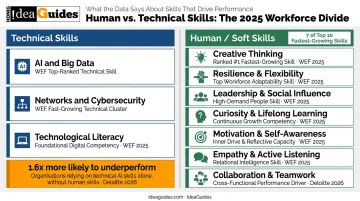
Workshops address these patterns directly — putting people in structured practice situations together, with a facilitator guiding the group through friction rather than around it.
The Business Case
A study co-authored by MIT Sloan's Namrata Kala found soft skills training returned approximately 250% ROI within eight months. The study population was factory workers, not corporate knowledge workers, so extrapolating the exact figure requires caution — but the directional argument holds: structured soft skills development is a financially sound investment, not just a cultural one.
Gallup's 2026 State of the Global Workplace report puts the cost of ignoring this in stark terms: global employee disengagement now costs an estimated $10 trillion in lost productivity annually.
Why 2026 Specifically Matters
Those cost figures don't exist in a vacuum. Hybrid and remote work eroded the informal skill-building that used to happen organically — the hallway conversations, the mentorship relationships that developed naturally in shared physical spaces. Organizations can no longer rely on proximity to develop these capabilities. They have to build them on purpose, in structured environments designed for exactly that. That's what well-designed workshops deliver.
Top Soft Skills Workshops for Corporate Teams in 2026
These workshops were selected based on employer demand data for 2026, demonstrated team-level impact, and cross-industry applicability.
Communication & Collaboration Workshop
Communication tops every employer soft skills survey for a reason. The NACE Job Outlook 2025 found that teamwork and written communication rank among the top three attributes employers seek — ahead of technical skills. But corporate communication failures aren't just interpersonal. They show up in meeting inefficiency, misaligned project handoffs, and cross-functional friction that slows execution.
Effective communication workshops address both dimensions: how individuals communicate and how teams build shared norms around clarity and feedback.
| Detail | Description |
|---|---|
| Workshop Focus | Active listening, assertive communication, feedback frameworks, reducing miscommunication in hybrid settings |
| Ideal For | Cross-functional teams, departments experiencing misalignment, teams in rapid growth or transition |
| Format & Length | Half-day to full-day facilitated session; runs as standalone or series; works in-person or virtual |
IdeaGuides' Leading Effective & Engaging Meetings training addresses this directly — covering how to enable full participation, manage difficult group dynamics, and drive decisions that teams actually commit to. Pergo adopted the methodology as a company-wide standard operating procedure after implementing it.
Emotional Intelligence (EQ) & Empathy Workshop
EQ has a strong peer-reviewed research base connecting it to individual performance and team-level psychological safety. Research published in Heliyon confirms that emotionally intelligent leaders produce measurable improvements in team outcomes and business results.
At the team level, EQ training changes how people interact under pressure — which is where collaboration either holds or breaks down.
| Detail | Description |
|---|---|
| Workshop Focus | Self-regulation, empathy development, emotional awareness in leadership, team trust-building |
| Ideal For | Leadership teams, manager cohorts, teams navigating organizational change or restructuring |
| Format & Length | Half-day with pre-work assessment (for example, an EQ self-assessment); works well as part of a leadership development series |
Creative Problem-Solving & Innovation Workshop
Creative thinking ranks #4 among the world's fastest-growing skills (WEF, 2025). The challenge is that creativity is almost impossible to develop through passive training — it requires structured practice in group settings where diverse thinking can be channeled productively.
Effective innovation workshops use frameworks like Creative Problem Solving (CPS) and divergent/convergent thinking to move teams from raw ideas to viable concepts. The real output is both the ideas themselves and the team cohesion that makes implementation stick.
| Detail | Description |
|---|---|
| Workshop Focus | Divergent thinking, structured brainstorming, creative confidence, applied innovation techniques |
| Ideal For | Product teams, strategy groups, departments stuck in routine thinking patterns, innovation-focused offsites |
| Format & Length | Half-day to full-day; highly experiential; most effective with a professional facilitator to guide ideation |
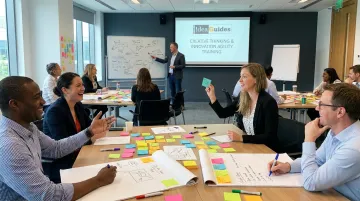
IdeaGuides specializes in exactly this format. Their Creative Thinking & Innovation Agility Training is 95% active — participants spend virtually no time in passive instruction. Sessions use proprietary frameworks (Fluency, Flexibility, Uniqueness) alongside established methodologies including Synectics, CPS, and De Bono's lateral thinking tools. In one BASF session facilitated by IdeaGuides, participants generated over 700 raw ideas, converging on 22 final concepts.
Conflict Resolution & Constructive Feedback Workshop
The CPP Global Human Capital Report found that 56% of employees have never received any formal conflict management training — despite spending an average of 2.8 hours per week dealing with workplace conflict. SHRM's 2024 Civility Index puts the organizational cost at over $2.7 billion per day in the U.S. alone.
Poor feedback culture compounds this. Gallup data shows that employees who receive meaningful feedback regularly are 3.6x more likely to be motivated to do outstanding work. Most teams don't have structured norms for giving or receiving it.
| Detail | Description |
|---|---|
| Workshop Focus | Conflict de-escalation, feedback delivery frameworks (for example, SBI — Situation/Behavior/Impact), constructive dialogue, psychological safety |
| Ideal For | Teams with known interpersonal friction, post-reorganization teams, managers preparing for performance conversations |
| Format & Length | Half-day; role-play scenarios are essential; group debrief is critical for lasting behavior shift |
Adaptive Leadership & Resilience Workshop
Resilience, flexibility, and agility rank #5 among the world's fastest-growing skills (WEF, 2025). ManpowerGroup's 2026 Talent Shortage Survey of 39,000 employers across 41 countries found that adaptability and willingness to learn are among the hardest-to-find soft skills — cited by 34% of employers.
For leadership teams, this is especially acute. Organizations navigating AI integration, structural change, or workforce transitions need leaders who can adjust their approach in real time — not just communicate the strategy clearly when everything is stable.
| Detail | Description |
|---|---|
| Workshop Focus | Leadership style flexibility, resilience under change, leading through uncertainty, adaptive decision-making |
| Ideal For | Senior leadership teams, high-potential manager cohorts, organizations undergoing strategic pivots |
| Format & Length | Full-day or modular program (2–3 half-days); includes self-assessment, peer feedback, and applied scenario practice |
What Makes a Soft Skills Workshop Actually Effective?
Facilitation Quality Is the Primary Variable
The curriculum matters less than who is running it. A skilled facilitator creates the psychological safety that allows honest participation, guides groups through friction without losing the thread, and ensures insights translate into concrete commitments that stick beyond the session room.
Professional facilitation credentials provide a recognized benchmark. Look for facilitators with demonstrated experience with similar organizations and the ability to customize content rather than deliver a standard script.
Doing Over Listening
An ATD/Engageli study published in 2025 found that active, experiential learning produced 54% better outcomes than passive instruction — with post-training assessment scores of 70% versus 45% for passive learners. Role-plays, live brainstorms, structured peer feedback, and scenario exercises create the neural pathways that watching a video simply cannot.
The Reinforcement Gap
Most workshops fail not because the session was poor but because nothing happens afterward. Without reinforcement, people forget approximately 70% of new information within 24 hours (Ebbinghaus). Best-practice workshop design includes:
- Pre-work assessments to set context and establish baselines
- Post-workshop action planning with specific commitments
- Manager reinforcement and modeling of new behaviors
- Follow-up check-ins at 30, 60, or 90 days
Customization Beats Generic Content
Workshops that reference the team's actual challenges, language, and goals consistently outperform off-the-shelf programs. That means stakeholder interviews before the session, co-designed agendas, and — for team development work — confidential pre-workshop conversations with individual members to surface the real issues before the group convenes. IdeaGuides builds each of these steps into every engagement by default.
How to Choose the Right Soft Skills Workshop for Your Team
Start with a gap assessment, not a catalog. The most common mistake is choosing a popular workshop rather than one that addresses what's actually broken. Gap identification can come from manager feedback, 360-degree reviews, team surveys, or a diagnostic conversation with a facilitation provider.
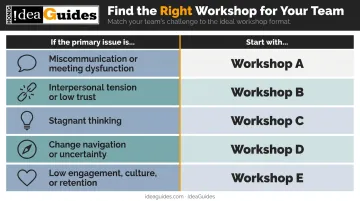
Use this quick decision framework:
| If the primary issue is... | Start with... |
|---|---|
| Miscommunication, meeting dysfunction | Communication & Collaboration |
| Interpersonal tension, low trust | Conflict Resolution & Feedback |
| Stagnant thinking, lack of new ideas | Creative Problem-Solving & Innovation |
| Change navigation, leadership uncertainty | Adaptive Leadership & Resilience |
| Low engagement, culture, or retention | EQ & Empathy |
Evaluate the facilitator, not just the program. Experience across industries matters more than a polished curriculum. A facilitator who has guided 150+ client engagements has seen a conflict exercise go sideways — and knows exactly how to bring the room back on track. That recovery instinct is what separates a productive session from a wasted afternoon.
Once you've identified the right focus area, here's how to move from decision to action:
- Request a diagnostic conversation before committing to any program
- Ask the facilitator for examples from your industry or a comparable organizational challenge
- Confirm the session format fits your team size and working style (on-site, remote, or hybrid)
- Look for providers who customize content rather than deliver off-the-shelf curriculum
Conclusion
The soft skills that define high-performing teams in 2026 — communicating clearly, navigating conflict, adapting under pressure — don't develop by completing modules or watching recorded sessions. They develop through deliberate practice, with other people, in structured environments guided by someone who knows how to make it stick.
For teams ready to move beyond surface-level training, IdeaGuides offers expert-led soft skills and team development workshops designed around your team's actual challenges. With 25+ years of facilitation experience and a client roster spanning corporations, government agencies, and nonprofits, IdeaGuides delivers the kind of structured practice that produces real, lasting behavior change.
Reach out at IdeaGuides.com or call 1.415.479.2028 to start the conversation.
Frequently Asked Questions
What are the most important soft skills for corporate teams?
Communication, emotional intelligence, collaboration, adaptability, and conflict resolution consistently top employer surveys. At the team level, these matter because they govern how people interact — not just what individuals know — which is where most performance problems actually originate.
What is the difference between a soft skills workshop and a soft skills training course?
Workshops are live, facilitated, interactive sessions focused on team-level practice and real-time behavior change. Training courses — especially online ones — deliver individual knowledge transfer. For team dynamics, that distinction matters: one develops shared behavior; the other builds individual awareness.
How long should a soft skills workshop be for corporate teams?
Most workshops run from a half-day (3–4 hours) to a full day, depending on depth and team size. Multi-session formats with reinforcement intervals between them tend to produce the most durable behavior change, since a single session rarely overcomes the forgetting curve.
How do you measure the ROI of a soft skills workshop?
Measure through pre/post behavioral assessments, team productivity metrics, employee engagement scores, and retention rates. An MIT Sloan-affiliated study found soft skills training returned approximately 250% ROI within eight months.
Can soft skills workshops be run virtually or must they be in person?
Both formats can work, but in-person workshops typically yield stronger results for team cohesion and interpersonal skill development. Virtual workshops are effective when well-facilitated with intentional interaction design — passive virtual delivery produces the weakest outcomes of any format.
How often should corporate teams attend soft skills workshops?
Once per year is a common minimum, but high-performing organizations treat soft skills development as an ongoing cadence — tying workshops to team milestones, leadership transitions, or identified performance gaps rather than scheduling them on a fixed calendar.