Introduction
Most organizations invest in leadership training. Far fewer actually produce effective leaders.
According to Deloitte, companies with effective leaders are 2–3 times more likely to outperform financially — yet barely one in ten companies believe they do an excellent job developing those leaders. Meanwhile, Gallup's State of the Global Workplace 2026 estimates that low engagement cost the global economy approximately $10 trillion in lost productivity — and managers account for 70% of variance in team engagement.
Manager training has moved from a developmental perk to a core pillar of corporate performance. The right program directly shapes how teams communicate and execute on shared priorities. Choosing the wrong one has consequences that extend well beyond the training room.
This article covers the 5 best manager training programs for 2026, how they were selected, and what to evaluate before committing your organization's development budget.
Key Takeaways
- Managers drive 70% of team engagement variance — undertrained managers are a direct productivity and retention risk
- The best programs prioritize behavior change over content delivery, combining live facilitation with practice and reinforcement
- Selection criteria: facilitation quality, curriculum depth, delivery flexibility, and measurable outcomes
- Match the program to your team's size, learning culture, and specific skill gaps — not brand recognition alone
- Custom facilitated training — such as IdeaGuides' workshops — tends to produce stronger team alignment and skills managers apply on the job than off-the-shelf alternatives
Why Manager Training Matters for Corporate Development
Manager training, in the corporate context, means structured development programs that build leadership capacity across communication, decision-making, team alignment, and performance coaching. Not remediation for struggling managers — deliberate investment in the entire management layer.
That investment has measurable stakes:
- $10 trillion in global productivity lost to disengagement in 2025 (Gallup)
- 70% of team engagement variance is attributable to managers
- Replacing a single manager costs approximately 200% of their annual salary
Yet only 26% of leaders rate their organization's leadership development as high quality, according to DDI's 2025 research. Most organizations have something in place — very few have something that works.
What Separates Effective Programs from the Rest
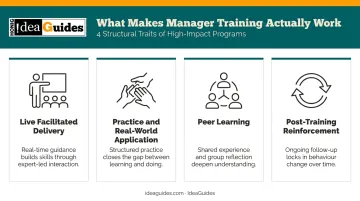
Training that produces real behavior change tends to share a few structural traits:
- Live, facilitated delivery — not self-paced modules watched in isolation
- Practice and real-world application built into the session itself
- Peer learning that mirrors actual team dynamics
- Post-training reinforcement that extends the learning beyond a single event
A 2017 meta-analysis on leadership training confirmed that face-to-face, non-self-administered delivery, combined with feedback, practice, and spaced sessions, produces meaningfully better outcomes than one-time or self-paced-only formats. In other words, a well-designed program with average content will outperform a content-rich program with poor delivery structure.
5 Best Manager Training Programs for Corporate Development in 2026
These programs were evaluated on facilitation quality, curriculum depth, delivery flexibility, scalability, and their ability to produce measurable behavior change — not brand recognition or price point alone.
1. IdeaGuides Manager Training & Facilitation Workshops
IdeaGuides is a San Francisco Bay Area–based facilitation and training firm with over 25 years of experience and more than 150 corporate clients. Their manager training programs aren't pulled from a standard catalog — each session is custom-designed around the client organization's goals, culture, and team dynamics.
What sets IdeaGuides apart is the facilitation model itself. Sessions are led by certified IAF (International Association of Facilitators) members and Master Trainers, including authors who have written books on innovation, team building, and meeting effectiveness.
Their "Leading Effective & Engaging Meetings" workshop — the firm's primary management development offering — is explicitly designed so that the training models a great meeting. Managers don't just hear about facilitation skills; they practice leading mini-meetings in real time, using tools they can apply the next morning.
The results are concrete. Lori Bassett, VP at Pergo, Inc., reported that the Leading Effective Meetings method became standard operating procedure across her organization. The City of Oakland reported staff applying training tools the same day they left the workshop.
Additional programs include Problem Solving & Decision Making, Innovation & Agile Thinking, and Facilitating Ideation Sessions — all customizable, all available in-person, off-site, or virtually.
| Criteria | Details |
|---|---|
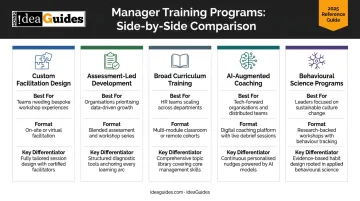
| Best For | Executive teams, senior leadership, cross-functional teams, and organizations seeking custom, facilitated manager development — in California and nationwide |
| Delivery Format | In-person or virtual facilitated workshops; custom-designed to organizational goals |
| Key Differentiator | Expert IAF-certified facilitators with 25+ years of experience; highly interactive sessions where every participant is heard and outcomes are immediately actionable |
2. Center for Creative Leadership (CCL)
CCL is a globally recognized, research-driven leadership development organization offering structured programs for managers at every career stage. Their catalog spans frontline new-manager training, mid-level leadership journeys, and custom organizational solutions.
Their evidence-based curriculum is built on decades of leadership research, and programs incorporate 360-degree assessments — including the Benchmarks Suite and Skillscope — that give managers genuine self-awareness alongside practical skills. CCL's Leadership Development Program (LDP) is a 5-day intensive embedded in a 5-month journey; their frontline program, Maximizing Your Leadership Potential, delivers 20 hours of focused development across a similar timeframe.
Two provider-reported outcomes stand out:
- 97% of LDP participants feel better prepared for future responsibilities
- 86% of leaders across more than 5,400 participants showed significant improvements in overall leadership effectiveness
The assessment infrastructure behind these figures is substantive, even accounting for provider sourcing.
| Criteria | Details |
|---|---|
| Best For | Organizations seeking structured, assessment-based leadership development with established academic credibility |
| Delivery Format | Virtual live programs, in-person regional campuses, and custom organizational solutions |
| Key Differentiator | Research-backed curriculum with 360-degree feedback and behavioral assessment tools built into the learning journey |
3. American Management Association (AMA)
AMA is one of the most established management training providers in the U.S., offering courses across communication, conflict resolution, delegation, performance coaching, and strategic thinking for managers at all levels — from first-time supervisors to experienced directors.
Its broad curriculum and multiple delivery formats make it a practical choice for companies building a consistent baseline of management skills across departments. Live in-person seminars, live online sessions, and self-paced on-demand options (with year-long access) give HR and L&D teams genuine scheduling flexibility.
AMA's strength is coverage and replicability. Organizations can deploy specific modules to address targeted skill gaps without committing to a full program redesign. Their catalog spans more than 100 management topics, making it one of the most comprehensive off-the-shelf options available to L&D teams.
| Criteria | Details |
|---|---|
| Best For | Companies wanting thorough, foundational management training for new or mid-level managers |
| Delivery Format | Live in-person seminars, live online, and on-demand courses |
| Key Differentiator | Comprehensive, well-established curriculum covering the full range of core management competencies in a structured, replicable format |
4. Hone
Hone is a modern manager training platform that blends live, expert-led classes with AI-powered coaching — creating a continuous learning experience designed to scale. Their catalog covers first-time manager essentials, coaching and feedback, conflict management, remote team leadership, and change management.
The platform's AI coaching layer (Hone AI, launched May 2025) functions as a voice-first interactive coach that supports managers between live sessions, allowing practice in the flow of work rather than waiting for the next scheduled class. This combination of live instruction and always-on reinforcement addresses one of the most persistent failures in manager development: the gap between the training room and daily application.
Note: Analytics and behavioral tracking features, as well as specific organization-size ranges served, were not independently verified in public sources. Buyers should confirm these capabilities directly with Hone.
| Criteria | Details |
|---|---|
| Best For | HR and L&D teams at mid-to-large organizations seeking scalable, behavior-tracked manager development with continuous reinforcement |
| Delivery Format | Live online classes combined with AI coaching; self-paced and on-demand options available |
| Key Differentiator | AI-powered coaching layer delivers always-on practice and feedback between live sessions |
5. DDI (Development Dimensions International)
DDI is a behavioral science–driven leadership development firm with more than 50 years of experience, specializing in competency-based assessment, targeted skill training, and blended learning. Their programs help organizations identify specific leadership gaps with precision, then address them through a cohesive journey of assessments, instructor-led training, and ongoing coaching.
Their competency framework defines leadership behaviors in measurable terms, allowing L&D teams to track behavior change rather than relying on completion rates. One provider-published example cited $20 million in savings from a DDI engagement at Hitachi Energy — a vendor-reported figure, but one that reflects DDI's outcome-measurement orientation.
| Criteria | Details |
|---|---|
| Best For | Organizations prioritizing research-backed, behavioral measurement in their manager development investment |
| Delivery Format | Blended learning: assessments, instructor-led sessions, and ongoing coaching support |
| Key Differentiator | Scientifically validated behavioral competency frameworks that tie training directly to measurable leadership outcomes |
How We Chose These Manager Training Programs
Programs were assessed on five criteria: facilitation quality, curriculum depth, delivery flexibility, scalability, and evidence of measurable outcomes. The evaluation excluded brand recognition and price point as primary factors.
The Most Common Selection Mistake
Organizations frequently choose manager training based on name recognition or cost — without asking whether the delivery method matches how their team actually learns, or whether outcomes extend beyond completion certificates.
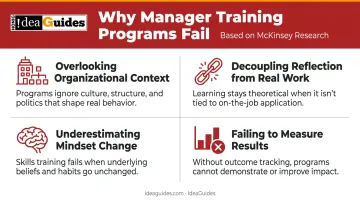
McKinsey's research on leadership development failures identifies four persistent failure modes:
- Overlooking organizational context
- Decoupling reflection from real work
- Underestimating the role of mindset change
- Failing to measure results
The Association for Talent Development (ATD) points to two additional culprits: programs that lack business alignment and designs that treat every manager the same.
What the Best Programs Share
Across all five programs selected, one pattern holds: training is treated as an ongoing process, not a one-time event. Whether that means a 5-month CCL journey, Hone's AI coaching between live sessions, or IdeaGuides' custom workshop built around a client's leadership culture, the structure is consistent: instruction followed by practice, application, and reinforcement.
Programs that skip that cycle — delivering content once and moving on — rarely produce lasting behavior change.
Conclusion
The right manager training program should align with your organization's specific goals, team size, and learning culture. Defaulting to the most recognizable name on the market — or the most affordable option — often produces programs that check a box without changing how managers lead.
Before committing, evaluate any program on delivery quality, facilitation expertise, post-training reinforcement, and how outcomes will be measured beyond who showed up.
For organizations that want a highly interactive, facilitated approach where every participant is engaged and leaves with tools they can apply immediately, IdeaGuides brings over 25 years of experience, 150+ clients served, and a team of certified IAF facilitators to that work. Contact IdeaGuides to discuss a workshop built around your team's specific needs at IdeaGuides.com or by calling 1.415.479.2028.
Frequently Asked Questions
What training should a manager have?
Managers benefit most from development across communication, delegation, conflict resolution, performance coaching, strategic thinking, and team alignment. The strongest outcomes come from programs that combine formal instruction with facilitated practice — not content delivery alone.
Which training method is most suitable for managerial development?
Live facilitated sessions (in-person or virtual) consistently outperform self-paced formats because they combine peer learning, real-time feedback, and interactive practice. Pair them with ongoing coaching or reinforcement to drive lasting behavior change.
Which course is best for a business development manager?
Business development managers typically benefit most from programs covering strategic thinking, communication, negotiation, and team leadership. The right choice depends on career stage — whether they need foundational management skills or advanced leadership development.
How long does manager training typically take?
Programs range from focused 2-hour workshops to 6–12 month learning journeys. Structure matters more than duration — the most effective programs build in reinforcement and real-world application, not just initial instruction.
How do I choose the right manager training program for my organization?
Start by identifying your team's specific skill gaps, preferred learning format, and desired outcomes. Then evaluate programs on facilitation quality, curriculum depth, delivery flexibility, and how results will be measured — not brand name or price point alone.