Introduction
Technical expertise gets people hired. Soft skills determine whether they thrive, lead, and stay.
Organizations are recognizing this fast. According to the World Economic Forum's Future of Jobs Report 2025, the share of workers completing employer-sponsored training rose from 41% in 2023 to 50% — and employers investing in that training overwhelmingly expected productivity and competitiveness gains as the payoff.
This guide covers the best online soft skills training courses for employees, which skill categories matter most, and how to evaluate platforms for your organization's needs.
One important gap runs through all of it: online training alone rarely produces lasting behavior change. The most effective organizations pair digital learning with live, facilitated practice. That distinction shapes every recommendation here.
Key Takeaways
- Soft skills — communication, emotional intelligence, collaboration, adaptability — directly drive team performance and retention
- Leading platforms vary widely in format, depth, and industry fit — the right choice depends on your team's needs
- Evaluate platforms on content relevance, analytics, and scalability before committing
- Online training builds the foundation — live practice sessions are what make new behaviors stick
What Are the Key Soft Skills Employees Need Most?
Soft skills are the interpersonal, behavioral, and self-management abilities that shape how people communicate, collaborate, and lead — distinct from technical or job-specific competencies. They're harder to quantify, but gaps show up fast — in stalled decisions, team friction, and missed deadlines.
Here are the skill families that consistently matter most.
Communication and Active Listening
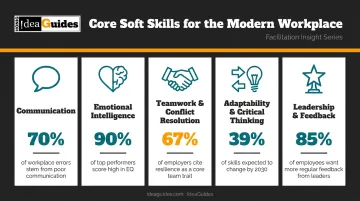
Communication tops LinkedIn's most in-demand skills list for 2024 — and poor communication is a leading driver of workplace conflict, misalignment, and lost productivity. Axios HQ's research found that while 77% of leaders believe their communications are helpful and relevant, only 46% of employees agree — a gap that creates friction at every level.
Training in communication improves virtually every other soft skill category — because how people exchange information shapes everything from conflict resolution to decision quality.
Emotional Intelligence and Empathy
Emotional intelligence (EQ) is the ability to recognize, manage, and respond to emotions — your own and others'. It's especially critical for managers and team leads.
A meta-analysis published in Frontiers in Psychology found EQ positively linked to organizational commitment, job performance, and job satisfaction, and negatively linked to turnover intention.
High-EQ leaders don't just perform better — their teams tend to stay longer.
Teamwork, Collaboration, and Conflict Resolution
These three are inseparable in practice. McKinsey data shows that three in four cross-functional teams underperform on key metrics — often because collaboration skills, not strategy, are the weak link.
In hybrid and cross-functional environments, teams are constantly tested on their ability to share accountability, resolve disagreements constructively, and communicate across different working styles. Training in these three areas produces fast, visible results.
Adaptability, Critical Thinking, and Problem-Solving
The WEF expects 39% of workers' core skills to change by 2030. Employees who can shift approaches, question assumptions, and solve problems independently are increasingly valuable — particularly in organizations navigating change or innovation pressure.
67% of employers in the WEF survey identified resilience, flexibility, and agility as core competencies for their workforce.
Leadership, Time Management, and Constructive Feedback
These aren't just manager skills. Giving and receiving feedback well, managing competing priorities, and demonstrating initiative are trainable behaviors that show measurable impact quickly — at every level of an organization. With structured training, improvements in these behaviors tend to surface within weeks — in how people run meetings, handle pushback, and follow through on commitments.
Best Online Soft Skills Training Courses for Employees
The platforms below were evaluated for organizational training programs — not just individual use. Selection criteria included content breadth, usability, customization options, and analytics capabilities.
LinkedIn Learning
LinkedIn Learning is the most familiar corporate soft skills platform for most working professionals — and for good reason. Its library spans over 26,000 courses covering communication, leadership, emotional intelligence, time management, and more. Learning paths organized by role make it easy to deploy targeted development at scale, and manager-level reporting gives HR teams visibility into team progress without heavy administrative overhead.
| Feature | Details |
|---|---|
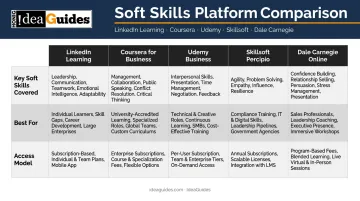
| Key Soft Skills Covered | Communication, leadership, emotional intelligence, time management, collaboration |
| Best For | Mid-to-large organizations wanting a scalable, self-paced solution with professional credibility |
| Access Model | Subscription-based (LinkedIn Learning for Business); contact vendor for current enterprise pricing |
Coursera for Business
Coursera's strength is academically rigorous, university-backed content. Courses from Yale, Duke, Michigan, and others give organizations a path to longer-form development with real credentials attached. Yale's Connected Leadership course is a strong example: structured, certificate-bearing content on organizational leadership and EQ. The learner analytics dashboard gives HR teams meaningful data for tracking progress across cohorts.
| Feature | Details |
|---|---|
| Key Soft Skills Covered | Emotional intelligence, leadership, critical thinking, communication, conflict management |
| Best For | Organizations that want credentialed, academically rigorous soft skills programs |
| Access Model | Team Plan: $399 per user/year (verify current pricing at purchase); Enterprise pricing is custom |
Udemy Business
Udemy Business is the practical, accessible option. Its Team Plan gives organizations access to over 28,000 courses covering leadership, public speaking, time management, teamwork, and adaptability — content built by working practitioners with real-world experience. It deploys quickly, requires minimal customization to get started, and is trusted by over 17,000 businesses worldwide.
| Feature | Details |
|---|---|
| Key Soft Skills Covered | Communication, public speaking, time management, teamwork, adaptability, problem-solving |
| Best For | SMEs and budget-conscious organizations needing a broad, flexible catalog |
| Access Model | Team Plan: $30 per user/month, billed annually (2–50 people); Enterprise pricing requires a quote |
Skillsoft Percipio
Skillsoft's Percipio platform is built for large enterprise L&D programs. AI-powered recommendations personalize learning paths, Skill Benchmark dashboards track proficiency against role expectations, and deep analytics give learning leaders the data they need to demonstrate ROI. For organizations focused on connecting training investment to measurable business outcomes, Percipio is purpose-built for exactly that kind of accountability.
| Feature | Details |
|---|---|
| Key Soft Skills Covered | Leadership, emotional intelligence, conflict resolution, communication, adaptability |
| Best For | Large enterprises with complex L&D requirements and a need for measurable ROI tracking |
| Access Model | Enterprise licensing; contact vendor for custom pricing |
Dale Carnegie Online
Dale Carnegie has been developing human relations and soft skills for over a century. Its online offering — including Dale Carnegie Unlimited, a live online subscription model — reflects that methodology directly. Courses use exercises, breakout rooms, and instructor interaction rather than passive video consumption. The focus is applied behavior change: how people actually show up in conversations, presentations, and leadership moments.
| Feature | Details |
|---|---|
| Key Soft Skills Covered | Communication, public speaking, leadership, confidence-building, interpersonal skills |
| Best For | Organizations prioritizing behavior change and practical skill application over content volume |
| Access Model | Course-by-course and team subscriptions available; contact vendor for current pricing |
How to Choose the Right Online Soft Skills Training Program
Picking a platform based on brand name alone is one of the most common — and costly — mistakes organizations make. A structured evaluation process changes that.
Start With a Needs Assessment
Before evaluating any vendor, audit which soft skills gaps are actually creating friction. Use 360-degree feedback, manager observations, or performance data to identify priority areas. A McKinsey survey found that 87% of organizations already faced skill gaps or expected them within a few years — the question is which gaps matter most for your teams specifically.
Evaluate Content Quality, Not Just Volume
Look for:
- Scenario-based, interactive content (not passive video lectures)
- Role-based learning paths relevant to your employee population
- Updated content that reflects how work actually happens today
Generic theory-heavy modules produce lower engagement and weaker behavior transfer than content grounded in real situations.
Assess Platform Capabilities That Matter at Scale
Key features HR and L&D teams should evaluate:
- Learner analytics and reporting — Can you track more than completion rates?
- Customization — Can you restrict content, create curated paths, or add proprietary material?
- Mobile accessibility — Will employees actually use this on the go?
- HRIS/LMS integration — Does it fit your existing tech stack?
- Growth capacity — Can it handle more users and programs without requiring a platform rebuild?
Define How You'll Measure Success Before You Buy
Organizations often skip the measurement question until after launch, which makes it nearly impossible to course-correct. Identify the target behavioral outcomes you want to see (not just completion percentages) and confirm the platform can surface the data needed to track them. If you can't point to behavior change after six months, you have no basis for deciding whether to expand, adjust, or replace the program.
Beyond the Screen: Why Blended Learning Gets Better Results
Online training is an efficient way to deliver frameworks, concepts, and foundational knowledge. What it can't replicate is the interpersonal practice that makes soft skills actually stick.
The 70:20:10 learning model — developed from Center for Creative Leadership research and widely used as an organizational design heuristic — suggests roughly 70% of meaningful development comes from on-the-job experience, 20% from peer and social learning, and 10% from formal training. Even if you treat those as rough guides rather than fixed ratios, the implication is clear: formal courses alone can't carry the full load of soft skills development.
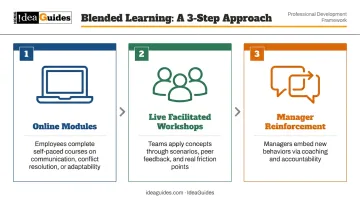
What a blended approach looks like in practice:
- Employees complete self-paced online modules on communication, conflict resolution, or adaptability
- Teams then apply those concepts in live facilitated workshops — practicing scenarios, receiving peer feedback, and working through real friction points together
- Managers reinforce new behaviors through coaching conversations and team-level accountability
The live component is where behavior actually changes. Watching a module on active listening and then practicing it in a structured group session with a skilled facilitator are two very different experiences.
IdeaGuides is one example of this in practice. The San Francisco Bay Area facilitation firm has spent over 25 years running live workshops in communication, teamwork, conflict management, and customer service for corporate, nonprofit, and government teams. If your organization is looking to pair online coursework with hands-on facilitation, their customized workshop programs are worth exploring.
Conclusion
Choosing the right online soft skills training comes down to fit — matching tools to your organization's actual skill gaps, team size, learning culture, and goals. The most recognized platform isn't always the right one.
That said, online training works best as a starting point, not the whole solution. Skills stick when they're practiced in real team contexts — through peer learning, manager coaching, and facilitated workshops that move knowledge into action.
Organizations ready to go beyond self-paced modules can contact IdeaGuides to explore customized workshops and team training programs designed to turn training into measurable team results.
Frequently Asked Questions
What are the 7 soft skills in the workplace?
The most commonly cited core soft skills are communication, teamwork, problem-solving, adaptability, emotional intelligence, time management, and leadership. These categories consistently appear across industry research as the most impactful for workplace performance.
What is the 70:20:10 rule for employee development?
The 70:20:10 model suggests roughly 70% of development comes from on-the-job experience, 20% from social and peer learning, and 10% from formal training. It's a design heuristic, not a fixed formula. That's why it explains why online courses alone rarely build durable soft skills without practice and reinforcement.
How do you learn soft skills online?
Choose scenario-based, interactive courses over passive video content, and practice concepts in actual work situations as you go. Supplementing online modules with peer feedback, coaching, or live workshops significantly improves how much of what you learn actually transfers to behavior.
What is the difference between soft skills and hard skills?
Hard skills are technical, job-specific, and measurable (data analysis, coding, financial modeling). Soft skills are interpersonal and behavioral: communication, empathy, leadership. Increasingly, soft skills determine how effectively hard skills get applied within teams.
How long does soft skills training take to show results?
Knowledge can be gained in hours; meaningful behavior change typically takes weeks to months of consistent practice and reinforcement. Ongoing learning programs, especially those combining online modules with live practice, consistently outperform one-time training events.
Can soft skills really be trained, or are they innate?
Research firmly supports soft skills as learnable. A field experiment published in the Journal of Political Economy found a 13.5% productivity gain from structured workplace soft skills training. These are not fixed personality traits, and organizations that invest in sustained, practice-based programs consistently see measurable results.