Introduction
Most teams don't realize they have a communication problem — they just know that something keeps going wrong. Meetings drag. Feedback lands badly. A Slack message gets misread as passive-aggressive. An email with no greeting reads as cold and curt to one person, while a phone call out of nowhere feels intrusive to another.
The underlying cause, usually, is generational. According to SHRM, today's workforce spans up to five generations simultaneously — and each arrived at work with different assumptions about what professional communication looks like.
The business cost is real. Grammarly and The Harris Poll estimated that poor workplace communication costs U.S. businesses $1.2 trillion annually — roughly $12,506 per employee per year, with teams losing nearly 7.5 hours weekly to miscommunication alone.
Cross-generational communication training addresses this cost directly — yet most organizations only pursue it after conflict has already surfaced. This guide walks through what effective training looks like, why it works, and how to measure whether it's actually changing behavior on your team.
Key Takeaways
- Cross-generational communication training helps teams recognize how generational context shapes behavior and build shared communication norms
- The five active workforce generations each bring distinct defaults around formality, feedback frequency, and preferred channels
- Effective training combines awareness-building, gap assessment, and co-created agreements rather than one-off workshops or stereotype checklists
- Common failures include treating generational labels as personality profiles and skipping structural follow-through
- Training outcomes are measurable: track engagement scores, meeting effectiveness ratings, and communication-related friction over time
What Is Cross-Generational Communication Training?
Cross-generational communication training is a deliberate, facilitated learning process that helps team members recognize how generational context shapes their communication behavior — and develop shared norms that allow diverse teams to collaborate more effectively.
The goal is not to eliminate generational differences. Differences don't disappear because you've held a workshop. The goal is to reduce the friction those differences create, and eventually turn them into an asset — so a team's generational range becomes a source of perspective rather than a source of tension.
What this training is not:
- Diversity and inclusion training — though the two often overlap
- Conflict resolution — though it helps prevent conflict from developing
- Etiquette or professional communication basics
- A personality assessment exercise
This training focuses specifically on observable communication behavior. Participants leave with shared agreements around:
- Channel preferences (email vs. messaging vs. in-person)
- Feedback styles and how to give and receive it across generations
- Formality expectations in written and verbal communication
- Working agreements that the whole team has shaped and signed off on
Why Multi-Generational Teams Struggle to Communicate
Each generation's communication defaults were shaped by the technology, institutions, and social norms of their formative years.
What feels "normal" to a Baby Boomer can feel slow and unnecessarily formal to a Gen Z colleague. What feels efficient to a Millennial can feel abrupt or disrespectful to a Gen X manager.
The Channel Preference Gap
SHRM reports that older workers generally prefer meetings and phone calls for substantive discussions, while younger workers favor instant messaging. Gen X tends to use asynchronous email chains until a face-to-face meeting is genuinely needed.
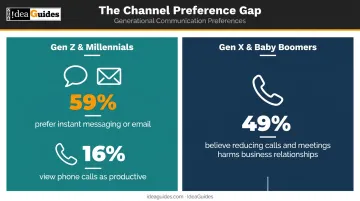
The gap is wide. Robert Walters found that 59% of Gen Z and Millennials believe instant messaging or email is the best way to get things done, while only 16% view phone calls as productive. On the other side, 49% of Gen X and Baby Boomers believe reducing calls and meetings would negatively affect business relationships.
Neither position is wrong. Both are rational responses to different professional contexts. The problem is that without explicit team norms, both sides read the other's behavior as a character flaw rather than a habit.
The Feedback Frequency Mismatch
Baby Boomers and Gen X typically expect structured, periodic performance reviews. Millennials and Gen Z expect ongoing, informal feedback loops. According to Gallup, only 19% of Millennials strongly agree they receive routine feedback, and only 17% strongly agree the feedback they receive is meaningful.
That gap doesn't just cause frustration. It produces disengagement among those who feel unseen, and perceived micromanagement among those who feel over-monitored.
The Formality Gap
Older employees tend to observe professional communication conventions: proper subject lines, full sentences, clear sign-offs. Younger employees communicate in shorter, more casual bursts — sometimes with no greeting, no punctuation, and no context.
Neither approach is inherently unprofessional. But without shared norms, both sides misread intent:
- A three-word Slack message reads as dismissive
- A five-paragraph email reads as bureaucratic
Same information. Different channel. Very different reception.
A Critical Caveat on Generational Labels
Generational tendencies are real patterns — but they are not deterministic. A 2024 meta-analysis by Ravid, Costanza, and Romero found few systematic, meaningful differences among generations across workplace outcomes, and noted that the academic literature itself may contribute to overstating generational stereotypes.
Effective training uses generational context as a starting hypothesis for individual conversations, not as a fixed profile. The aim is to surface hidden assumptions so teams can negotiate shared norms — rather than trading one set of blind spots for another.
How Cross-Generational Communication Training Works
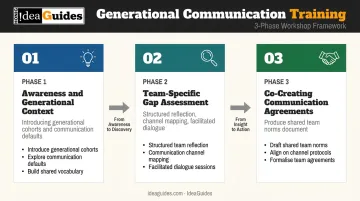
Effective programs move through three stages. Skip the first, and you get compliance without understanding. Skip the third, and awareness never becomes behavior change. All three matter.
Phase 1: Awareness and Generational Context
This phase introduces participants to the five generational cohorts, their defining formative experiences, and the communication behaviors commonly associated with each.
The facilitator's job here is critical: this content must be presented as context, not stereotype. Participants should leave understanding their own defaults — not with a new set of labels for their colleagues. The emphasis is on self-awareness, not other-categorization.
Phase 2: Team-Specific Gap Assessment
This phase shifts from general generational patterns to the specific team's actual communication friction points. Activities typically include:
- Structured reflection exercises on real miscommunications
- Channel preference mapping across the team
- Facilitated conversations that surface where breakdowns have actually occurred
This is where an external facilitator makes a meaningful difference. IdeaGuides conducts pre-session confidential interviews with participants to surface issues that employees won't raise with their direct managers in the room.
Their core facilitation philosophy — neutral meeting leadership that equalizes the interactive playing field — creates conditions where honest feedback can actually emerge. Internal HR or manager-led sessions rarely achieve the same candor.
Phase 3: Co-Creating Team Communication Agreements
The output of Phase 3 is a practical team communication agreement — a shared document covering:
- Preferred channels for different types of communication
- Expected response times
- How to flag urgent items
- Meeting norms and feedback preferences
This is what transforms training insights into operational habits. IdeaGuides' team sessions are specifically designed to produce co-created outputs — facilitators guide groups through convergence to consensus rather than imposing a top-down policy document.
Two important notes:
- Co-creation increases buy-in. Teams follow agreements they wrote; they comply with — or quietly ignore — agreements handed to them.
- Agreements need revisiting. Schedule quarterly check-ins to review and update the agreement as your team evolves and new members join.
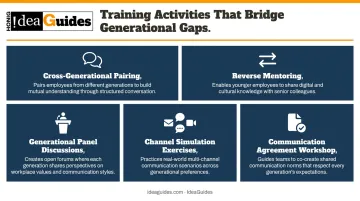
Key Training Activities That Bridge Generational Gaps
Activities should generate genuine interaction across generational lines, not just passive learning about differences. The most effective ones build mutual respect through shared experience.
Cross-Generational Pairing and Coffee Chats
Structured conversation pairs — where participants discuss their work experiences, defining career moments, or communication preferences — build interpersonal familiarity that makes subsequent collaboration easier.
Facilitators should provide topic prompts and rotate pairings across the program to expose team members to multiple perspectives. The conversation itself matters less than the habit of engaging across generational lines without a task agenda driving it.
Reverse Mentoring Sessions
Reverse mentoring pairs early-career staff with senior colleagues — with the junior employee doing the teaching. Research published in Frontiers in Communication identifies reverse mentoring as a channel through which younger generations transfer knowledge and contemporary perspectives while engaging with senior employees, supporting intergenerational communication and reciprocal learning.
For it to work as more than a novelty exercise, formal structure is required: defined learning goals, regular cadence, and clear expectations on both sides. Without that structure, it tends to fizzle after the first session.
Generational Panel Discussions
Panel discussions where team members from different generations respond to the same questions — about communication preferences, work expectations, what they wish colleagues understood — replace assumption with direct testimony.
When facilitated well, this format is most effective in larger teams or cross-functional alignment sessions. Participants often discover that colleagues they assumed were being difficult were simply operating from a different set of reasonable defaults.
Communication Channel Simulation Exercises
Teams practice delivering the same message through different channels — in-person, email, instant message, video — then debrief on how tone, clarity, and perceived professionalism varied across participants. What surprises most teams: the same words read as curt in a Slack message and perfectly reasonable in an email.
This exercise builds shared sensitivity to channel appropriateness without requiring anyone to abandon their preferred style.
Team Communication Agreement Workshop
This is a facilitated working session, not a lecture. The team collectively drafts their communication norms together, with a skilled facilitator ensuring every voice contributes — including quieter and more junior participants who might defer to senior colleagues in unstructured settings.
IdeaGuides' sessions use both introverted and extroverted processes to address this directly:
- Written input before open discussion, so quieter participants contribute on equal footing
- Small-group work that surfaces perspectives that get lost in full-team settings
- Structured convergence methods that weight contributions by quality, not volume
The result is a communication agreement that reflects the whole team's actual preferences — not just the loudest voices in the room.
Common Mistakes That Undermine Cross-Generational Training
Treating Generational Categories as Personality Types
The most common facilitation error is presenting generational profiles as predictive. When participants leave a session thinking "Gen X people are like X," training has reinforced the bias it was meant to reduce.
Effective programs frame generational tendencies as starting points for individual conversations — not substitutes for them. Rudolph, Rauvola, and Zacher have argued that many common beliefs about generational differences in organizations are myths that programs should actively challenge — not reinforce.
Running a One-Off Workshop Without Follow-Through
Many organizations treat cross-generational training as a single event. Research by Mehner et al. found that only up to 30% of training content is typically implemented in the workplace — meaning standalone workshops without structural reinforcement produce temporary awareness, not lasting behavioral change.
Without follow-through — team communication agreements, periodic check-ins, leadership modeling — those insights evaporate within weeks.
Assuming Psychological Safety Exists Before Surfacing Generational Friction
Even when structural follow-through is in place, a second failure point can undermine everything: running sessions before psychological safety exists. Team members won't honestly discuss communication frustrations if they don't feel safe doing so. The Workforce Institute at UKG found that one in three employees worldwide would rather quit than voice concerns, and 63% feel their voice has been ignored by a manager or employer.
Leaders must explicitly establish ground rules and demonstrate vulnerability before expecting candor. Run a session before that trust exists, and you'll get polite nods — not the honest dialogue that actually changes how people work together.
To avoid all three mistakes, effective programs typically include:
- Framing generational tendencies as conversation starters, not fixed traits
- Scheduling follow-up sessions and team agreements after initial training
- Building explicit psychological safety before surfacing sensitive friction points
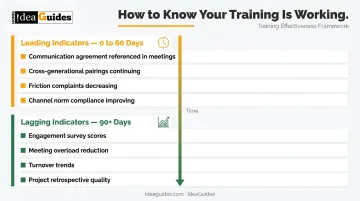
How to Measure Whether Your Training Is Working
Leading Indicators (Short-Term)
Look for these signals in the first 30-60 days:
- Is the team's communication agreement being actively referenced in meetings and one-on-ones?
- Are cross-generational pairings continuing outside formal sessions?
- Have communication-related friction complaints decreased in retrospectives?
- Is there evidence of channel norm compliance (fewer unnecessary meetings, faster async responses)?
Lagging Indicators (90+ Days)
After 90 days, track:
- Engagement survey scores around "feeling heard" and "communication clarity"
- Reduction in meeting overload (a signal that channel agreements are working)
- Voluntary turnover trends among employees who cited communication breakdowns in exit interviews
These indicators only tell you something changed if you were already tracking behavior — not just attendance. Showing up to a workshop doesn't confirm behavioral change. The metrics that actually tell you training worked are behavioral:
- Channel compliance (are people using the agreed-upon tools?)
- Feedback frequency between cross-generational pairs
- Meeting load per employee over time
- Quality of cross-generational collaboration in project retrospectives
Frequently Asked Questions
What is an effective strategy to improve communication across a multigenerational team?
Start by surfacing each team member's actual communication preferences through direct conversation — not assumed from their generational cohort. Then co-create a team communication agreement that defines channels, expected response times, and meeting norms that everyone commits to following. The agreement only works if the team builds it together.
What are the five generations in the workforce?
The five generations are the Silent Generation (1928–1945), Baby Boomers (1946–1964), Generation X (1965–1980), Millennials (1981–1996), and Generation Z (1997–2012). Each group's formative experiences with technology and institutions shaped distinct workplace communication defaults.
What is the preferred communication method for Millennials at work?
Millennials generally favor digital tools (instant messaging platforms, collaborative software) over phone calls or formal email chains. They also value frequent, informal feedback rather than annual reviews — though individual preferences vary, and assuming based on generational cohort alone will lead you astray.
What are the 5 C's of effective communication?
The 5 C's are Clarity, Conciseness, Coherence, Correctness, and Completeness. Applying these consistently across all channels helps bridge generational differences by setting a shared quality standard that works whether you're writing a Slack message or delivering a formal email update.
How do you measure the success of cross-generational communication training?
Track both leading indicators — team communication agreement adoption, cross-generational interaction frequency — and lagging indicators like engagement scores, reduction in communication-related friction in team retros, and voluntary turnover trends. Measuring workshop attendance alone tells you nothing about whether behavior actually changed.
What is the difference between traditional mentoring and reverse mentoring in cross-generational teams?
Traditional mentoring pairs senior employees with junior staff to transfer institutional knowledge. Reverse mentoring inverts this — younger employees coach senior colleagues on emerging technology, digital tools, or evolving workplace trends — and both parties gain from the exchange.