Introduction
Nonprofit board retreats represent a real investment — in time, in focus, and often in budget. Yet many end without clear decisions, documented action items, or any meaningful follow-through. Board members leave energized, then return to the same dynamics at the next regular meeting.
Most underperforming retreats share the same structural gaps: no agreed-upon purpose, agendas built top-down without member input, and nothing in place to track what was decided. The effort is there — the planning scaffolding isn't.
BoardSource's 2021 Leading with Intent report found that 59% of chief executives said their boards spent too little time thinking strategically — and boards that focused on strategic issues outperformed operationally focused ones by a wide margin on direction-setting.
A well-planned retreat is the most direct way to close that gap. This checklist covers what to do before, during, and after — so your board leaves with decisions on paper, owners assigned, and a clear path forward.
Key Takeaways
- Define a specific, agreed-upon purpose before any agenda is drafted
- Start planning 6–8 weeks out and gather input from board members, not just leadership
- A strong agenda balances team building, strategic discussion, and board development — leave routine meeting business off the retreat
- A professional facilitator keeps discussion on track and draws out perspectives leadership might otherwise miss
- Post-retreat follow-through — named owners, tracked action items — is what turns decisions into results
The Complete Nonprofit Board Retreat Planning Checklist
Retreat planning unfolds in stages. Each phase sets up the next, and skipping ahead creates the kind of gaps that show up on the day itself.
Phase 1: 6–8 Weeks Before the Retreat
Start here before anything else is scheduled or drafted.
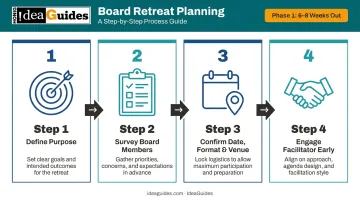
- Define the primary purpose. Ask: "This retreat will be a success if…" Get the board chair and executive director aligned on that answer before agenda conversations begin. Vague intent produces vague outcomes.
- Survey board members. Ask about their priorities, concerns, and what success looks like for them. BoardSource recommends pre-retreat interviews or questionnaires so members feel heard — and so leadership learns what it didn't know to ask.
- Confirm the date, format, and venue. Choosing a location different from the regular meeting space signals to participants that this is a different kind of work. In-person off-site settings consistently produce deeper strategic conversations; virtual formats work well for focused, single-topic sessions.
- Engage a facilitator early. If you're working with an external facilitator, this is when to begin the intake process, not two weeks out.
Phase 2: 2–4 Weeks Before the Retreat
With purpose and input gathered, now build the agenda.
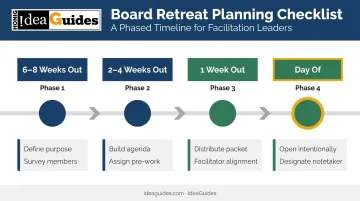
- Draft a balanced agenda across three areas: team connection, strategic discussion, and board development. Exclude routine items — financial reports, committee updates, approval of minutes. Those belong at regular meetings.
- Assign pre-work. Send board members a short self-assessment, a set of preparatory questions, or key organizational data to review in advance. Boards that come in already thinking about the material go deeper faster on the day.
- Confirm all logistics: catering, A/V, breakout space, materials, and any guest experts or presenters.
Phase 3: 1 Week Before the Retreat
With logistics locked and the agenda set, this phase is about alignment and final readiness.
- Distribute the final agenda packet with enough lead time for review. Include pre-read materials, ground rules, and a clear schedule with timing.
- Check in with your facilitator to align on discussion flow, how to handle off-topic items, and any group dynamics worth anticipating.
Phase 4: Day of the Retreat
- Open intentionally. Begin with a structured connection activity before moving into strategy. Whatever you call it on the agenda, the goal is to get board members talking and thinking together before the day's harder work begins.
- Designate a separate notetaker. This person — separate from the facilitator — captures decisions, action items, owners, and timelines in real time, not reconstructed afterward. What gets recorded gets followed through on.
What Should a Board Retreat Include? Building the Right Agenda
A board retreat serves a fundamentally different purpose than a regular board meeting — and the agenda needs to reflect that from the first hour.
Team Building and Connection
Board members who know each other as people — not just as governance colleagues — have more candid strategic conversations. Build in structured time for connection early in the day, particularly for boards with newer members.
Also make space to reflect on the past year: wins, contributions, and moments that reconnected people to why the organization exists. This isn't soft content; it builds the emotional foundation for the harder strategic conversations ahead.
Strategic Planning and Big-Picture Discussion
Dedicate the largest block of time to forward-looking conversations that a 90-minute monthly meeting cannot hold — long-range vision, major organizational decisions, revenue diversification, or mission evolution.
Small breakout groups are essential here: they ensure every board member contributes, prevent a few voices from dominating, and produce richer input than open-table discussion alone. Reconvene to synthesize, then capture decisions before the energy dissipates.
Board Development and Fundraising
Many boards avoid this topic at retreats. It's exactly the right venue for it. Include at least one session on board roles, fundraising responsibilities, or governance expectations.
Set measurable board goals for the coming year — with specific owners attached, not just aspirations. Accountability conversations are far easier to have at a retreat than at a regular meeting, when time pressure works against candor.
What to Leave Off the Agenda
Exclude:
- Financial report presentations
- Committee updates
- Approval of minutes or prior meeting business
- Operational status updates
These items consume the strategic bandwidth the retreat exists to protect.
Key Factors That Make or Break a Nonprofit Board Retreat
Execution quality depends on a handful of controllable variables. Getting these right separates retreats that produce momentum from those that are quickly forgotten.
Clarity of Purpose
The single biggest predictor of retreat success is whether there is a shared, specific definition of what "success" looks like before the day begins. Giving USA identifies clearly articulated purposes and objectives — developed with board leadership — as the foundation of an effective retreat. Without that clarity, facilitators and participants are working from different mental agendas.
Board Member Ownership
When board members see their input reflected in the agenda, their engagement during the retreat is noticeably higher. The survey step in Phase 1 isn't administrative — it's what creates ownership before anyone walks in the door.
Professional Facilitation
An external facilitator brings something a board member or staff leader cannot: genuine neutrality. They can challenge the group, draw out quieter voices, and navigate tension without the political dynamics that arise when someone inside the organization leads the room.
This also means both the executive director and board chair can participate fully as contributors rather than process managers, which often produces better input from the people whose perspectives matter most.
IdeaGuides' experienced facilitators, including Michael Wong who specializes in nonprofit organizations, bring over 25 years of experience designing nonprofit retreats. Their pre-retreat process involves stakeholder interviews and board surveys to build an agenda around the board's actual priorities, not a borrowed template.
Venue and Environment
A change of physical environment signals to participants that this is different work. Natural light, appropriate acoustics, and spatial flexibility all support clearer thinking and more candid conversation. Choose a space with breakout capacity and minimal outside interruptions.
Common Mistakes Nonprofits Make When Planning Board Retreats
Most board retreats underperform not because of bad intentions, but because of avoidable errors.
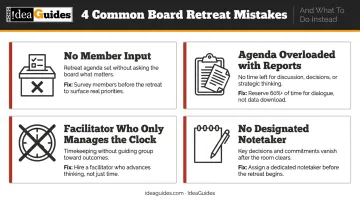
- Designing the agenda without member input creates low ownership from the start. If board members aren't surveyed beforehand, the issues they most want to address simply don't make it onto the agenda.
- Loading the agenda with reports and governance items crowds out the strategic conversations that only a retreat can support. A retreat isn't a longer board meeting — it's a different kind of work entirely.
- Hiring a facilitator who only manages the clock — without challenging the group, drawing out quieter voices, or synthesizing ideas into clear next steps — delivers about the same result as having no facilitator at all.
- Skipping a designated notetaker means commitments go uncaptured. Without specific names and timelines attached to each decision, retreat outputs evaporate within weeks — and decisions assigned to no one get done by no one.
Post-Retreat: Turning Decisions into Action
What happens in the weeks after the retreat determines its real return on investment.
Within one week: Distribute a clean summary of all decisions made, action items assigned, owners named, and target completion dates. This document becomes the accountability anchor for the months ahead.
Ongoing: Assign a small working group — board and staff — to own post-retreat implementation tracking. Build a standing agenda item into quarterly board meetings to report progress.
Retreat outcomes that aren't tied to regular meeting agendas get buried under routine business within a quarter.
Before the next retreat cycle: Debrief the planning process itself while it's fresh. What worked? What fell flat? What should change next time? This institutional memory makes future retreats progressively more effective.
BoardSource's framework for post-retreat follow-through is clear: a post-retreat action plan should state what will be done, who holds responsibility, and when results are expected, including a post-retreat evaluation. The National Council of Nonprofits similarly recommends connecting strategic initiatives to regular board meeting agendas so progress stays visible.
Frequently Asked Questions
What should a board retreat include?
A nonprofit board retreat should include three core elements: team-building activities, forward-looking strategic discussion, and board development or goal-setting. Routine board meeting business — financial reports, committee updates, minutes approval — should be explicitly excluded.
How long should a board retreat be?
Most nonprofit board retreats run a half day to a full day. Full-day formats (6–8 hours) work best for complex strategic conversations, while half-day retreats suit focused single-topic sessions or boards with significant scheduling constraints.
What is the purpose of a nonprofit board retreat?
A board retreat creates space for deeper, forward-looking work that regular meetings can't accommodate: strategic alignment, relationship building, and governance planning. The extended, uninterrupted format is what makes that kind of thinking possible.
Who should attend a nonprofit board retreat?
The board of directors and executive director are the core attendees. Senior staff may join for specific sessions, and some organizations bring in guest experts for particular agenda items. The retreat should not become an all-staff event.
How often should a nonprofit hold a board retreat?
Annually is the standard, typically timed to align with strategic planning cycles or the start of a fiscal year. Organizations navigating significant change or growth may benefit from an additional mid-year session.
Should we hire a facilitator for our nonprofit board retreat?
Yes. An external facilitator lets both the ED and board chair participate fully as contributors rather than process managers. They also bring structure, neutrality, and group techniques that self-facilitation rarely matches.