Introduction
Sales talent alone won't carry your team in 2026. According to Gartner, 67% of B2B buyers now prefer a rep-free purchase experience, and 45% used AI during a recent buy. Meanwhile, Salesforce research shows 57% of sales professionals report longer sales cycles — and overwhelmed reps are 45% less likely to hit quota.
The pressure is real. Hiring more reps or running another one-day workshop won't close the gap. What does work is a structured, repeatable training system — one that builds adaptive skills, connects learning to revenue, and scales across the organization.
This guide covers five corporate sales training programs worth evaluating in 2026 — what each does well, who it suits, and what to look for when choosing between them.
Key Takeaways
- Corporate sales training is an ongoing system, not a one-time event — reinforcement cadence determines whether skills stick
- Top 2026 programs are built on customization, practice, and leadership buy-in — not just content delivery
- Today's buyers arrive better informed and AI-assisted — consultative selling is the baseline, not a differentiator
- Start program selection with an honest audit of your team's skill gaps
- Facilitated workshops that build shared language and cohesion give formal training a foundation to land on
What Is Corporate Sales Training — And Why It Matters in 2026
Corporate sales training is a structured, company-wide approach to developing selling skills, communication consistency, and process alignment — across every role, from frontline reps to sales leadership. It's distinct from generic skills workshops or one-off seminars in one critical way: it's designed to create a shared playbook, not just individual improvement.
Modern buyers arrive armed with research, AI-sourced comparisons, and firm opinions before a rep enters the picture. A rehearsed pitch won't move them. What closes deals now is adaptive selling — the ability to read a specific buyer's context, ask the right questions, and build trust through the conversation itself.
Research from Training Industry puts a sharp point on the stakes: organizations with highly effective sales training are 4.9 times more likely to get new sellers productive quickly and 4.8 times more likely to provide ongoing reinforcement. The gap between companies that invest in rigorous training and those that don't shows up directly in ramp time and quota attainment.
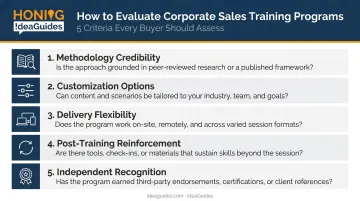
The five programs below were selected based on five criteria:
- Methodology credibility — grounded in research, not just frameworks
- Customization options — adaptable to industry, role, and sales cycle
- Delivery flexibility — in-person, virtual, or blended formats
- Post-training reinforcement — built-in mechanisms to make skills stick
- Independent recognition — including Training Industry's 2026 Top Sales Training Companies list and Selling Power's Top 30
Best Corporate Sales Training Programs in 2026
Dale Carnegie — Winning with Relationship Selling
Dale Carnegie has been developing sales and leadership skills since 1912. Its flagship sales program focuses on building genuine client connections through active listening, trust-based conversations, and relationship-driven pipeline development — not transactional pitching.
Three features distinguish it from standard sales training: ISO 9001:2015 certification, the eVolve digital learning platform for blended delivery, and in-the-moment coaching throughout each session. Courses run in 35 languages across 80 countries, making it a practical fit for enterprise teams operating globally.
| Category | Details |
|---|---|
| Focus | Relationship selling, communication, emotional intelligence |
| Format | Virtual (eight 2-hour weekly sessions) or in-person (3 consecutive days); blended options available |
| Ideal For | Enterprise teams, customer-facing roles, organizations prioritizing long-term client retention |
Sandler Training — Sales Certification
Sandler flips the traditional sales script. Rather than training reps to pitch and push, it develops consultative problem-solvers who ask better questions, qualify ruthlessly, and take control of the sales process — without pressure tactics.
The program includes a pre-training skills-gap assessment and benchmarking process that identifies where each team member actually stands. From there, reps pursue role-specific certification tiers (Bronze, Silver, and Master), with approximately 12 months required for Bronze certification. Weekly reinforcement sessions replace the one-time intensive format, which is what drives lasting behavior change rather than a short-term knowledge bump.
| Category | Details |
|---|---|
| Focus | Consultative selling, discipline, accountability, objection handling |
| Format | Onsite, virtual facilitator-led, and blended; most clients engage for 12 months or longer |
| Ideal For | Teams seeking a structured, repeatable sales process and long-term behavioral change |
RAIN Group — Foundations of Consultative Selling
RAIN Group's consultative selling curriculum takes a modular approach — participants complete prework videos and assignments before classroom sessions, which means live time is spent on application and practice, not passive content delivery. The program covers the full sales cycle from prospecting through closing.
Key differentiators include:
- High degree of customization to fit specific sales contexts
- Delivery across 75+ countries for global or distributed teams
- RAIN Sales AI for simulated conversations and performance monitoring
- A 90-Day Sales Achievement Challenge to help reps build new habits through coaching
| Category | Details |
|---|---|
| Focus | Consultative conversations, storytelling, insight selling, pipeline development |
| Format | Onsite, virtual instructor-led (multiple modules), blended, or self-study |
| Ideal For | B2B sales professionals and hybrid/remote teams needing structure and virtual mastery |
Richardson Sales Performance — Consultative Selling
Founded in 1979, Richardson has built its reputation on behavioral science applied to sales development. Its Connected Selling Curriculum™ blends consultative, challenger, and agile selling approaches through the Accelerate Sales Performance platform. The platform uses assessments, video, gamification, and bite-sized modules to drive engagement and track real-time skill development.
Enterprise clients include Cisco, Honeywell, Verizon, and American Express. Format options are flexible: one- or two-day instructor-led workshops, or virtual delivery through two or four four-hour sessions.
| Category | Details |
|---|---|
| Focus | Buyer-centered dialogue, consultative selling, objection handling, needs-based positioning |
| Format | Onsite (1–2 day workshop) or virtual (2–4 workshops of 4 hours each) |
| Ideal For | Mid-to-large sales teams seeking formal, role-based development with measurable behavior tracking |
The Brooks Group — IMPACT Selling
The Brooks Group's IMPACT Selling program is built on a six-step buyer-centric methodology: Investigate, Meet, Probe, Apply, Convince, Tie-It-Up. Each step is designed to build credibility, surface buyer challenges, and maintain alignment through the close — without relying on pressure tactics.
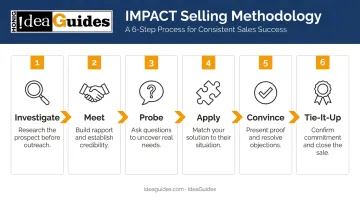
The program includes personal skill assessments, structured post-training reinforcement through BrooksUP (micro-content, practice exercises, and flash drills), and consistent recognition from major industry rankers. The Brooks Group earned a 2023 Top Virtual Sales Training Company recognition from Selling Power.
| Category | Details |
|---|---|
| Focus | Foundational selling, customer relationship building, qualification and closing |
| Format | In-person or virtual (six 2-hour sessions, meeting three days per week) |
| Ideal For | New and experienced reps, B2B sales teams, and organizations seeking a repeatable process with built-in reinforcement |
What Makes a Corporate Sales Training Program Effective?
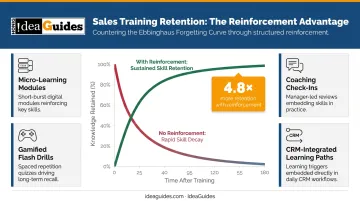
The biggest mistake organizations make is treating training as an event. A two-day intensive can create momentum — but without reinforcement, most of what participants learn fades quickly. This is the core insight behind the Ebbinghaus Forgetting Curve: memory decays rapidly when learning isn't revisited, and sales skills are no exception.
Effective programs address this through structure, not just content.
Customization Over Generic Curricula
Off-the-shelf programs teach principles. Customized programs teach your reps how to sell your product to your buyers through your sales stages. When training is built around real scenarios — actual objections, actual buyer personas, actual competitive dynamics — reps can apply what they learn immediately rather than spending months translating it.
Role-Play and Scenario-Based Practice
Knowing a framework and executing it under pressure are different skills. Role-playing bridges that gap. It builds confidence, creates muscle memory around objection handling and discovery conversations, and allows reps to fail safely before they fail in front of a real buyer.
Training Industry describes AI-powered role-play as an emerging frontier — simulated prospect conversations that give reps scalable, on-demand practice between live coaching sessions.
Ongoing Reinforcement Beyond One-Time Events
According to the Sales Management Association, organizations with highly effective sales training are 4.8 times more likely to provide ongoing reinforcement. The practical translation is micro-learning modules, gamified flash drills, coaching check-ins, and CRM-integrated learning paths that keep skills fresh over months, not days.
Leadership Alignment and Facilitated Workshops
When sales managers and senior leaders don't participate in structured, facilitated sessions alongside their teams, the shared language breaks down fast. Reps hear one thing in training, then watch their managers operate from a different playbook.
Facilitated, collaborative workshops — where the whole team builds a common vocabulary and aligns around shared behavior expectations — are often the missing ingredient. IdeaGuides specializes in exactly this kind of engagement: interactive, facilitator-led sessions that help corporate teams build a shared vocabulary and establish the behavioral frameworks that make formal training stick.
With over 25 years of experience working with organizations like BASF, Dow, American Express, and CBRE, IdeaGuides brings structured methodologies for turning groups into aligned, collaborative teams.
How to Choose the Right Corporate Sales Training Program for Your Team
Start With an Honest Gap Audit
Before evaluating vendors, identify where your team actually struggles. Common gaps fall into distinct categories:
- Prospecting and pipeline generation — reps aren't getting enough qualified conversations
- Consultative discovery — reps pitch too early and miss buyer context
- Objection handling — reps lose momentum when buyers push back
- Closing and qualification — deals stall late or get stuck in committee
- Post-sale retention — customer relationships erode after the contract is signed
The answer determines whether you need foundational methodology training, advanced skill development, or a cultural and behavioral reset. A team that can't prospect needs something different from a team that can't close.
Key Evaluation Criteria
Once you know your gaps, evaluate programs across these factors:
- Delivery format — in-person, virtual, or blended; distributed and hybrid teams should prioritize providers with strong asynchronous and virtual capabilities
- Customization level — can the provider tailor content to your products, buyer types, and sales stages, or is it primarily off-the-shelf?
- Certification options — does the program offer recognized credentials that create accountability and progression?
- Post-training reinforcement model — how does the program sustain skill development after the initial sessions?
- Class size and cohort structure — smaller cohorts typically produce better engagement and more meaningful role-play practice
- Client track record — has the provider worked with organizations similar to yours in size, industry, or sales model?
Measure ROI Before Training Begins
Ask every prospective provider how they measure behavior change and connect training outcomes to business results. The KPIs that matter most:
- Quota attainment rate
- Deal win percentage
- Ramp-to-productivity time for new hires
- Customer retention rate
CRM integration makes this tracking far more reliable — look for providers who can pull actual pipeline data, not just post-training survey scores. If a provider can't walk you through their measurement framework, that's a sign the accountability stops at the workshop door.
Conclusion
The best corporate sales training programs in 2026 are ongoing systems, not one-size-fits-all solutions. They align teams, develop adaptive skills, and create measurable performance improvement tied directly to revenue. Buyers are more informed, sales cycles are longer, and the organizations that outperform are simply the ones with the most cohesive, consistently reinforced sales cultures — regardless of how much raw experience their reps bring in.
Start by identifying your team's gaps, then match them to a methodology, format, and reinforcement structure that fits how your people actually sell. From there, consider pairing your chosen program with expert facilitation — the element that turns good training into lasting behavior change.
IdeaGuides has worked with organizations across technology, financial services, manufacturing, and professional services for over 25 years. Their facilitator-led workshops build shared language and team cohesion, translating what reps learn in the classroom into how they actually show up in front of buyers.
To explore how a custom facilitation or team alignment engagement can complement your sales training initiative, reach out to IdeaGuides at bruce@IdeaGuides.com or call 1.415.479.2028.
Frequently Asked Questions
What are the best corporate sales training programs?
The most consistently recognized programs include Dale Carnegie, Sandler Training, RAIN Group, Richardson Sales Performance, and The Brooks Group — all of which appear on Training Industry's and Selling Power's 2026 top provider lists. The "best" depends on your team's size, selling model, and where your reps are losing deals.
What are the core C's of sales?
Richardson's framework identifies four C's for effective sales presentations: Capture, Connect, Content, and Conclude. Other methodologies use variations of this structure, but the core principle is consistent: earn attention through consultative engagement before presenting a solution.
What is the 70/30 rule in sales?
The 70/30 rule holds that prospects should speak 70% of the time in a sales conversation, with the rep using their 30% to ask effective questions and guide the dialogue. Sandler Training is among the most prominent advocates of this principle, which emphasizes discovery and active listening over pitching.
What is the difference between corporate sales training and regular sales training?
Regular sales training builds individual skills. Corporate sales training creates scalable systems that align the entire sales organization around a shared process, language, and accountability structure — including sales managers and leadership, not just frontline reps.
How do you measure the ROI of a corporate sales training program?
Key metrics include quota attainment rate, deal win percentage, ramp-to-productivity time for new hires, and customer retention. Programs integrated with CRM data make tracking more reliable. Ask providers upfront how they tie training outputs directly to these business results.
How often should corporate sales training be conducted?
Training should function as an ongoing system rather than an annual event. Initial intensive sessions should be followed by regular reinforcement through micro-learning, coaching check-ins, and structured role-play practice, updated as market conditions and team needs change.