That's the wrong lesson to take. The real barrier isn't that planning takes too long—it's that nobody's designed a version that fits how small businesses actually operate. A focused, well-prepared one-day session can produce a complete strategic plan: purpose, vision, priorities, and a first-quarter action plan, all before you close up shop for the day.
This article walks through how that works: the prep that makes compression possible, an hour-by-hour agenda, why facilitation matters more than people expect, and what happens after everyone goes home.
Key Takeaways
- One day is enough to cover purpose, vision, SWOT, and priorities when the agenda is time-boxed and disciplined
- Pre-work before the session is what makes one-day compression possible
- Neutral facilitation prevents the loudest voice in the room from becoming the strategy
- The plan isn't finished at 5 PM—quarterly reviews and clear ownership carry it forward
Why a One-Day Strategic Planning Process Works for Small Businesses
Multi-day corporate retreats exist for a reason: large organizations have layers of stakeholders, competing business units, and budgets that can absorb three days of executive time. Small businesses don't have that luxury. Guidance from the Wyoming Small Business Development Center points to a common pattern: small business owners often view strategic planning as complicated, time-consuming, and built for bigger companies. That perception, not a lack of ambition, is often what keeps a plan from ever getting started. The alternative many owners try instead: stretching planning across several weeks of scattered meetings.
- Momentum dies between sessions
- Priorities shift before the plan is finished
- Nobody remembers what was decided three meetings ago A single, well-run day avoids that trap entirely. Everyone's in the room, decisions get made in sequence, and there's no gap for the plan to lose steam. The goal isn't an exhaustive 40-page document. It's clear direction. You only need enough detail to make the right decisions, not to anticipate every possible scenario. Bruce Honig, IdeaGuides' Chief Executive Facilitator, has guided more than 150 clients through strategic planning and alignment sessions. His structured facilitation methods follow a clear sequence:
- Reflect on the past
- Define mission and values
- Analyze the present
- Envision the future
- Set goals and tactics
Before the Big Day: Pre-Work That Makes One Day Possible
Compression only works if the analytical heavy lifting happens beforehand. The session itself should be for decisions, not for discovering basic facts about your own business.
Gather baseline data in advance:
- Last 12 months of financial performance
- Recent customer feedback or survey results
- A competitor scan covering pricing, positioning, and recent moves
- Notes on what worked and what didn't last year
According to SCORE's small business planning guidance, owners should evaluate current operations, products, financial performance, and competitive position before planning starts. From there, narrow to three or four feasible goals.
Surface SWOT Input Early
Don't wait until the session to ask your team what's broken. Short pre-session interviews or a simple survey with key staff will surface strengths, weaknesses, opportunities, and threats before anyone sits down. This turns the in-session SWOT exercise into a discussion of what to do about known issues, rather than a slow discovery process.
Keep the Invite List Tight
Invite only the people who can actually make decisions. A one-day session with twelve attendees and three decision-makers wastes everyone's time. Set one clear objective for the day and stick to it.
The One-Day Strategic Planning Agenda, Hour by Hour
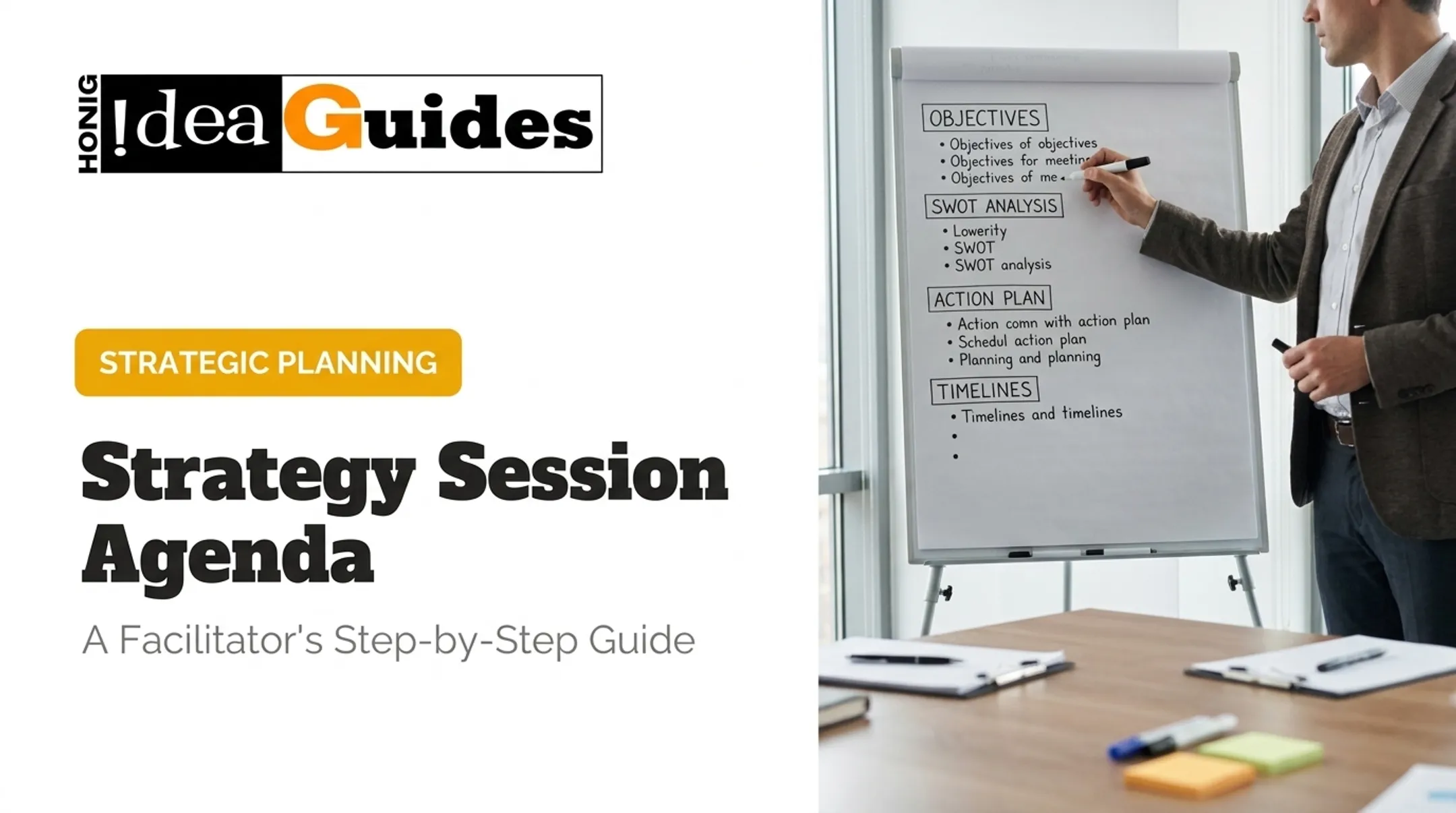
Use this hour-by-hour structure to move from purpose to owned priorities in a single day—without losing the decisions that usually take a multi-day offsite.
| Time Block | Focus | Duration |
|---|---|---|
| Morning | Purpose & Vision | 60-90 min |
| Mid-morning | SWOT Analysis | 60-90 min |
| Midday | 1-3 Year Priorities | 60 min |
| Afternoon | Goals & Quarterly Objectives | 90 min |
| Late afternoon | Reality Check | 30-45 min |
| Closing | Recap & Commitments | 30 min |

Morning: Purpose and Vision
Start with why the business exists and where it’s headed in three to five years. Skip abstract mission-statement wordsmithing—get genuine agreement on purpose, customers served, and a plain-language picture of success.
Mid-Morning: SWOT Analysis
With pre-work already surfaced, SWOT becomes structured brainstorming rather than a blank-page exercise. Capture strengths, weaknesses, opportunities, and threats quickly, then cluster what must shape the day’s choices. The Harvard Business Review frames SWOT as a tool for understanding—use it to inform priorities, not to fill a whiteboard.
Midday: Setting 1-3 Year Priorities
Narrow SWOT findings to three to five strategic priorities for the next one to three years. Dot-voting works well: give each person a limited number of votes, let preferences surface, then discuss trade-offs before you lock the list. Everything that doesn’t make the cut becomes a parking lot—not a silent obligation.

Afternoon: Goals and Quarterly Objectives
Translate each priority into SMART goals (specific, measurable, achievable, relevant, time-bound) and break the near term into quarterly objectives. Assign one owner per goal.
For each goal, leave the room with:
- A measurable outcome and target date
- The first-quarter milestones
- A single accountable owner (not a committee)
Late Afternoon: Reality Check
Stress-test the plan against budget, staffing, and cash flow before anyone leaves. A goal that needs two hires you can’t fund isn’t a goal—it’s a wish. Cut scope, sequence work, or drop a priority now rather than in month four.
Closing: Recap and Commitments
Confirm who owns what, by when, and how the plan reaches the rest of the team. Capture next check-in dates while energy is high. This is the block leaders most want to rush—don’t. Clear commitments are what make the day stick.
The Facilitator's Role: Why an Outside Guide Changes the Outcome
A neutral facilitator does two things internal teams struggle to do for themselves:
- Keep the discussion on schedule
- Prevent the most senior or loudest voice from becoming the default strategy
NDSU Extension's facilitation guidance describes the facilitator's role as designing and protecting the process—not authoring the substantive answer. That distinction matters. The owner keeps decision authority. The facilitator keeps the room fair, on time, and honest about assumptions.
Structured techniques speed consensus groups often can't reach alone when no one is watching the clock or the room dynamics:
- Timeboxing
- Dot-voting
- Guided brainstorming

In one one-day strategic planning session, a client described IdeaGuides facilitator Bruce Honig's role as keeping participants "engaged and on task" throughout the day. The board left with "good direction and attainable goals"—not because the facilitator wrote the strategy, but because he kept the group focused enough to build it themselves.
That is the point of an outside guide: protect the process so the team can own the answer. IdeaGuides has refined this approach over 25+ years, with facilitators who specialize in compressed, high-stakes planning days.
After the One-Day Session: Making the Plan Stick
Once the session ends, the real work of execution begins.
- Document and distribute within days, not weeks. Momentum from the session fades fast once people return to daily fires.
- Set a quarterly review cadence. Revisit objectives, check progress against owners and deadlines, and adjust for what's changed.
- Build in accountability structures. Assign clear owners and regular check-ins so commitments don't evaporate once the room empties.

Research from Bridges Business Consultancy has tracked strategy implementation across organizations for years. One theme stands out: plans fail from lack of follow-through far more often than from flawed initial thinking.
One IdeaGuides client reported that goals set during a single planning session went on to drive the agenda for monthly meetings afterward. The plan's real value shows up in the months after the session, not just on the day itself.
Frequently Asked Questions
What are the 5 P's of strategic planning?
Mintzberg's Five Ps (Plan, Ploy, Pattern, Position, and Perspective) show that strategy is more than a written document. In a one-day session, teams lock the Plan and Position while clarifying the Patterns and Perspective that shape how they compete.
What are the 5 key components of a strategic plan?
Mission, vision, SWOT analysis, goals, and action plans form the core building blocks. The VMOSA model (Vision, Mission, Objectives, Strategies, Action Plans) captures this same structure in a practical sequence.
What are the 7 steps of a business plan?
A business plan and a strategic plan aren't the same thing. A business plan typically covers an executive summary, company description, market analysis, organization, products or services, marketing, and financials. A strategic plan is a dynamic roadmap for direction and priorities.
What are the 5 C's of strategy implementation?
Company, Customers, Competitors, Collaborators, and Context. This framework helps teams confirm a strategy accounts for internal capability and the external environment before execution begins.
Can a small business really finish strategic planning in just one day?
Yes, with proper pre-work and skilled facilitation. The day itself is for decisions, not discovery. Follow-up work like documentation and quarterly reviews still continues afterward.
How often should a small business revisit its strategic plan after the one-day session?
Quarterly reviews work well for most small businesses, paired with a deeper annual refresh to reassess priorities as the business and market shift.