
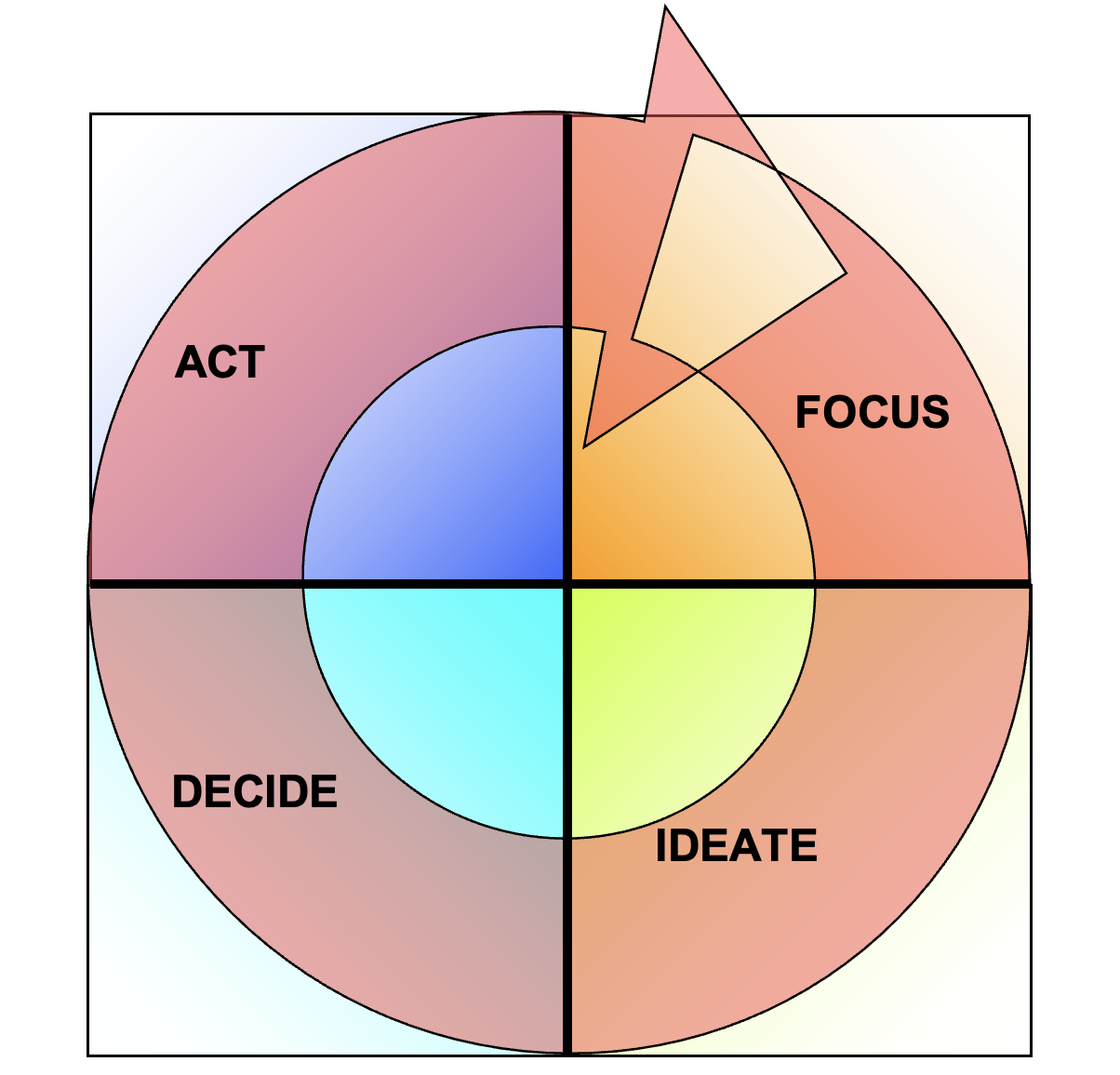
Following a team creative process during your meetings will enable you and your team to be more creative and capable of solving more problems. The process has four basic steps: Focus, Ideate, Decide and Act.
The Team Creative Process
Focus
Before generating ideas it is very important to determine what ideas you are looking for and creating a “challenge question.” Focus does this. A challenge question is a question that defines the challenge, problem or project in a clear, specific and accurate way. For the sake of innovation, the challenge question should invite more than one answer. It should start with one of the following:
"How can we…"
"How to…"
"What are ways to…"
"How might we…”
and would end with a goal. This question will be used to "focus" the ideate step.
Teams often bypass focus, yet it is actually the most critical step in the process. It determines what ideas to generate.
For example, suppose a team tries to solve the following challenge:
A mother loves to celebrate the holidays in unique and memorable ways. But she is getting on in age. She is trying to get her decorations down from on a shelf in the garage, and because of her bad back, she couldn’t reach up to lower them.
A typical first response from a team might be use a stepladder. While it’s true that a stepladder is a possible solution to her reaching the decorations, it is important to look at this challenge in a little more depth to get at the "real" problem.
Ask what the mother’s really need. Is it to reach the decorations? Sure. But is it also to celebrate the holidays in unique and memorable ways? Yes. This “higher level” need of creating a unique and memorable holiday is what is prompting the mother to decorate the house in the first place.
The team can brainstorm solutions all day to help the mother reach her ornaments. But what if the team re-focuses the problem to "How to make the holidays unique and memorable for the mother and her family?" Then a different level of ideas and solutions could be generated. One such idea would be to go to a special Broadway show with the whole family. This new idea speaks to a different higher level of need, which may be most appropriate. If you generate ideas to a challenge in too low of a need you might be missing the opportunity to generate many great ideas.
Conclusion: the Focus step is critical to generating valuable ideas that solve the right problems.
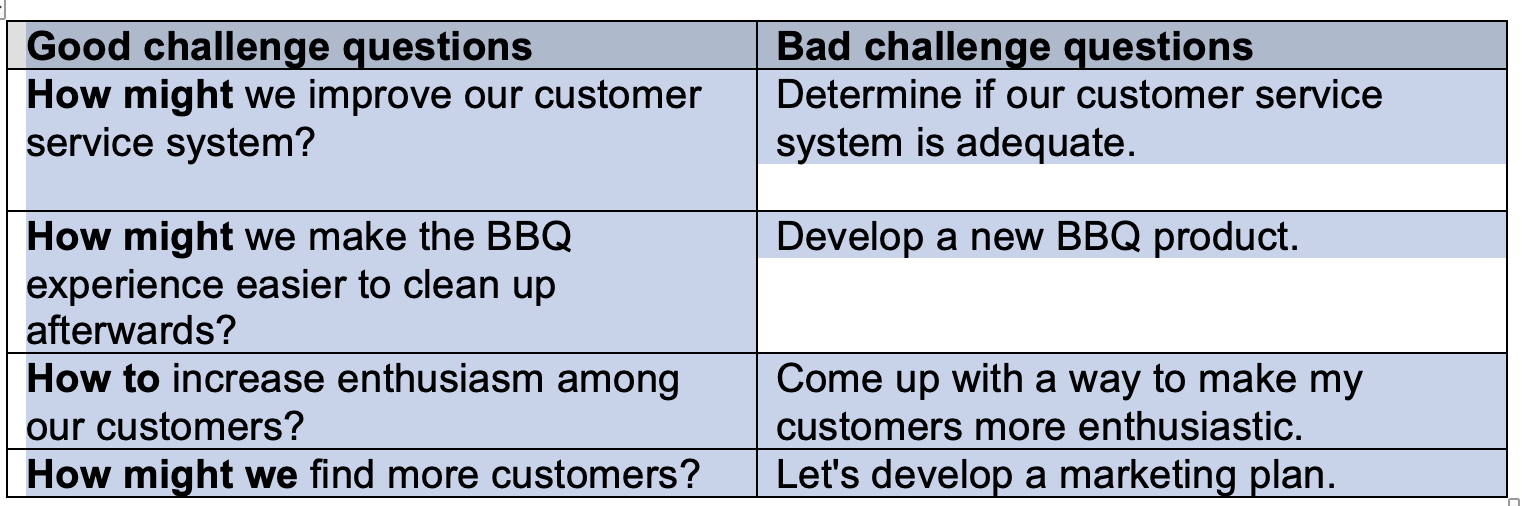
Bad challenge statements lack specificity, are not open-ended and do not ask for lots of ideas.
Ideate
"The best way to have a good idea is to have lots of ideas."
Linus Pauling
Ideate is the focus of this book. Your team is finished with this stage when it has generated enough ideas from which to find a few "jewels". Unfortunately, there is no science to determine when your team has generated enough ideas. The only guide you have to work with is to examine the ideas and ask, "do we have enough potentially great ideas to work with?"
Note that the other steps of the team creative process can also involve some idea generation. For example, one way to come up with a good focus statement is to generate lots of Challenge Questions (ideas for the focus).
The key guidelines for Ideate typically include:
No Judging (of group or self)
"Free-wheeling” is encouraged
Quantity is wanted (go for quantity not quality)
Combing and improving on other ideas (piggybacking) is encouraged
Decide
The purpose of the Decide step is to organize ideas, reduce the number of ideas and to come up with the best idea. Finding the best ideas involves taking lots of ideas and then:
Discussing them
Adding more
Refining them
Sorting them
Merging them
Finding the best ones
Keep it simple: Whichever process you use with the group to make the decision, it is important to keep the process simple and easy to understand to avoid confusion.
Be clear on the criteria for selection: Before your group starts to "merge" and "vote" on the ideas, make sure that everyone is in agreement about the criteria for selecting a good idea. Be specific.
Equal votes: It is important that everyone has a "say" in the decision. This way you will achieve greater buy-in around whatever the decision is. By doing this you will also get different and valuable perspectives, which typically results in superior decision making.
Allow for intuition: Allow for people to express what their "inner voices" are saying about the ideas. Create a means by which your team can do this without judgement. Make use of all concerns; when this happens, better ideas rise to the top.
Act
Once it has been decided which idea (or ideas) have been chosen, the team must create an Action Plan. The plan is a map of how to implement the idea. The end result of Act is a clear picture of who will do what by when, the first step toward successful implementation of your idea.
Do not leave it up to chance: Don’t assume that the great ideas your team selected will be automatically implemented. It is critical to spend time determining what tasks need to be done, and who will do them.
Assign someone: You may decide some tasks need to be done by two or more people. However, only one person should be made responsible for ensuring that the task gets done.
Determine success: As a group, decide on what would determine a successful implementation of the idea.